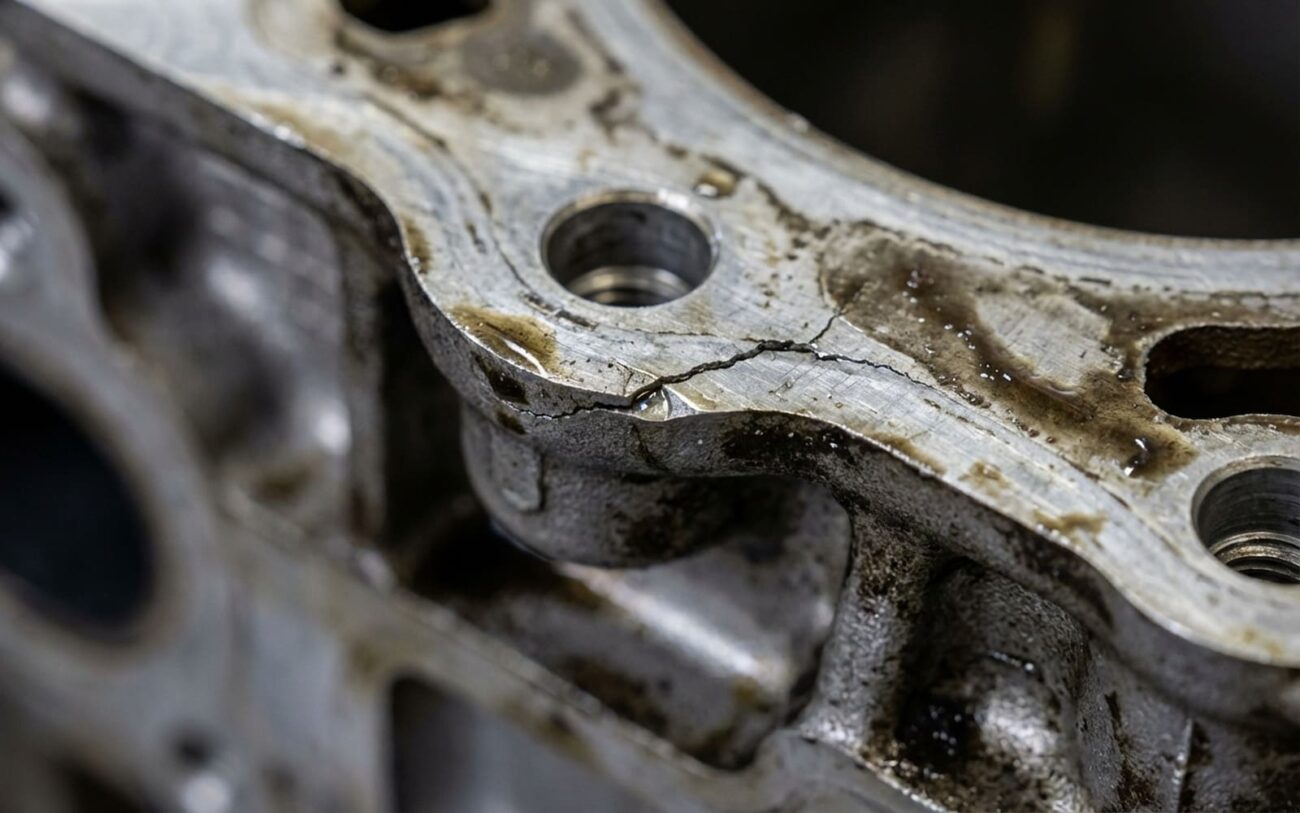
Warped Engine Block? Yeah, It’ll Kill Your Compression. Here’s How I Know.
Let me be absolutely clear: a warped engine block will cause low compression. It’s not a theory; it’s a hard fact I’ve seen play out in my shop countless times over the last 25 years. We’re talking about a fundamental structural failure, often after an engine has been through one too many severe overheating episodes.
While a blown head gasket or a warped cylinder head pops up more frequently, a warped block is a whole different beast. It’s the foundation. If the deck surface—that’s the flat top of the block where the cylinder head bolts down—isn’t perfectly true, that head gasket isn’t sealing anything. Not properly, anyway.
What happens then? Combustion pressure leaks. It leaks between cylinders, or worse, it leaks into your coolant passages. You get misfires, a serious drop in power, and eventually, a cross-contamination of fluids. And this isn’t a simple gasket swap. This is structural damage, and it demands a serious approach. Let’s dig into how I spot it, confirm it, and what your options are when you find it.
Variance: 45 PSI
How I Spot a Warped Block: Symptoms and Initial Tests
The first real clue I usually get is a compression test showing low or inconsistent readings, especially across multiple adjacent cylinders. Think cylinders 2 and 3, or 4 and 5. These are often near the hottest spots, like the exhaust ports. If I see a variance of, say, 45 PSI between cylinders, like in that dashboard example, my alarm bells are ringing.
A leak-down test often confirms it. You’ll hear air escaping into the cooling system (a bubbling sound in the radiator) or the crankcase (a hiss from the oil fill cap or dipstick tube). On the road, the engine will run rough, have trouble starting, or just feel weak under load.
But here’s what really makes me suspect a block issue over just a head gasket: when coolant and combustion gases are clearly mixing. You’ll see that classic “milkshake” under the oil cap or on the dipstick—that’s emulsified oil from coolant getting where it shouldn’t. You might also notice persistent bubbling in the coolant reservoir when the engine’s running, or white exhaust smoke that has a distinct sweet smell. That sweet smell means you’re burning coolant, plain and simple. These aren’t just head gasket symptoms; they scream a deeper problem with the sealing surface.
The Real Test: Confirming Block Warpage (Not Just a Gasket)
This is where experience really pays off. You simply cannot assume it’s just a head gasket. I’ve seen too many people—and even some less experienced shops—replace a head gasket only for the problem to come right back. Why? Because they didn’t verify the flatness of the mating surfaces. If the block or head is warped, that new gasket is doomed from the start.
The definitive test? You have to pull the cylinder head. There’s just no shortcut here. Once the head is off, that’s when you get out your precision straightedge and a set of feeler gauges. You’re checking the block deck surface across multiple planes—lengthwise, crosswise, and diagonally. You’re looking for deviations that exceed the manufacturer’s service limits. For most engines, anything over 0.10mm (about 0.004 inches) is a problem. Some manufacturers are even tighter.
| Symptom | Why I Suspect the Block | Other Possibilities (Mimics) | My Go-To Confirmation Steps |
|---|---|---|---|
| Low compression in adjacent cylinders (no obvious internal wear) | Deck surface warpage creating a leak path between cylinders. | Warped cylinder head, blown head gasket, worn valve seats or guides. |
Head off. Precision straightedge and feeler gauge across the block deck. Compare to factory specs (e.g., 0.10mm max deviation). |
| Coolant in oil (“milkshake”) or combustion gases in cooling system (bubbling in reservoir) | Deck distortion breaking the seal around coolant/oil passages. | Cracked cylinder head, failed head gasket, leaking intake manifold gasket. |
Cooling system pressure test, then a chemical block tester. If positive, pull the head and visually inspect both decks. Also, check for head cracks: how to tell if your cylinder head is cracked or burnt. |
While the head’s off, I always check it for flatness and cracks too. Thermal stress rarely damages just one component. I’ve seen plenty of aluminum heads warp right alongside a distorted cast iron block, especially in engines where the different expansion rates cause extra stress. For more on head gasket symptoms, you can look at symptoms of a blown head gasket caused by a cracked engine block.
What Causes a Block to Warp? It’s Almost Always Overheating.
In nearly every case I’ve encountered, a warped block comes down to severe or repeated overheating. The cylinder block, especially around those high-heat areas like the exhaust ports and between cylinders, gets hammered by extreme thermal cycling. When one part heats up much faster or hotter than another, it expands unevenly. If that happens too suddenly, or too many times, the metal simply can’t return to its original shape. That’s what we call plastic deformation, and it results in warpage.
Some engines are more susceptible than others. I’ve seen this issue more frequently on certain aluminum-block four-cylinders where extended overheating led to measurable deck distortion beyond spec. In fact, for some models, there are known service bulletins that specifically address this, noting that overheating can cause warpage exceeding 0.20mm (that’s about 0.008 inches), which is often too much to safely machine.
Here’s the critical takeaway:
A failed head gasket is usually a consequence, not the root cause. If you’re replacing a gasket, you absolutely have to ask why it failed. If the engine overheated, assume the deck surfaces need to be checked for flatness before you put anything back together. Skipping that step is how you guarantee a comeback.
Your Options: Machining the Block or Replacing It
This Is Serious Structural Work.
Once you’ve confirmed the block deck is out of spec, you’re looking at two main options. Neither is cheap, and both demand precision work. This isn’t a DIY job; you need a proper machine shop or a full engine swap.
Deck Resurfacing (Machining) Machine Shop Required
Block Replacement Critical Failure Fix
Making Sure the Fix Actually Worked (Don’t Skip This!)
If you went the machining route, verification is non-negotiable. The machine shop should give you a flatness report showing measurements across all critical planes. But even then, before reassembly, I always double-check it myself with a straightedge and feeler gauge. Never just assume it’s perfect because it came back from the shop.
After everything’s back together, a cylinder leak-down test is your best friend. You want to see less than 10% leakage across all cylinders, and absolutely no air escaping into the cooling system or crankcase. Once the engine is running and fully warmed up, use a combustion gas analyzer to test the coolant. Zero exhaust gases should be present. Any detection means that seal is still compromised, and you’ve got more work to do.
For a replacement block, the validation is a bit more straightforward but equally important. A compression test should show all cylinders within 10% of each other and well within factory specifications. And a cooling system pressure test must hold steady at the radiator cap’s rated pressure (typically 13–18 psi) for at least 30 minutes, with no loss whatsoever.
The Hard Reality: Cost and When to Walk Away
Let’s talk numbers, because this isn’t just about fixing the engine—it’s about whether it makes financial sense for you.
| Repair Type | DIY Cost (Parts/Machining) | Shop Cost (Typical) | Success Rate (My Experience) | Secondary Risk if it Fails Again |
|---|---|---|---|---|
| Deck machining and reassembly | $300 – $500 | $1,500 – $2,500 | ~85% | Repeat overheating, another head gasket failure, or even spun crankshaft bearings if debris gets in there. |
| Short block replacement | $2,500 – $5,000+ | $4,000 – $8,000+ | 95%+ | Installation errors leading to deep engine knock or premature failure. |
My Economic Rule of Thumb:
If the repair cost is going to exceed 60% of the vehicle’s private-party value in “Fair” condition, it’s time to seriously consider alternatives. Putting $6,000 into a car that’s only worth $4,000 isn’t an investment; it’s a financial loss. Sometimes, you just have to cut your losses. For more on diagnosing persistent coolant issues, check out engine overheating and coolant loss with no visible leaks.
Prevention: It’s All About Respecting Your Cooling System
The only truly sure way to prevent block warping is to prevent overheating in the first place. That means you need to treat your cooling system with the respect it deserves. It’s the lifeblood of your engine.
My Essential Cooling System Checklist:
-
Flush and refill your coolant on schedule. This maintains the corrosion inhibitors and, crucially, its boiling point protection. Don’t cheap out on coolant.
-
Test the radiator cap and the entire cooling system pressure regularly. A weak cap lets the boiling point drop significantly, making overheating much easier.
-
If that temp gauge even starts to creep up, shut down immediately. A small leak or a failing water pump can escalate to block warpage in a matter of minutes. Seriously, pull over.
-
After any overheating incident, run a combustion gas test on the coolant. Early detection of internal leaks can save your block—and your wallet. See: white smoke from exhaust that smells like coolant.
