That Deep Engine Knock: What It Really Means (and What I Do About It)
Alright, let’s talk about that deep, rhythmic thumping sound coming from your engine. The one that’s a metallic knock, usually loudest when the engine’s just idling, but still there if you give it a little gas. If you’re hearing that, you’re not dealing with a simple ticking lifter or some harmless pinging. What you’ve got is a bottom end knock – what we mechanics call a rod knock or a main bearing knock. And let me tell you, it’s a serious cry for help from inside your engine block.
In plain terms, this noise happens when there’s too much space between the crankshaft journals and their bearings. Think of it like this: these metal parts are supposed to be separated by a thin, pressurized film of oil. That oil film is critical. When it breaks down – because of wear, low oil, or some other damage – those metal surfaces start hitting each other. That’s the knock you hear. It’s a low-frequency, heavy sound, and it’ll get faster as your engine RPMs go up.
CRITICAL WARNING: Low Oil Pressure Light!
If you see that low oil pressure warning light come on, especially when the engine is hot and idling, and you’re also hearing a knock? That’s not a coincidence. It means oil is escaping too fast through those worn-out bearing clearances. This is an emergency. Shut the engine down immediately and do not restart it. I’ve seen too many engines completely destroyed because someone tried to “make it home.” You’re not saving time; you’re guaranteeing total engine failure.
I’ve been doing this for over 25 years, and I’ve seen countless engines turn into scrap metal because a driver ignored that knock. A spun bearing – where the bearing shell actually rotates in its bore – can absolutely ruin a crankshaft and damage the engine block beyond repair. Once that happens, your rebuild costs don’t just go up; they skyrocket, often making the whole car a write-off.
My Diagnostic Approach: Pinpointing That Knock
Not all engine knocks are created equal, and believe me, misdiagnosing this can cost you a fortune in wasted time and parts. Before you start tearing into the bottom end, you’ve got to be sure the noise isn’t coming from somewhere else, like the valvetrain or an accessory. Here’s how I typically approach it.
Distinguishing the Real Deal from Imposters
The behavior of the noise is your biggest clue. Does it change with engine load? Temperature? RPMs? A true rod knock, for instance, often softens a bit if you can cut fuel or spark to that specific cylinder. A main bearing knock, on the other hand, tends to stay pretty consistent because it affects the entire crankshaft assembly.
My Go-To Tests for a Deep Knock:
-
Cylinder Contribution Test (Shorting Out): This is key for rod knocks. If you can temporarily disable a cylinder (either by pulling a plug wire on older engines or using a scan tool to cut injector pulse/spark on modern ones), and the knock lessens or disappears, you’ve likely isolated it to that connecting rod. -
Mechanical Oil Pressure Gauge: Don’t trust the dash light. Install a mechanical gauge. If your oil pressure is consistently below 10 psi per 1000 RPM when warm, especially at idle, you’ve got excessive internal clearance – almost certainly a main bearing issue. -
Stethoscope: A good old mechanic’s stethoscope is invaluable. Listen carefully around the oil pan rail, near the main bearing caps, and up by the connecting rods. The location of the loudest knock helps narrow it down.
Here’s a quick rundown of typical knock scenarios I see:
-
Deep knock at idle: This often points to a connecting rod bearing failure. The clearance between the rod cap and crank journal is too wide. Piston slap can sound similar, but it usually goes away once the engine warms up. A hydraulic lifter tick is typically higher-pitched.
-
Deep knock under load/acceleration: This is classic main bearing failure. The crankshaft itself is moving too much in its block bores. Detonation (pinging) can be confused with this, but it often sounds more like marbles or gravel rattling in a can.
-
Low oil pressure with knock: As mentioned, this is a huge red flag. Excessive bearing clearance is letting oil bleed off from the main oil gallery too quickly. While a faulty sensor or clogged pickup screen can cause low pressure, with a knock, internal damage is almost a certainty.
Beyond the Bearings: When the Engine Block Itself Is the Problem
Most bearing failures come down to lubrication issues – old oil, low oil, or just neglected maintenance. But sometimes, the problem goes deeper, right to the engine block itself. And that, my friends, is a game-changer. If the block’s structure is flawed, just replacing bearings is like putting a band-aid on a gushing wound; it won’t fix the root cause.
The block is the foundation. It holds the main bearing saddles and keeps the crankshaft perfectly aligned. If those bores are out of spec – maybe from a casting defect, a fatigue crack, or corrosion – the crankshaft won’t spin true. That leads to uneven bearing wear and, you guessed it, a knock. I’ve seen issues like “core shift” during casting, where the internal passages aren’t quite right, leading to thin spots or misaligned bearing bores. On engines like the Ford 5.0L Coyote and some GM LS variants, there have even been factory Technical Service Bulletins (TSBs) addressing main bearing knocks linked directly to bore alignment problems.
Watch for Internal Coolant Leaks:
Another sneaky block problem, especially in aluminum blocks, is internal coolant leakage due to casting porosity. Coolant mixing with your oil is a death sentence for bearings. It destroys lubricity and accelerates wear, leading to a knock. If you’ve done a head gasket and still find coolant in the oil, the block itself might be the real culprit. This is a tough one to chase down, but it’s crucial.
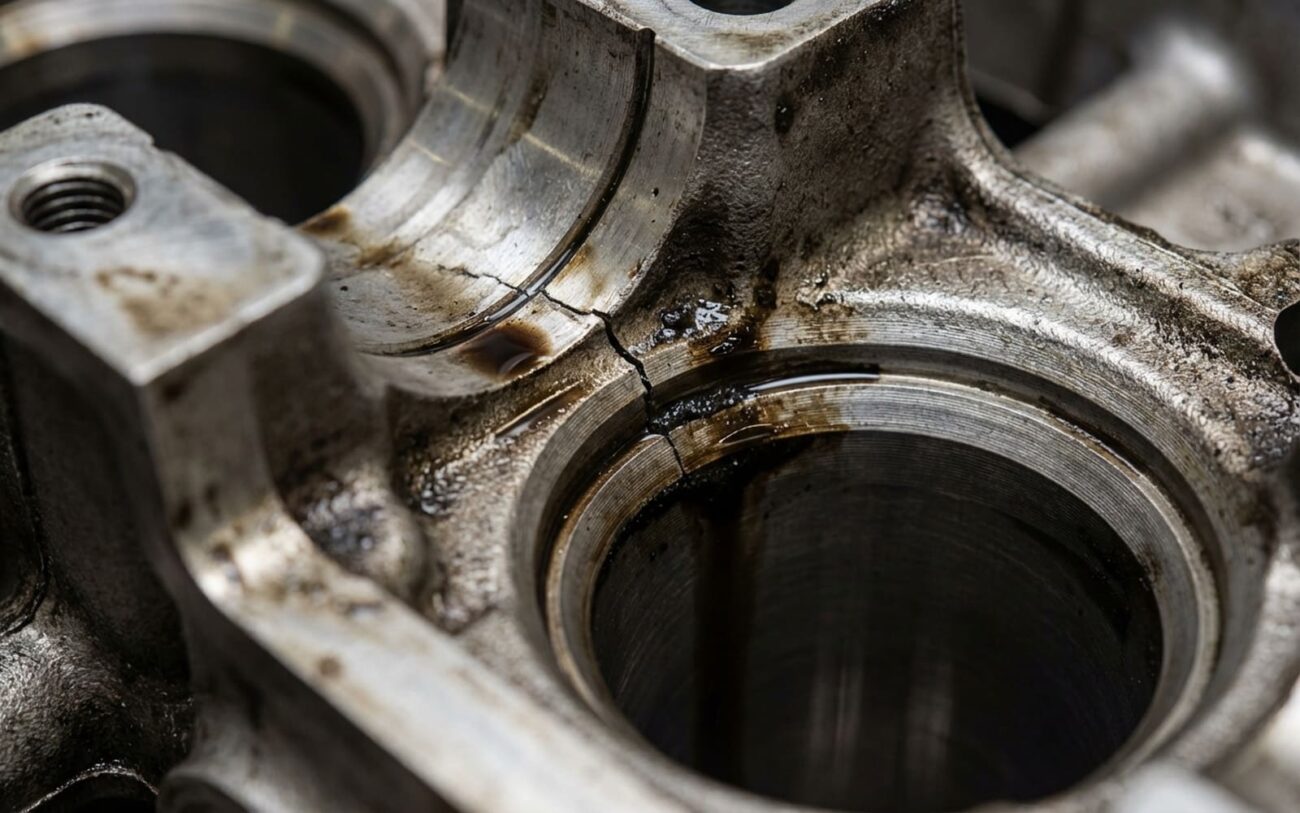
Fatigue cracks in the main bearing caps or the main webs of the block are also a possibility, particularly in high-output or turbocharged engines. These cracks can open and close ever so slightly under engine load, disrupting that vital oil film and causing premature bearing failure. In my experience, I see cracked main caps more often than a full-blown cracked block, but either way, you’re looking at a complete engine disassembly to even find them.
The Hard Truth: Your Repair Options (and What NOT to Do)
Once you’ve confirmed that deep internal knock, you’re looking at a major repair. There’s no quick fix, no magic bullet. The engine has to come apart. Your options really depend on the extent of the damage – specifically, whether that engine block can be salvaged.
Option 1: Machining the Block (If Possible)
If the crankshaft journals are still smooth enough to be ground, and the block’s main bores are mostly intact but just a little worn, then machining might be an option. This means line-boring or line-honing the main bearing saddles. But let me be clear: this is absolutely NOT a DIY job. This requires precision machine shop work. The block has to be machined with the main caps torqued to factory specifications – often a multi-step torque-to-yield procedure like 70 ft-lbs plus a 90-degree turn – using a calibrated torque wrench and an angle gauge. Get this wrong, and you’re right back where you started, or worse.
Option 2: Block Replacement
If the block has a crack in a main web, severe bore damage (spalling), or alignment issues that are beyond what machining can fix, then a new block is your only dependable solution. Trying to weld cast iron or aluminum in high-stress areas like the main bearing saddles is usually a waste of time and money; the heat and residual stress almost always lead to re-cracking. In these situations, you’re looking at a rebuilt short block, a good used engine, or a new long block from the factory.
A Stern Warning on “Temporary Fixes”
Confirming the Fix: How I Verify a Rebuild
After a major engine rebuild, you can’t just cross your fingers and hope for the best. Verification is absolutely everything. You need objective, measurable criteria to confirm that the repair actually worked and that the engine is ready for the road. Here’s my checklist:
-
Dimensional Accuracy: Every main bearing bore, every rod journal – they all have to be within OEM tolerances. We’re talking incredibly tight specs here, usually within ±0.0005 inches for diameter, and even tighter for alignment. This is checked with precision bore gauges and straightedges or laser alignment tools. Any deviation, and you’re looking at uneven loading and another premature failure.
-
Oil Pressure Check (Mechanical Gauge!): After warm-up, the oil pressure absolutely must meet factory specifications. And I mean with a mechanical gauge, not just relying on the dashboard idiot light. For most engines, that’s at least 25 psi at hot idle and typically over 45 psi at 2,000 RPM. If the pressure is still low, there’s still excessive clearance somewhere, and the job isn’t done right.
-
Audible Silence: This might sound obvious, but there should be zero audible knock under any condition – cold start, idle, acceleration, deceleration. I use a stethoscope or an electronic listening tool to check every main and rod cap location. Any hint of a knock means something is still wrong.
-
Controlled Road Test: Finally, a thorough road test. I gradually apply load, monitor oil pressure and temperature closely, and listen for any unusual noises. A properly rebuilt engine should feel smooth, responsive, and silent. Any reputable machinist or shop will stand behind this work, because if it fails, it’s usually a full seizure. Confidence in the process is paramount.
The Bottom Line: Cost and the Tough Decision
Repairing a deep engine knock is almost always expensive. This isn’t just about fixing the engine; it’s about making a sound financial choice for your vehicle. You’ve got to weigh the repair cost against the car’s overall value.
Here are the typical ranges I see in my shop for these kinds of repairs, including parts and labor. Keep in mind these are estimates and can vary wildly by vehicle make, model, and region:
-
Block Line Bore & Bearings: $2,500 – $4,500. This is if the block is salvageable and only needs machining and new bearings. Success rate is usually high (85-95%) if done right. DIY cost could be $500–$1,500 for parts and specialized tool rentals, but the risk of catastrophic seizure if done improperly is very high.
-
Used Engine Replacement: $4,000 – $7,000. This involves sourcing a used engine, which comes with its own risks. Success rate is around 70-85%, highly dependent on the donor engine’s mileage and history. DIY cost for the engine and fluids might be $1,500–$3,000, but you’re inheriting potential failures from the used engine.
-
New OEM Assembly (Short or Long Block): $8,000 – $15,000. This is the most expensive, but also the most reliable option, with a success rate near 99% and a full warranty. DIY cost for the assembly alone could be $5,000–$9,000, but the downtime and complexity are significant.
My Rule of Thumb:
I always tell my customers this: if the repair cost is more than 50% of your vehicle’s clean trade-in value (check Kelley Blue Book or NADA guides), it’s time to seriously consider replacing the vehicle. Spending $6,000 to fix a car that’s only worth $4,000 just doesn’t make financial sense, even if you love that car. I know it’s an emotional decision, and it’s a tough call, but it’s better than pouring good money after bad into a depreciated asset.
How to Prevent This From Happening Next Time
Look, most bottom end failures are completely preventable. It really comes down to consistent, proper maintenance and paying attention to your engine. Here’s what I stress to all my customers:
-
Change your oil on time, every time. This is non-negotiable. Especially if you tow, drive in hot climates, or do a lot of stop-and-go. Use the OEM-recommended viscosity. If it’s conventional oil, stick to 3,000–5,000 miles. Full synthetic? You might get 5,000–7,500 miles, but don’t push it. Clean oil is the lifeblood of your engine.
-
Don’t neglect your coolant. Old coolant becomes acidic over time. That acid can corrode internal passages and even lead to block porosity, which, as we discussed, can cause bearing failure. Follow the factory schedule – usually every 5 years or 100,000 miles.
-
Listen to your engine. Get to know its normal sounds. If you hear a new, low-frequency knock, that’s not something to “keep an ear on.” Investigate it immediately. And if your vehicle has an oil pressure gauge (not just a light), watch for any unusual trends or drops.
-
Use your tools. If you’re mechanically inclined and have an OBD2 scanner, monitor for codes like P0325 or P0330 (knock sensor faults). These can flag abnormal combustion that puts extra stress on the bottom end.
