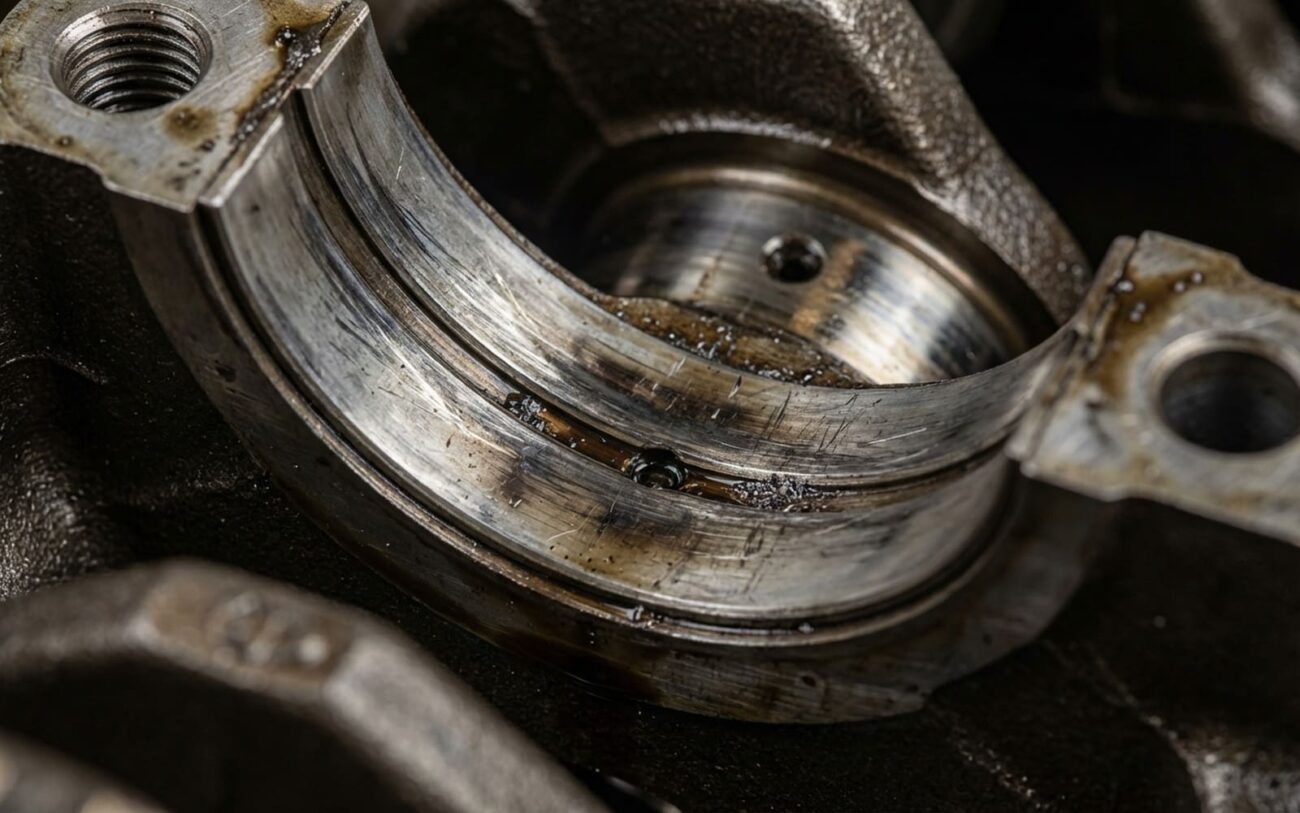
Alright, let’s talk about spun bearings. After 25 years turning wrenches, I can tell you this isn’t just a “problem”—it’s usually the end of the road for an engine. When a crankshaft bearing spins, you’re not looking at a simple repair; you’re looking at total engine failure, and yes, it absolutely will lock up your engine. It’s one of the quickest ways to turn a running vehicle into a very expensive paperweight.
The Sound and Feel of a Dying Engine
When a bearing starts to go, you’ll hear it first. It’s a deep, metallic knocking or grinding noise, usually coming from the lower end of the engine, right around the oil pan. This isn’t a subtle tick; it’s a heavy, rhythmic thud that gets louder and more urgent as the engine revs. That sound is the connecting rod, which should be riding smoothly on a thin film of oil, slamming directly into the crankshaft journal. The bearing—that precision insert designed to keep metal from touching metal—has either disintegrated or rotated out of its proper position. Once that happens, it’s metal-on-metal, and the clock is ticking.
That contact generates incredible heat, enough to literally weld the rod cap or the bearing shell right to the crankshaft. When that happens, the crankshaft stops turning. Period. If you try to start it, you’ll get a click, maybe a groan from the starter, but the engine won’t crank over. If you’ve been ignoring a flickering oil pressure light, you’ve probably just accelerated this whole process. That knocking noise? That’s your engine’s last cry for help. Keep driving, and you’re not getting anywhere faster; you’re just guaranteeing yourself an engine replacement.
Diagnosing the Lockup: Is It Really a Spun Bearing?
An engine that won’t turn over doesn’t always mean a spun bearing. Other things can mimic the symptoms, so you need to be methodical before you start tearing into things. I’ve seen hydrolocked cylinders (from coolant or fuel), seized transmissions, or even pistons fused to cylinder walls from extreme overheating. The trick is figuring out exactly where the lockup is happening.
My Diagnostic Steps:
-
Engine Won’t Rotate by Hand: This is the big one. First, I’ll try to turn the engine over manually using the crank pulley bolt. If it’s locked solid, my first thought isn’t always a bearing. I’ll pull all the spark plugs. If it still won’t turn, I’m checking for hydrolock—liquid in a cylinder. You can often see or smell fuel/coolant coming out of the spark plug holes. If there’s no hydrolock, then I’m thinking internal engine mechanical failure.
-
Severe Bottom-End Knock: If the engine is still turning but making that awful knocking, I grab my mechanic’s stethoscope. I’ll listen carefully around the oil pan rails and the main cap areas. A spun rod bearing will have a very distinct, heavy knock that’s usually loudest right at the bottom of the engine. Other noises, like piston slap or a worn wrist pin, can sound similar but are often higher pitched or less localized. If you’ve got this knock, a quick oil analysis showing high levels of copper, lead, or aluminum (bearing materials) is a pretty strong confirmation.
-
Low Oil Pressure: This is a huge red flag. A spun bearing creates massive clearance, and that oil pressure just can’t build up properly, even at higher RPMs. Don’t trust the dashboard “idiot light” for this. I always install a mechanical oil pressure gauge at the sender port. If the pressure stays low regardless of engine speed, especially after a cold start, a spun bearing is highly likely. Of course, it could also be a bad oil pump or a clogged pickup screen, but with the knock, it’s usually the bearing.
If you’ve got that severe knock and low oil pressure, and especially if the engine won’t turn over after ruling out hydrolock, then in my experience, you’re almost certainly looking at a spun bearing. The definitive test? Drop the oil pan. You’ll usually find bearing material (copper, aluminum, steel flakes) in the pan, and often you can see the damaged connecting rod or crankshaft journal right then and there.
Why Bearings Fail: It’s All About the Oil Film
A “spun bearing” isn’t about the crankshaft failing; the crank is usually the victim. It’s about that precision insert—typically steel-backed with a soft alloy like babbitt or aluminum—that sits between the connecting rod or main cap and the crankshaft. These bearings are designed to float on a microscopic film of oil. When that film breaks down, metal touches metal, heat builds up, and the bearing material smears, spins, or just disintegrates.
The Main Culprits I See:
-
Oil Starvation: This is by far the most common cause. Running the engine low on oil, a clogged oil pickup screen in the pan, a failed oil pump, or even a collapsed oil filter can all reduce or completely cut off oil flow. Without that oil, the bearing overheats and fails almost instantly. I’ve seen it countless times.
-
Insufficient Bearing Crush: Bearings are designed to “crush” slightly into their housing when the cap is torqued down. This keeps them from spinning. If the bearing isn’t seated right, or if the housing bore itself is worn or out of spec, the bearing can lose its grip and spin under load.
-
Excessive Clearance: Whether it’s from normal wear and tear, improper installation, or a poorly machined crankshaft, too much clearance prevents that critical hydrodynamic oil film from forming correctly. The oil just leaks out of the gap instead of supporting the bearing.
And don’t forget contaminants. Metal shavings, dirt, or sludge in the oil will accelerate wear like nothing else. I’ve also seen patterns in certain engine families—especially high-output or turbocharged models—where manufacturing debris or design flaws in the oil system led to premature bearing wear. It’s not always just neglect, but in nearly every case, the root cause still boils down to a breakdown in oil flow or pressure.
Just to clarify, a broken connecting rod and a spun bearing are related, but they’re not the same thing. A spun bearing often leads to a rod failure, but not every rod knock is from a spun bearing. Sometimes it’s just fatigue or an over-rev.
Your Repair Options: From Pipe Dream to Full Replacement
Once that engine has seized, or you’ve got a confirmed spun bearing, your options are pretty limited, and none of them are easy. There are no magic fixes here, and every legitimate repair requires significant disassembly.
Option 1: The “Caught It Early” Repair (Rare)
The affected connecting rod needs to be checked for bore distortion using a dial bore gauge. The crankshaft journal itself has to be inspected with a micrometer for taper, out-of-round, and scoring. If the damage is truly minor, the journal can be polished or ground undersize, and then you install matched undersize bearings. You’ll need precision tools: micrometers, plastigage for final clearance checks, a torque wrench with angle measurement, and a dial indicator. Rod bolts are almost always torque-to-yield and must be replaced. Reuse them, and you’re just asking for another failure down the road. Always follow the factory torque sequence and angle specs exactly—I’ve seen specs like 30 Nm plus 90 degrees, then another 90 degrees, but you always confirm with the service manual. And for break-in, use the OEM-specified oil viscosity and filter; it’s critical for proper flow and pressure.
Option 2: The Realistic Approach (Full Engine Rebuild or Replacement)
I get this question all the time: “Can I just get it running to move it across the parking lot?” My answer is technically yes, but at enormous risk. If the engine is knocking but still turning, some folks try heavy oil additives or “engine sealants” to temporarily thicken the oil and cushion the bearing. It might buy you 30 seconds of operation. That’s it. But here’s the reality: that additive can clog the oil pump or filter, starving other bearings. It might force a failing rod to let go completely, potentially punching a hole right through the engine block. I’ve even seen engines catch fire from this kind of desperation. It’s a last-resort Hail Mary with a very high chance of turning a potentially repairable situation into total destruction. If you absolutely have to move the car, flatbed it. Don’t risk it.
How I Know a Rebuilt Engine Is Done Right
A rebuilt or replaced engine isn’t trustworthy until it’s properly validated. Skipping steps here is just asking for an immediate re-failure. Here’s my process:
Before that first start, you must prime the oil system. I use a drill-driven oil pump primer or a hand-operated priming tool to circulate oil through all the passages until I see full pressure register on a mechanical gauge at the sender port. This ensures every bearing is properly lubricated before the crankshaft even thinks about turning. Once it’s running, I verify oil pressure immediately—I’m looking for at least 10 psi per 1000 RPM at operating temperature, but I always refer to the factory specification for that specific engine. And I’m monitoring with a mechanical gauge, not just relying on the dashboard light.
Then, I listen. Carefully. Stethoscope on the oil pan, on the main cap areas. Any knocking, ticking, or grinding means trouble. Next, I follow the manufacturer’s or rebuilder’s break-in procedure to the letter. This usually involves 20–30 minutes of varied RPM (say, 1500–3000) under light load—no just idling it in the bay. This helps seat the bearings properly. On some high-performance builds, I’ll even re-torque the rod bolts after a heat cycle, though that’s less common on modern engines. Finally, I always recommend changing the oil and filter at the recommended break-in interval to flush out any initial wear particles. It’s cheap insurance.
The Cold, Hard Economics of a Seized Engine
Let’s be blunt: repairing a seized engine is expensive. The decision often comes down to dollars and cents, not emotion. Here’s what you’re typically looking at in my shop:
- Single Bearing Replacement (If Possible): If we can pull off that rare, early-catch repair, you’re still looking at $2,500–$4,000 in shop costs. A DIY attempt might be $500–$1,000 for parts and machine work, but the success rate is lower if you don’t have the right tools and experience. The risk? If debris remains or the oil system isn’t perfectly clean, you’ll destroy the engine completely.
- Crankshaft and Multiple Rod Replacement: This is more common. Shop costs usually run $4,000–$7,000. DIY might be $1,500–$2,500. Success rates are good if done right, but you risk vibration if the crank isn’t balanced correctly.
- Used or Remanufactured Long Block Engine Replacement: This is what most customers end up with. Shop costs are typically $6,000–$10,000+, sometimes more on complex vehicles. If you’re doing the swap yourself, parts alone could be $3,000–$5,000. The success rate is over 95% with a good quality unit, and you usually get a warranty. The main risks are ancillary part failures (sensors, wiring) or dealing with a warranty claim if the replacement unit has issues.
My Expert Rule of Thumb
Here’s my rule after 20 years in the bay: if the repair estimate exceeds 60% of the car’s current private-party value—check KBB or NADA—it’s rarely worth fixing. This rule has exceptions, of course: a classic car, a daily driver with deep sentimental value, or a high-mileage vehicle that’s otherwise in pristine condition. But generally, pouring $7,000 into a $10,000 car rarely makes financial sense. You’re almost always better off investing that money into a more reliable vehicle.
How to Keep This From Ever Happening Again
Preventing a spun bearing comes down to one thing, and one thing only: consistent, clean oil under pressure. Bearings fail from oil starvation, not just old age. Use the exact viscosity and specification (like API SP or Dexos) recommended in your owner’s manual. If you drive in stop-and-go traffic, tow, or make frequent short trips, follow the “severe service” oil change interval—that’s every 3,000 to 5,000 miles, not 7,500 or 10,000. Trust me on this; it’s cheap insurance.
Never, ever ignore the oil pressure warning light. If that light comes on while you’re driving, shut the engine off immediately. That light means your oil pressure has dropped below safe levels, and your bearings are already at risk. Even a few minutes of operation without proper pressure can start the failure process. And if you hear a new knocking sound from the lower engine, stop driving. Seriously. It’s not going to get better by itself.
For older or high-performance engines, I always recommend installing a real mechanical oil pressure gauge. It shows you trends—like a slow drop in pressure at idle—that the factory idiot light will never warn you about. And finally, always let the engine idle for 10–15 seconds after a cold start before driving off. This gives the oil time to circulate and build full pressure, which is especially critical in modern engines with variable valve timing or turbochargers.
