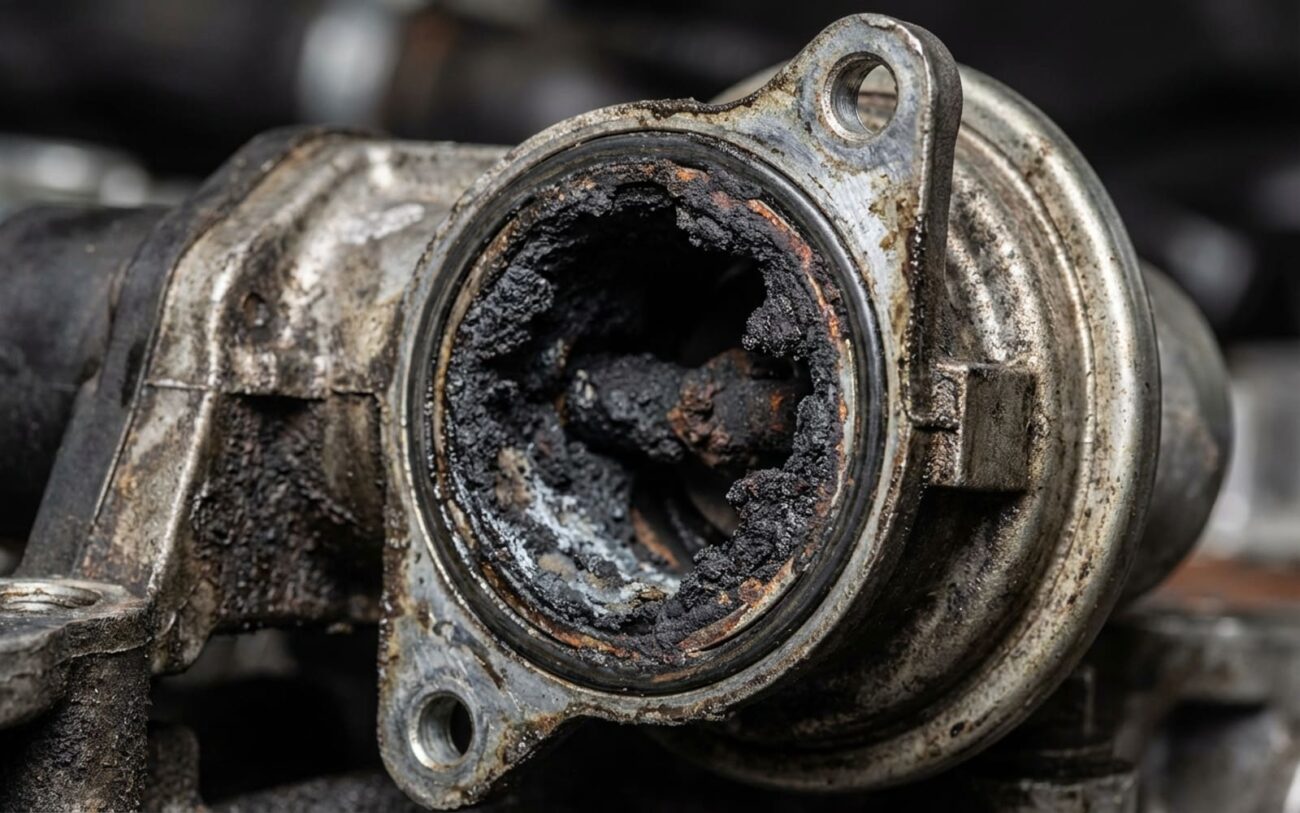
Alright, let’s talk about those P0401 and P0402 codes. If your check engine light just popped on and you’ve pulled one of these, your engine’s computer (the ECM) is trying to tell you it’s got a problem regulating the Exhaust Gas Recirculation, or EGR, system. Now, these aren’t just random numbers; they’re direct signals, but what they really mean for your vehicle can be a bit more complicated than a simple part swap. I’ve seen these codes countless times over the years, and while they point to the EGR, the actual fix isn’t always as straightforward as you’d hope.
What These Codes Are Really Telling You
The EGR system’s job is to reintroduce a small, controlled amount of exhaust gas back into the engine’s intake. This cools down combustion temperatures, which in turn reduces harmful nitrogen oxide (NOx) emissions – a big deal for smog tests and the environment. But when it doesn’t work right, you run into two main scenarios, each with its own set of headaches.
A P0401 – Insufficient EGR Flow basically means the valve isn’t opening enough, or the passages that feed exhaust gas back into the intake are blocked. In my experience, this is almost always due to carbon buildup. On a turbo diesel, you’ll feel a noticeable power loss, see higher combustion temperatures, and your NOx emissions will go through the roof – often enough to fail a smog test. Without that cooled exhaust gas diluting the air-fuel mixture, the engine runs hotter, putting extra stress on components like the cylinder head and the entire exhaust system. For diesels, a stuck-closed EGR valve can also overload the DPF, leading to frequent regenerations or even outright DPF failure.
How I Pinpoint the Real Problem (Don’t Just Guess!)
Look, you can’t just throw parts at a code. I’ve seen more than a few mechanics swap EGR valves only to have the code return because the real culprit was a faulty MAP sensor, a sneaky intake leak, or even a restricted exhaust. Misdiagnosis is incredibly common with EGR issues. The key is systematic testing, not guessing.
My first step is always to grab a capable scan tool. We need to command the EGR valve open and closed and then monitor the real-time sensor feedback. That’s how you separate a mechanical failure of the valve itself from a sensor issue or a problem with the control circuit. Here’s a breakdown of what I look for:
| What You’re Seeing | Often Points To (EGR System) | What Else Could Be Fooling You | My Go-To Test to Confirm |
|---|---|---|---|
| DTC P0401 or P0402 | Clogged EGR cooler or transfer tubes, a stuck EGR valve (open or closed), or a faulty position sensor on the valve itself. | A bad MAP sensor, an exhaust leak upstream of where the EGR taps in, or a restricted intake path. | Use a bidirectional scan tool to command the EGR valve open and closed. Watch the MAP or MAF sensor response. If MAP doesn’t change when commanded open, you’ve got a flow problem. |
| Rough idle, engine stalling | Classic symptoms of a stuck-open EGR valve (P0402), allowing too much exhaust into the intake at idle. | An intake manifold gasket leak, a failed idle air control (IAC) motor on older vehicles, or any significant vacuum leak. | Command the EGR valve closed with your scan tool. If the idle stabilizes, the EGR system is definitely the source. Alternatively, you can temporarily block the EGR passage (carefully!) to see if the idle clears up. |
| Excessive black smoke (diesel) | A stuck-closed EGR valve (P0401) or a completely clogged EGR cooler, leading to incomplete combustion. | Faulty fuel injectors, a turbocharger boost leak, or a severely clogged air filter. | Compare the commanded vs. actual EGR position in live data. If there’s a discrepancy, you’ve found your culprit. I also use a borescope to inspect the EGR cooler and passages for heavy carbon. |
| Hissing or vacuum noise | A cracked diaphragm in a vacuum-operated EGR valve, or a leaking EGR tube gasket. | A split vacuum hose elsewhere in the engine, a leaking PCV system, or even a crack in the intake manifold. | Perform a smoke test on the intake system. If smoke starts escaping from the EGR valve actuator or its connections, you’ve found your leak. |
Why These Systems Fail (The Real Dirt)
EGR systems fail for pretty predictable reasons – mostly heat, contamination, and good old wear and tear. Exhaust gas isn’t clean, not by a long shot. Mix that with crankcase vapors from the PCV system, cool it down in an EGR cooler, and you’ve got the perfect recipe for carbon sludge. This gunk builds up on the EGR valve seat, preventing it from sealing or opening fully. It clogs the small passages in the EGR cooler, restricting or blocking flow entirely. Over time, especially in high-mileage diesel engines, that cooler can turn into a solid mass of carbon. I’ve seen it more times than I can count.
Electronic EGR valves have their own issues. The stepper motor can wear out, or the internal position sensor can drift out of calibration, sending bad signals to the ECM. Vacuum-operated diaphragms eventually crack from constant heat cycling. And those EGR coolers? They’re under immense thermal stress. Repeated heating and cooling cycles cause metal fatigue, leading to tiny cracks in the coolant tubes. When that happens, you get coolant mixing with exhaust gases, or combustion pressure pushing into the cooling system – symptoms that mimic a blown head gasket or a warped block.
Important Diagnostic Note:
This overlap is why diagnosing coolant contamination requires care. You really need to rule out the EGR cooler before you condemn a head gasket. For more on this, check out: Engine Overheating and Coolant Loss with No Visible Leaks.
Some engines are definitely more prone to these issues than others. For example, certain 3.5L EcoBoost engines in Ford trucks have well-known issues with carbon buildup in the EGR passages, frequently triggering P0401 codes. While Ford issued updated PCM calibrations and cleaning procedures, the root cause is still carbon accumulation from normal operation, especially if you do a lot of short-trip driving. And always remember: a vacuum leak at the intake isn’t an EGR failure, even if it causes similar drivability problems. Don’t confuse the symptom with the system itself.
Your Repair Options: From a Quick Clean to a Major Teardown
The right repair depends entirely on what’s actually broken and how much of a pain it is to get to. Some jobs you can tackle in your garage on a Saturday; others definitely need a professional shop with specialty tools and the time to do it right.
EGR Valve Cleaning [DIY-FEASIBLE]
EGR Valve Replacement [DIY-FEASIBLE]
EGR Cooler or Tube Replacement [PROFESSIONAL-ONLY]
Intake Manifold Removal & Cleaning [PROFESSIONAL-ONLY]
How I Verify the Repair (Making Sure It’s Really Fixed)
Just clearing the code isn’t enough. You need to verify the repair under real operating conditions, otherwise, you’ll be seeing that check engine light again in a few days or weeks. Trust me on this one.
For an EGR valve replacement or cleaning, I always start the engine and let it reach full operating temperature. Then, with my scan tool, I use the bidirectional control function to command the valve from 0% to 100% open. I watch both “Desired EGR Position” and “Actual EGR Position” in the live data stream. They should track within about 5% of each other across the entire range. Any lag or failure to move smoothly indicates a mechanical issue or a sensor problem. After that, I complete a full drive cycle – cold start, idle, acceleration, highway cruising – to ensure the ECM doesn’t relearn the fault and set another code.
If you’ve replaced an EGR cooler, you absolutely must pressure-test the cooling system to OEM specs – typically 15–20 psi – and let it hold for at least 20 minutes with no drop. After the engine warms up, I perform a combustion leak test (often called a “block tester”) on the coolant overflow reservoir. If that test fluid changes color, it means exhaust gases are still entering the coolant, which points to a cracked cooler (if it’s a new one, it’s likely a defect or installation error) or, worse, a head gasket issue. For major carbon cleaning jobs, I monitor long-term fuel trim (LTFT) at idle; it should stabilize within ±8%. I also check MAP sensor readings when the EGR is commanded closed; the values should match expected vacuum levels for your altitude. Proper validation requires the right tools: a capable scan tool, a cooling system pressure tester, a block tester, and occasionally a smoke machine.
Weighing the Cost and Making the Call
Repair cost versus vehicle value is the reality check we all have to face. Here’s a realistic breakdown based on what I see in the shop, but remember, these are estimates and can vary wildly by region and vehicle:
| Repair Type | DIY Cost (Parts) | Shop Cost (Est. Labor + Parts) | My Success Rate | Secondary Risk |
|---|---|---|---|---|
| EGR Valve Cleaning | $20 (cleaner, gasket) | $200 – $400 | 70% (It often comes back) | Valve may re-stick quickly; risk of stalling returns. |
| EGR Valve Replacement | $150 – $500 | $400 – $1,000 | 95% (If the diagnosis was right) | Minimal, provided an OEM-spec part is used. |
| EGR Cooler Replacement (Diesel) | $300 – $800 | $1,200 – $2,500 | 98% (When done right) | Improper installation can lead to coolant leakage or even hydrolock if not careful. |
Here’s my rule after 25+ years in the bay: if the repair cost starts to exceed 40% of the vehicle’s current market value – say, you’re looking at a $2,000 repair on a truck only worth $5,000 – you need to take a serious step back. Evaluate the whole picture. How’s the transmission shifting? Is the turbo still boosting properly? Any signs of rust or structural damage? Pouring money into one major system on a vehicle with multiple aging components rarely pays off in the long run. Sometimes the smarter move is to repair only what’s absolutely essential to keep it running safely, or to consider replacing the vehicle altogether.
Keeping It From Happening Again
My Prevention Strategies
-
For diesel engines, always use high-quality ultra-low sulfur diesel (ULSD). And seriously consider an OEM-approved cetane booster or detergent additive. They really do help reduce soot buildup, which is the enemy of the EGR system.
-
If you’ve got a gasoline GDI engine, stick to only ILSAC GF-6 or API SP-certified low-ash motor oil. And don’t skimp on those oil change intervals. Preventing oil vapor carbonization is key to keeping those intake valves and EGR passages clean.
-
Grab even a basic OBD-II scanner and use it every few months to check for pending codes. Catching a slowly sticking valve early on can save you from a much more expensive repair down the road. It’s cheap insurance.
-
On diesels, keep an eye on your DPF regeneration frequency. A sudden increase in regens can be a red flag that your EGR valve is starting to fail (P0401), forcing the engine to produce more soot because it’s not getting enough exhaust gas back in.
