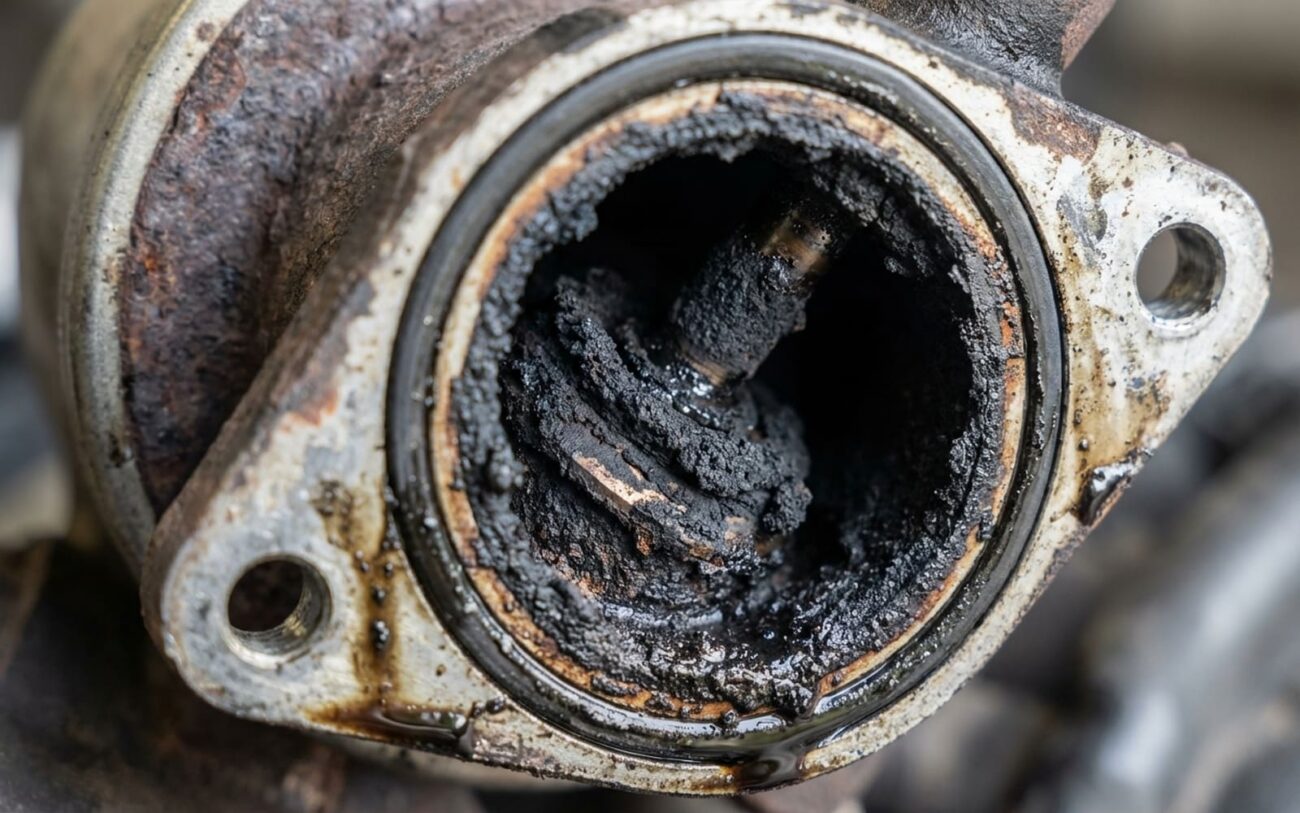
When Your EGR Valve Chokes: What Happens to Your Engine
If you’re hearing a sharp, metallic pinging sound when you hit the gas, or if your engine’s running hotter than it should be under load, don’t ignore it. I’ve seen plenty of engines come into the shop with those exact complaints, and more often than not, the EGR (Exhaust Gas Recirculation) valve is the silent culprit.
Here’s the deal: the EGR system is designed to recirculate a small, precise amount of exhaust gas back into the intake manifold. This isn’t for power; it’s to cool things down. That inert exhaust gas doesn’t burn; it actually absorbs heat from the combustion process, which lowers peak cylinder temperatures. When that valve gets clogged or sticks, that cooling effect vanishes. And that’s when your engine starts to suffer.
Delta: +240°F
The Consequence
“Higher combustion temps and increased pressure create conditions ripe for detonation. That’s when you start hearing—and feeling—the consequences.”
The Red Flags I Look For: Symptoms of a Failing EGR
There are three main things that scream “EGR problem” in my shop. Pay attention to these – they’re not just annoyances, they’re signs of real trouble brewing inside your engine.
Next up is overheating under load. Your temperature gauge might look perfectly normal driving around town, but as soon as you hit the highway or climb a hill, it starts to creep up. This isn’t usually a coolant leak; it’s internal heat generation because the EGR isn’t doing its job. If you’re seeing this without any visible leaks, your EGR system is definitely on my suspect list.
Finally, there’s rough idle or stalling. This usually happens when the EGR valve gets stuck partially open. At idle, your engine needs a very precise air-fuel mixture. If exhaust gas is bleeding into the intake when it shouldn’t be, the mixture goes lean, and the engine misfires or stalls out. Carbon buildup is almost always to blame here, holding that valve off its seat.
How I Pinpoint the Problem: Is It Really the EGR?
These symptoms can overlap with other issues, so you can’t just jump to conclusions. That’s how you waste time and money. Here’s how I approach diagnosing a potential EGR problem:
Diagnostic Roadmap
Before you start tearing things apart, grab your scan tool. It’s your best friend here.
-
For Engine Knock: Hook up the scan tool and monitor EGR position command versus actual position during a road test, especially under load. If the PCM is asking for 80% flow and you’re seeing 10%, you’ve found your issue. Also, a visual inspection of the EGR passages after removing the valve can confirm carbon blockage.
-
For Overheating Under Load: Again, the scan tool is key. Command the EGR valve open and closed. Does the actual position match? If it’s stuck closed or restricted, that’s why your combustion temps are through the roof. Remember, EGR-related overheating rarely shows up at idle; it’s a load-dependent issue.
-
For Rough Idle/Stalling: Check for Diagnostic Trouble Codes (DTCs) like P0400 (flow malfunction) or P0401 (insufficient flow). Then, with the engine idling, monitor the EGR position sensor. It should read 0% flow. If it’s showing even a small percentage, that valve is stuck open and letting exhaust gas into the intake, causing a lean condition and misfires.
Always consider other common causes too. For knock, think about advanced timing, carbon buildup in the combustion chamber, low-octane fuel, or a faulty knock sensor. For overheating, rule out a bad water pump, a stuck thermostat, or air in the cooling system. And for a rough idle, vacuum leaks, a dirty throttle body, or a bad MAF sensor can mimic EGR issues.
Why These Things Go Bad in the First Place
In my experience, carbon buildup is the number one killer of EGR valves and their passages. Exhaust gas isn’t clean air; it’s full of soot, unburned hydrocarbons, and moisture. Over time, especially if you do a lot of stop-and-go driving or short trips where the engine never fully heats up, these deposits bake onto the valve pintle, stem, and seat. It’s like hardening glue, eventually seizing the valve or blocking the flow entirely.
Pro Tip: Watch for EGR Cooler Leaks
On some engines, particularly diesels and direct-injection models like Ford’s EcoBoost or GM’s EcoTec, you’ll find an EGR cooler. If that cooler cracks, coolant can leak into the exhaust stream. When coolant mixes with soot, it creates a thick, nasty sludge that can completely seize the valve or clog the passages. I’ve seen this on many 2015-2017 F-150s with the 3.5L EcoBoost, often throwing a P0401 code for insufficient flow. It’s a mess.
Your Repair Options: From a Quick Clean to a Major Job
Safety First, Always
EGR systems operate at extreme temperatures, so never, ever try to remove or clean a valve until the engine has cooled completely. And when you’re using pressurized cleaners, always wear proper eye protection. Trust me on this one.
Surface Carbon Cleaning DIY Feasible
Internal Passage Blockage Professional Only
Mechanical or Electrical Failure
How to Know the Fix Actually Worked
Just because the check engine light turns off doesn’t mean the problem is truly solved. You need to verify the repair. Here’s my checklist:
-
Idle Quality: After the repair, the engine should idle smoothly and stably. No surging, no misfires.
-
Scan Tool Verification: This is critical. Run an EGR functional test with your scan tool. Command the valve open and closed and watch the actual position. It should match what the computer is commanding, every time.
-
Knock Test: Take the vehicle for a good road test. Find a hill or accelerate hard. That metallic pinging sound should be completely gone.
-
Temperature Check: Again, use your OBD2 scan tool to monitor coolant temperature. Under sustained highway load, the temperatures should stabilize within 5–10°F of your thermostat’s rating. If it’s still climbing, something else is wrong.
A word of caution: if overheating persists after an EGR fix, don’t immediately assume the repair failed. The prior overheating may have already caused more serious damage, like a warped cylinder head or a compromised head gasket. That’s a whole different can of worms.
The Cost and the Hard Decision
So, what’s this going to set you back? It really depends on how bad the problem is. A simple EGR valve cleaning might cost you $20-$50 if you do it yourself, mostly for cleaner and a new gasket. At a shop, you’re looking at $150-$300. This usually has a high success rate if the carbon buildup is light.
If the valve itself needs replacing, parts alone can run $150-$500, and a shop will charge you anywhere from $400-$800, sometimes more, depending on access. This is usually a very high success rate fix.
Now, if the carbon has gotten into the intake passages and requires manifold removal and cleaning, that’s where the costs really jump. DIY might be $100-$200 for supplies, but at a professional shop, you’re looking at $500 all the way up to $1,500. This kind of job has a moderate to high success rate, but there’s always a risk of debris getting into the cylinders if not done meticulously.
How to Keep It From Happening Again
Prevention is always cheaper than repair. Start with using Top Tier detergent gasoline – it really does make a difference in keeping your fuel system clean. Regular oil changes are also key. For direct-injection engines, which are particularly prone to carbon buildup, I recommend a periodic professional induction cleaning every 30,000 to 50,000 miles. Catching these issues early often means a simple cleaning instead of a $1,500 manifold job.
