Alright, let’s talk about an engine that runs fine when you’re on the gas but dies the moment you lift your foot. You know, that annoying stall when you’re slowing down for a light or coming to a stop sign. In my 25+ years in the shop, I’ve seen this symptom hundreds of times, and almost every single time, it points to a problem with how the engine handles air at idle. We’re talking about your idle air control (IAC) system or, on newer vehicles, the electronic throttle body.
First Things First: Is It Really the Idle System?
Before you even think about cleaning or replacing parts, you’ve got to confirm that the idle air system is the actual culprit. A lot of other issues can mimic a bad IAC or throttle body. I’ve seen countless guys—and even some experienced techs—jump straight to cleaning the throttle body, only for the problem to come right back a week later. That’s wasted time and money.
Here’s how I approach it in the shop, checking the common symptoms and ruling out the look-alikes:
-
Engine stalls cold or hot when you let off the gas.
This is the classic symptom. Your engine runs fine under load, but as soon as you close the throttle plate, it just dies. It’s starving for air because the idle air passage is blocked or the IAC valve isn’t doing its job.
What I Check:
- Primary Suspects: IAC valve stuck closed, carbon buildup completely blocking the idle air passage, or a failed IAC motor/driver circuit.
- Common Mimics: A big vacuum leak (think a cracked PCV hose, a bad intake gasket, or a failing brake booster), a faulty Throttle Position Sensor (TPS) not telling the computer the throttle is closed, or low fuel pressure.
- My Go-To Test: I grab my bi-directional scan tool. I’ll command the IAC valve to move while watching the RPM. If the RPM doesn’t change, or the valve doesn’t respond, that’s a strong indicator of an IAC problem. I also visually inspect the throttle bore for heavy carbon buildup around the plate.
-
Erratic or “hunting” idle after restarting.
You restart the car, and the idle jumps up and down, or it just can’t settle. This usually means the system is trying to compensate for inconsistent airflow.
What I Check:
- Primary Suspects: The IAC pintle is sticking intermittently, or you’ve got carbon flaking off and temporarily blocking the idle passage.
- Common Mimics: A fluctuating vacuum leak (sometimes they’re not constant), a failing Mass Air Flow (MAF) sensor sending bad air readings, or even clogged/leaky fuel injectors.
- My Go-To Test: Again, the scan tool. I’ll monitor the IAC’s commanded position and compare it to the actual RPM. If the computer is commanding a stable IAC position, but the RPM is bouncing all over, the problem is likely external (vacuum, fuel, MAF). If the RPM is erratically following the IAC command, then I’m looking at a mechanical issue with the IAC itself.
-
Predictable stall on a “snap-throttle” shut.
You rev the engine quickly and then let off, and it just dies every time. This is often a more severe version of the first symptom.
What I Check:
- Primary Suspects: The IAC is completely dead, or the throttle bore is totally sealed by carbon, leaving no idle air path.
- Common Mimics: The TPS isn’t reporting “closed throttle” to the ECU, so the computer never even tries to activate the IAC. Or, you could have a significant fuel pump or pressure regulator failure.
- My Go-To Test: I’ll start with a thorough cleaning of the throttle body and IAC. If that doesn’t fix it, I’ll test the TPS voltage at idle. Most cars want to see around 0.45-0.55V with the throttle closed. You’ll need a digital multimeter for this, but always check your service manual for the exact specs for your vehicle.
If your diagnostic work points away from the idle air system, don’t forget to really dig into those vacuum leaks. They’re incredibly common and often get overlooked. A simple cracked hose can cause all sorts of headaches. For more on that, you can check out this article: vacuum leak symptoms car.
What Exactly Goes Bad in These Systems?
When we’re talking about idle air control, there are a few predictable ways these things fail. After decades of turning wrenches, I’ve seen these patterns play out time and again.
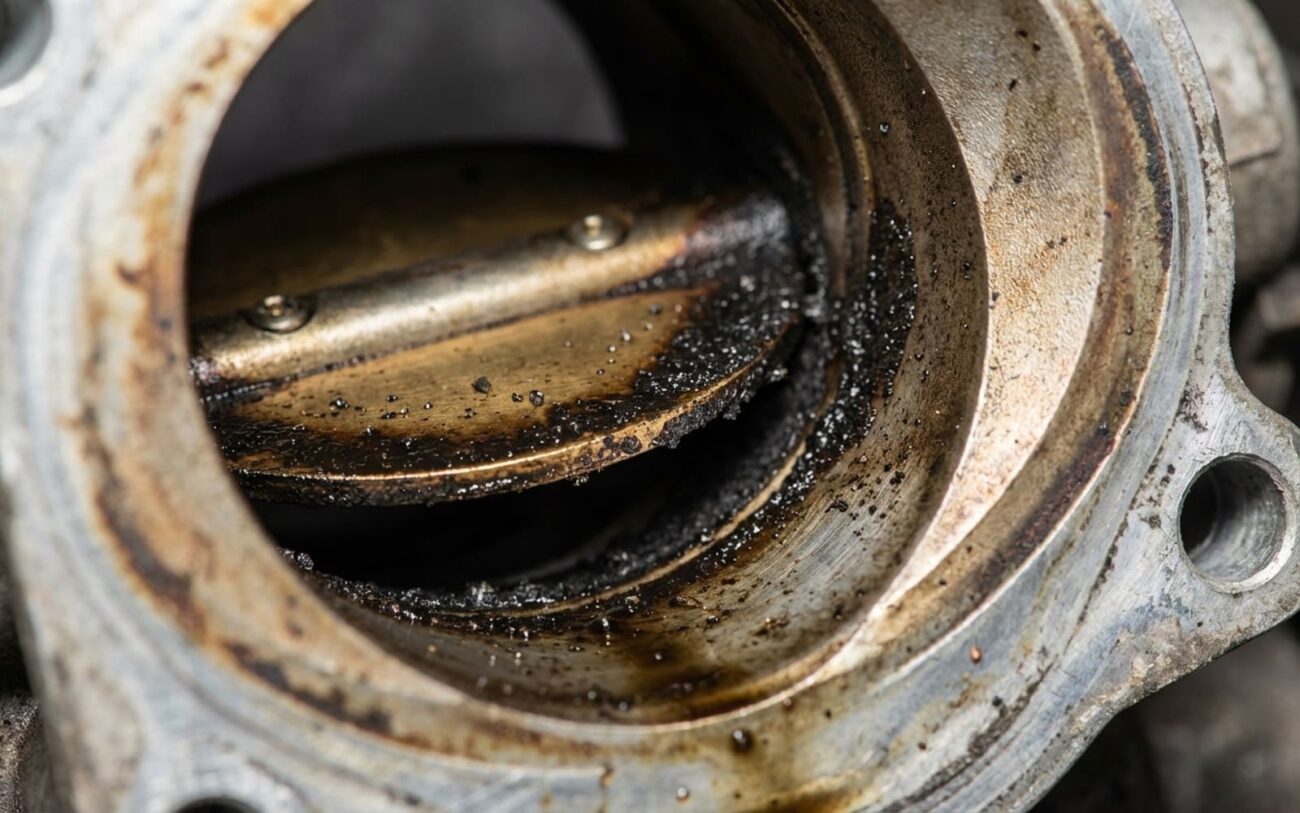
The most common culprit, by far, is carbon buildup. Every engine, through its PCV (Positive Crankcase Ventilation) system, recirculates oil vapor back into the intake. Over time, that oil vapor bakes onto hot surfaces and turns into hard carbon deposits. These deposits can glue the IAC pintle (the little plunger that controls airflow) in place, or worse, completely seal off the tiny idle air passage around the throttle plate. I’ve pulled throttle bodies where that passage was so choked with carbon, you couldn’t even see light through it. No wonder the engine died every time the driver let off the gas.
Next up is internal electrical failure in the IAC valve. Inside that valve, there’s a solenoid coil that moves the pintle. Sometimes, that coil just gives up—it can open up (break) or short out. When that happens, the valve is dead, and the computer can’t control idle airflow. You won’t see this with your naked eye; you’ll need a multimeter to check for resistance across the coil terminals or a scan tool to see if it’s responding to commands.
Then there’s mechanical wear. On high-mileage engines, the bore where the IAC pintle slides can wear down. This causes sloppy movement, or even air leaks around the pintle, leading to erratic idle. The throttle body itself isn’t immune either. The bore can erode or become pitted over time, which means the throttle plate can’t seal properly, or it might even stick slightly.
And finally, don’t underestimate carbon buildup on the throttle plate edge itself. The engineers design a very precise air gap around that plate for proper idle airflow. Carbon reduces or eliminates that gap, effectively choking the engine. This isn’t just theory; I’ve dealt with specific vehicles, like some 2.4L engines from the late 2000s, that had known issues with carbon-related stalling on deceleration, and there were even service bulletins about it. But remember, a disconnected vacuum hose or a weak fuel pump isn’t an IAC problem. Always rule those out first.
Repair Options: What to Do Once You’ve Diagnosed It
Your next move depends entirely on what your diagnosis revealed and how much access you have to the components.
Carbon Buildup – Clean It Yourself DIY-FEASIBLE
Failed IAC Valve – Replace It DIY to PROFESSIONAL
Internal Throttle Body Damage – Replace the Assembly
Chemical Cleaning – Use with Caution TEMPORARY / LAST-RESORT
How to Know You’ve Really Fixed It
Don’t just button everything up, fire it up, and drive off. A proper repair validation is crucial, and it takes a bit more than a quick test drive.
After you’ve cleaned or replaced components, start the engine and let it idle. I usually let it run for at least 10 minutes, cycling the A/C on and off a few times. The RPM should stay stable, within about ±50 RPM of the target idle speed. You shouldn’t see any hunting, surging, or dying. Then, perform what I call the “throttle snap” test: quickly open the throttle wide, then immediately release it. Do this several times. The engine should return to a smooth, stable idle without any hesitation or stalling. If it stumbles or dies, you’re not done yet.
If you replaced the entire throttle body, especially on newer electronic units, you absolutely must perform the OEM’s specific throttle adaptation or relearn procedure. Without it, the engine computer (ECU) won’t know the new throttle body’s idle position, and it won’t control idle correctly. You’ll need a good scan tool for this. While you’re at it, use that scan tool to monitor live data: check the IAC commanded position, actual RPM, and TPS voltage. Verify that the TPS voltage increases smoothly from idle (typically around 0.5V) all the way to wide-open throttle (usually 4.5–5V). A digital multimeter can give you TPS voltage in a pinch, but a scan tool gives you the full picture, confirming that the entire system is communicating and functioning as it should.
Cost, Risk, and Is It Worth the Fix?
Here’s a realistic breakdown of what you can expect to pay and the success rates. These numbers are based on common front-wheel-drive four- and six-cylinder engines I’ve worked on. Keep in mind, prices can vary a lot by region, vehicle make, and even the specific part brand.
| Repair Type | DIY Cost (Parts) | Shop Cost (Est. Labor + Parts) | Success Rate | Secondary Risk |
|---|---|---|---|---|
| Throttle Body Cleaning | $10–$20 | $120–$200 | Over 90% | Low (if done correctly) |
| IAC Valve Replacement | $50–$150 | $250–$400 | Over 95% | Moderate (risk of vacuum leaks if gasket isn’t sealed) |
| Throttle Body Assembly Replacement | $300–$800 | $600–$1,200 | Near 100% | High (if relearn isn’t performed or wiring is damaged) |
My Two Cents:
If you’re looking at a new throttle body costing more than, say, 40% of your car’s current market value, don’t be afraid to consider a quality used or remanufactured unit. I’ve had great success with them. These assemblies rarely fail a second time unless there’s an underlying issue, so a good used part from a trusted auto recycler can save you hundreds with very minimal risk. Just make sure it comes from a reputable source.
Preventing Idle Stalling Before It Starts
Like most things in automotive repair, an ounce of prevention is worth a pound of cure. Keeping your idle air system happy really comes down to two main things: what you put in your tank and how well you maintain your PCV system.
-
Use Top Tier detergent gasoline. This isn’t just marketing hype, folks. Top Tier fuels contain higher levels of cleaning additives that actively work to reduce carbon buildup in your intake tract, on your valves, and yes, in your throttle body. I’ve seen side-by-side comparisons in the shop where engines fed Top Tier fuel stayed remarkably clean, while others needed a throttle body cleaning by 60,000 miles. It really does make a difference.
-
Keep your PCV system in good shape. Remember how I talked about oil vapor causing carbon buildup? The PCV (Positive Crankcase Ventilation) valve is designed to regulate that. If it gets stuck open, it’ll dump too much oil vapor into your intake, accelerating carbon formation like crazy. I recommend replacing your PCV valve every 80,000–100,000 miles as a simple, cheap piece of preventive maintenance. It’s often overlooked, but it’s crucial.
-
Listen for early warnings. Your car will usually give you subtle hints before it completely dies on you. A slight hesitation when you let off the gas, a rougher idle on a cold start, or an RPM that takes a little longer to settle down after you rev it—these are all red flags. While you’re checking your oil, grab a flashlight and shine it into the throttle bore. If you see a thick, black carbon ring forming where the throttle plate seats, that’s your cue to schedule a cleaning before it becomes a stalling problem.
Catching these issues early is key. It’ll save you from the frustration of stalling, the embarrassment of failing an emissions test, and the expensive wear and tear on your starter and catalytic converter. Trust me on this one.
