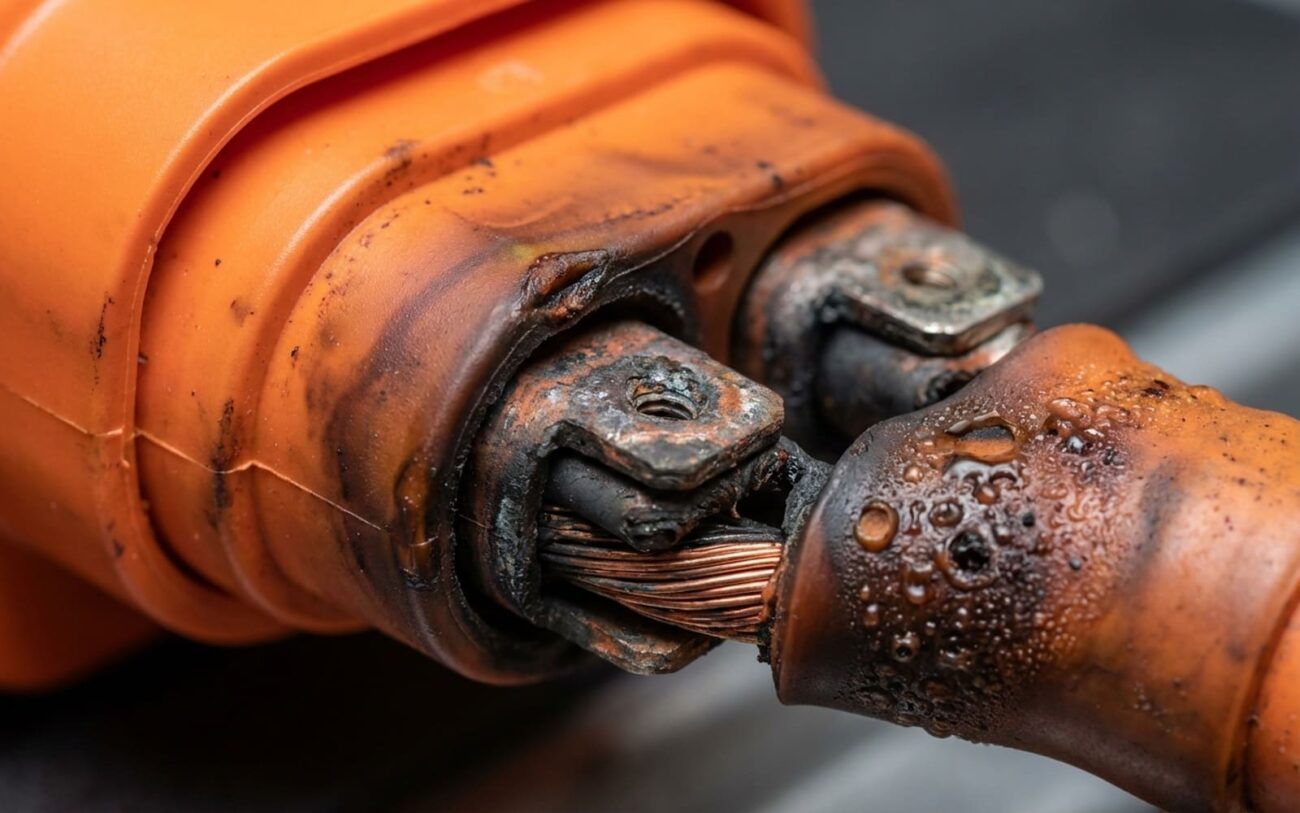
Alright, let’s talk about one of the most frustrating things an EV owner can run into: their battery overheating during a fast charge. It’s not just an inconvenience; it’s the car telling you something serious is going on. I’ve seen this issue pop up more and more as EVs age, and it almost always means the car is trying to protect itself from real damage.
What You’ll See and Hear
When an EV battery starts to get too hot during a fast charge, the car’s built-in safety systems kick in hard. You’ll notice the charging speed drops off a cliff, usually within minutes. I’ve had customers tell me they plug in expecting 150 kW, and within 10 or 15 minutes, it’s already down to 50 kW or less. And this happens even when the battery isn’t anywhere near 80% state of charge, which is when you’d normally expect to see a taper. That’s the Battery Management System (BMS) hitting the brakes on the current to keep things from melting down.
At the same time, you’ll hear those cooling fans and pumps working overtime, often running at full blast for the entire charging session. Sometimes even on a mild day, they’re screaming. The car might throw a warning on the dash, something like “Battery Temperature High” or “Charging Speed Reduced.” In more serious cases, you might even feel heat radiating from the undercarriage, especially around the middle or rear where the battery pack lives.
If you ignore these warnings, the BMS can decide to just shut down charging entirely, which can leave you stuck. But honestly, that’s the least of your worries. The real problem is the long-term damage. Sustained high temperatures are a killer for lithium-ion batteries. They accelerate degradation, permanently reduce your range, and significantly increase the risk of something much worse, like a thermal runaway event. This isn’t just a minor bug; it’s a core system failure that needs immediate attention.
My Approach: Pinpointing the Real Problem
This is where experience really comes into play. Those symptoms – slow charging, loud fans, heat warnings – they all scream “battery overheating.” But the trick is figuring out why. Is the battery itself actually failing, or is something in the external cooling system giving us a false alarm? Mixing those up will lead you down a very expensive rabbit hole of misdiagnosis. My job is to isolate whether the problem is truly inside the sealed battery pack or in the thermal management system that’s supposed to keep it cool.
Here’s how I break it down, looking at the common symptoms and what they usually point to:
Symptom: Charging power drops, cooling system goes wild.
This is the most common complaint. The car is throttling power and trying its best to cool things down. What could it be?
- External Suspects (Mimics): Often, it’s something simple in the cooling loop. A faulty battery coolant temperature sensor could be lying to the BMS, making it think the battery is hotter than it is. Or maybe the coolant level is low, the coolant pump itself has failed, or the radiator/heat exchanger is clogged up. I’ve seen all of these.
- Internal Pack Suspects: If the external stuff checks out, then we’re looking inside the pack. This could be internal cell imbalance, where some cells are working harder and heating up more than others. High-resistance busbar connections or individual cells with elevated internal resistance are also big culprits, generating excess heat right where it shouldn’t be.
My Definitive Test: I hook up a professional scan tool and monitor individual cell group temperatures and voltages during a fast charge. If I see a temperature difference (a “delta”) exceeding 5°C (that’s about 9°F) between the hottest and coolest groups, that’s a dead giveaway for an internal pack issue. If all groups are heating up evenly but too fast, then I lean more towards an external cooling system problem.
Symptom: Excessive heat coming from the underbody, especially near the charge port.
This one’s a bit more specific. You can literally feel the heat.
- External Suspects (Mimics): Sometimes, it’s not the battery at all. A poor connection right at the charging inlet, a damaged charging cable, or even a malfunctioning DC fast charger itself can generate a lot of heat.
- Internal Pack Suspects: If it’s internal, we’re usually talking about overheating at the high-voltage contactors or busbar connections inside the pack. This happens due to increased resistance or even arcing.
My Definitive Test: I grab my thermal imaging camera. During a charge, I scan the undercarriage. If the hotspot is clearly on the battery pack casing itself, and not just at the charging inlet, then the problem is definitely internal to the pack.
Common Root Causes I’ve Encountered
Once we’ve narrowed down whether the issue is internal or external, we can dig into the specific failures. It’s usually one of a few well-known problems.
External Thermal Management System Failures (The “Mimics”)
- Faulty Sensors: A bad battery coolant temperature sensor is a common one. It might be reading wrong, or the wiring could be compromised. The BMS acts on bad data, leading to unnecessary throttling.
- Coolant System Issues: Low coolant levels, air in the system, or a failed coolant pump will absolutely prevent proper heat transfer. A clogged radiator or heat exchanger is another big one; I’ve seen plenty of those, especially if the coolant hasn’t been changed on schedule.
- AC System Problems: Some EVs use the vehicle’s air conditioning system to cool the battery coolant loop. If your AC isn’t working right – maybe a low refrigerant charge or a failed compressor – it can directly impact battery cooling. Think about those Porsche Cayenne V6/V8 models with their heat exchanger issues; it’s a different system, but the principle of a shared cooling component failing and affecting another system holds true.
Internal Battery Pack Failures
- High-Resistance Connections: This is a big one. Poor welds or crimps between cells and busbars, often from manufacturing defects, create hot spots. Over time, repeated heating and cooling cycles can fatigue these connections, leading to micro-cracks and even higher resistance.
- Degraded Cells: Individual cells can just wear out faster than their neighbors. They develop higher internal resistance, which means they generate more heat and struggle to accept a charge as efficiently as the rest of the pack.
- Internal Coolant Leaks: In liquid-cooled packs, a failed cooling plate or seal inside the pack can lead to coolant leaking onto busbars or sensor terminals. This causes corrosion, electrical shorts, and is a major safety hazard. This is one of those “stop driving immediately” situations.
- Physical Damage: Road debris or impacts can compromise the internal structure, spacing, or cooling channels, especially in low-mounted packs. I’ve seen cases where even a minor impact caused a single module to derate the entire pack during fast charging, making it look like a full-pack failure.
- Known Manufacturing Defects: Sometimes, it’s a known issue. There have been service bulletins for certain EV model years due to batches of cells with higher-than-specified internal resistance. These were often addressed with software updates or, in more severe cases, module replacements.
The Fix: What It Takes
Once we know what the problem is, the repair path becomes clear. But there’s no single magic bullet here; it all depends on where the fault is and how bad it is.
External, Accessible Defects PROFESSIONAL-ONLY
Internal Module Defects PROFESSIONAL-ONLY / OEM-SPECIFIC
Widespread Internal Damage NON-REPAIRABLE
After the Repair: Verifying the Work
Just because the last bolt is tightened doesn’t mean the job’s done. You absolutely have to verify the fix under real-world conditions. Skipping this step is asking for trouble.
- For External Seal Repairs: I always perform a coolant system pressure test. Typically, that means holding 15 psi for 30 minutes with no pressure drop. Then, I run a controlled DC fast charging session, carefully monitoring all cell group temperatures. The maximum temperature delta between cells should stay under 5°C.
- For Module Replacements: You need to complete the full BMS initialization process. After that, I run a charge cycle from about 20% to 80% state of charge. The charging curve should match the OEM profile, with no premature throttling. Critically, all cell group voltages should stay within 50 millivolts of each other throughout the charge.
- For Full Pack Replacements: Success means full system integration. That includes correct BMS programming, completing all required drive cycles for calibration, and making sure the vehicle’s range and charging behavior are fully restored. I use an OBD2 EV diagnostic tool to confirm there are no pending BMS fault codes (like P0A0F) and that battery preconditioning functions properly, especially when heading to a fast charger.
The Hard Truth: Cost & When to Walk Away
Let’s be realistic here – these aren’t cheap oil changes. EV battery repairs carry some serious financial weight. Here’s a breakdown of what I typically see in terms of cost and risk:
| Repair Type | DIY Cost | Shop Cost (Estimated) | Success Rate (My Experience) | Secondary Risk if Failed |
|---|---|---|---|---|
| External seal replacement | Not applicable (extreme high-voltage risk) | $500 – $1,500 | High (>95%) | Coolant intrusion into pack, leading to corrosion or thermal event |
| Single module replacement | Not applicable | $2,000 – $6,000 | Medium-High (if proper calibration is done) | Cell imbalance, reduced usable capacity, recurring BMS warnings |
| Full battery pack replacement | Not applicable | $12,000 – $25,000+ | High (if installed correctly) | Major financial loss if original diagnosis was incorrect |
The bottom line for me is this: if a full pack replacement is needed, and the estimated cost starts to creep past 50% of your vehicle’s current market value, you really need to evaluate the economics. You could be throwing good money after bad. In those situations, especially if the EV is out of warranty and has a lot of miles on it, it often makes more sense to consider a replacement vehicle.
Keeping Your Battery Healthy: Prevention
The best repair is the one you never have to do. Preventing EV battery overheating is always the smartest move.
- Follow Coolant Schedules: Don’t skip battery coolant replacement. Manufacturers typically recommend it every 5–7 years or 100,000 miles, but check your specific manual. And always, always use only the specified dielectric coolant. Mixing types can lead to corrosion or drastically reduce thermal efficiency. I’ve seen it cause problems in systems similar to those in the Porsche Cayenne or Hyundai Ioniq, even if those are different vehicles.
- Monitor Performance: Keep an eye on your peak DC fast charging rate. If you consistently charge from, say, 20% state of charge, track that initial kW number over time. A steady decline – even 10–15% over a year – can be an early warning sign of increasing internal resistance in the battery. An OBD2 scanner with good EV support can also help you check for early BMS warnings or temperature sensor faults long before they light up your dashboard.
- Use Battery Preconditioning: When you can, use your car’s battery preconditioning feature. Many EVs, like the Tesla Model S/X or Hyundai Ioniq 5, can warm or cool the battery to an optimal temperature before you even arrive at a charger. This keeps the cells in their happy zone, reduces thermal stress during charging, and pays big dividends in long-term battery health. It’s a small habit that makes a huge difference.
