Steering Angle Sensor Faults: Why Your ABS, ESP, and Lane Assist Go Haywire
After more than two decades wrenching on cars, I can tell you straight up: if your ESP, ABS, and traction control lights suddenly light up like a Christmas tree, especially with a “Lane Assist Unavailable” message, a faulty steering angle sensor (SAS) is usually the first place my mind goes. It’s a hugely common failure, particularly on European and Japanese vehicles, and it’s not just a nuisance—it’s a safety system shutdown.
Here’s why: the SAS is the brain’s eye for where the steering wheel is pointed and how fast you’re turning it. It feeds that critical real-time data to the electronic stability control (ESC) module. Without accurate input from the SAS, the ESC system can’t tell what you, the driver, are trying to do versus what the car is actually doing. When that signal gets flaky or disappears, the system throws its hands up, disables those critical driver aids, and lights up your dash to let you know you’re on your own.
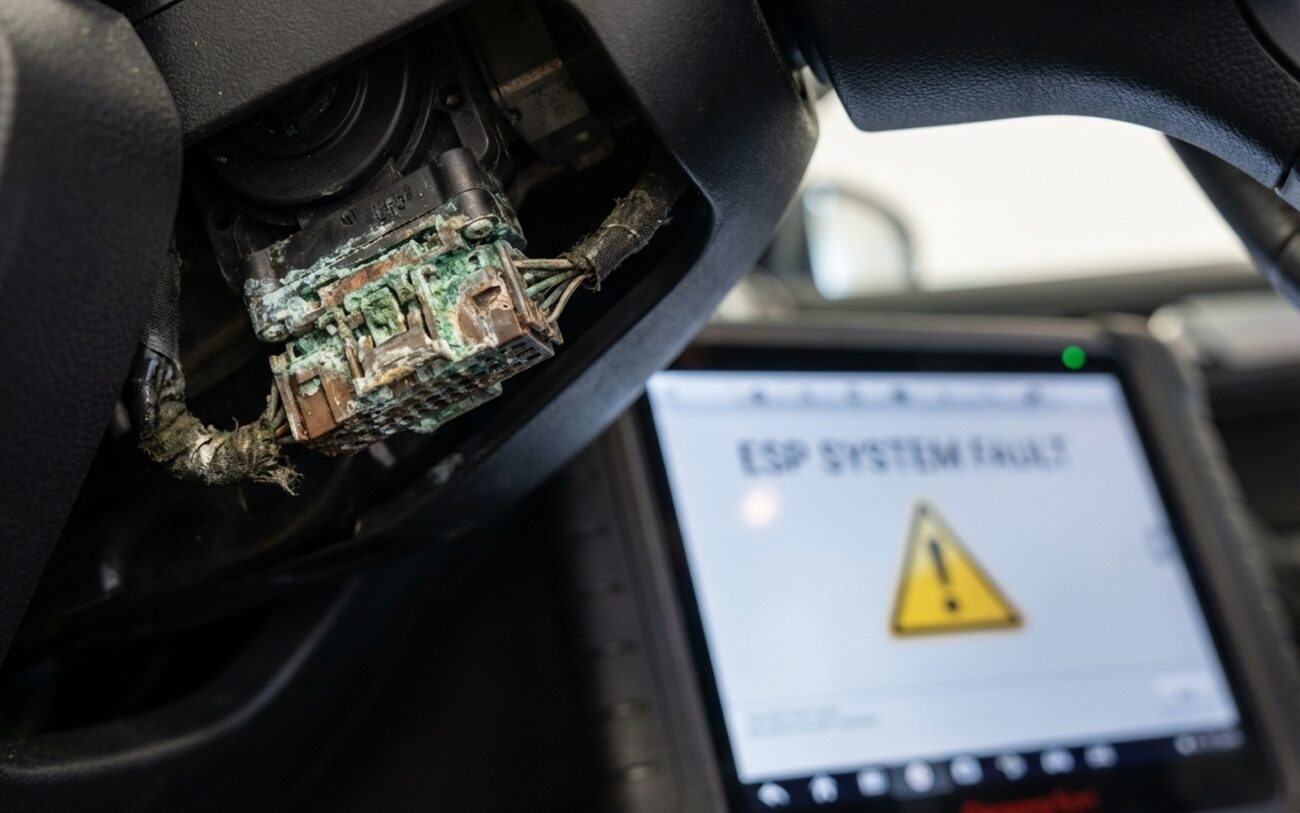
I see this failure pattern regularly. The dashboard graphic you see here is a pretty good representation of what a scanner might show me. Look at that “Offset: 14.5°” and the “Center” bar being way off. That’s a dead giveaway.
The ESC module is comparing that steering angle data to what the wheel speed sensors are saying. If the wheel speed sensors say you’re going straight, but the SAS is reporting a 14.5-degree turn, well, that’s a “plausibility” error. The system can’t trust the data, so it defaults to a safety shutdown. It’s better to disable the system than to act on bad information and potentially cause an accident.
Offset: 14.5°
Symptoms I See: How to Spot a Failing Steering Angle Sensor
The most common sign is a cluster of warning lights. I’m talking ESP, ABS, traction control, maybe “Stability Control Off,” and often “Lane Assist Unavailable” all popping up together. Usually, this happens shortly after you start the car or during your first turn out of the driveway. These systems need good steering angle data, so when the sensor fails its internal self-check, they just shut down.
But watch out for this one: sometimes, the SAS doesn’t just fail outright; it starts to drift. This is where things get dangerous. I’ve had customers describe the car suddenly activating the ESP system—you know, that feeling of one wheel braking hard or the engine power cutting out—while they’re driving perfectly straight. That’s the system reacting to a false input, thinking you’re in a skid when you’re not. It’s reacting to a steering angle that isn’t actually there. If your car is doing that, get it looked at immediately.
Another red flag I often see is after a battery replacement or even just disconnecting the battery. The lights stay on, even if the car seems to drive fine. This doesn’t always mean the sensor itself is dead, but it definitely means the SAS is involved. Often, it just needs a proper calibration after the power interruption, but if it won’t calibrate, then the sensor itself is likely toast.
Digging Deeper: Is It Really the SAS, or Something Else Mimicking It?
This is where experience really counts. You can’t just pull a C0051 code (that’s a common SAS fault code, by the way) and throw a new sensor at it. The stability system is complex; it uses inputs from wheel speed sensors, a yaw rate sensor, a lateral acceleration sensor, and of course, the steering angle sensor. A fault in any of these can make the whole system freak out and mimic a SAS failure.
My diagnostic approach is always data-driven, not just code-based. Here’s what I look for:
Common Symptoms and How I Pinpoint the SAS:
ESP/ABS/Traction Control lights with SAS codes (e.g., C0051)
If you’ve got these lights and a specific SAS code like C0051, it’s often an internal sensor element failure. We’re talking degraded Hall-effect magnet or circuit board damage inside the unit.
But don’t jump to conclusions. I’ve seen a damaged clock spring ribbon cable, a corroded connector, or even just a wiring short or open circuit cause the exact same codes. The clock spring carries the SAS signal, so if it’s bad, the SAS looks bad.
The definitive test here is to monitor live steering angle data with a good scan tool. A healthy SAS should show smooth, linear movement from about -720° (left lock) to +720° (right lock). If it’s jumping, dropping out, or showing a fixed value, that’s your SAS.
Unwanted ESP activation during straight-line driving
This is that dangerous signal drift I mentioned earlier. The sensor is reporting a non-zero angle even when the steering wheel is perfectly centered and you’re driving straight.
This can also be caused by a faulty wheel speed sensor (telling the ABS module one wheel is spinning differently), a failing yaw rate sensor (reporting a turn when there isn’t one), or even an internal ABS module error.
For this, I do a road test with data logging. I watch the yaw rate sensor and the steering angle sensor simultaneously. If the yaw rate is zero (meaning the car isn’t actually turning) but the SAS is reading 10-15 degrees, then the SAS is definitely the source of the problem.
Don’t Forget the Mechanicals: Before you even think about the sensor, always check the mechanical foundation. A severely misaligned front end—maybe from worn rear control arm bushings or compromised subframe alignment—can force the steering wheel off-center just to drive straight. The SAS expects the wheel to be centered when the car is going straight. If it’s cocked, the system can detect an invalid angle during calibration. Fix the alignment first, then recalibrate. On older Mercedes W210 and W211 platforms, for instance, rusted subframe mounts can shift alignment dramatically, but that’s not a SAS fault—it’s a mechanical foundation issue.
Why These Sensors Kick the Bucket
When I’ve confirmed it’s truly an internal SAS failure, it almost always comes down to component-level wear. Most modern sensors use Hall-effect technology, which measures changes in magnetic fields as the steering shaft rotates. Over time, that internal magnet can weaken, or the ASIC (that’s the application-specific integrated circuit, basically the sensor’s tiny computer chip) can degrade. Thermal cycling—the constant heating and cooling under the dash—and voltage spikes are the usual culprits.
I’ve personally seen units fail after repeated battery jump-starts or even alternator surges. Those electrical events can be brutal on sensitive electronics like these sensors.
The Fix: There’s Only One Real Path, And It’s Not DIY Repair
No Internal Repairs, Period.
Let’s be clear: you can’t rebuild, clean, or “fix” a failed internal steering angle sensor. It’s a sealed, precisely calibrated unit. Tampering with it is just going to render it completely unusable. Replacement is the only viable solution when the sensor itself is truly faulty.
Physical Replacement
Mandatory Calibration (Initialization)
-
On VW/Audi, I usually go into “Basic Settings” and look for channel 060, then perform the “Zero Point Calibration.”
-
For BMW and Mercedes, it’s an adaptation routine done through their proprietary software, ISTA (BMW) or XENTRY (Mercedes).
-
GM and Ford typically have a “Center learn” or “zero position learn” function accessible via a capable scan tool.
Making Sure the Repair Actually Worked (Beyond Clearing Codes)
Just clearing the codes and seeing the lights go out isn’t enough. A proper repair needs to be validated. First, after you’ve installed the new sensor and done the calibration, confirm with your scan tool that no DTCs have returned. Then, check the live steering angle data again. It should read 0° ±2° with the wheels pointed straight ahead.
Next, you need to drive the vehicle. I usually recommend at least 10–15 minutes on a mix of city and highway roads, making several slow and moderate turns. The system needs this drive cycle to complete its plausibility checks—it’s comparing the new SAS input with wheel speed differences and yaw rate data. Only after these checks are satisfied will the ESC module fully reactivate all systems.
After the drive, recheck the live data. The angle should track smoothly, without any jumps, glitches, or lag. If it’s good, you’re golden.
What’s This Going to Cost, and Is It Worth It?
Let’s talk dollars. A new steering angle sensor itself can range from $150 to $500, depending on the make and model. But that’s just the part. If you’re tackling this yourself, you’ll need a capable professional scan tool for calibration, and those start around $500 and go way up. So, a DIY job isn’t cheap or easy.
If you take it to a shop, you’re looking at a total cost of $400 to $1200. This includes the part, labor for replacement (which involves airbag safety and steering wheel removal), and the mandatory calibration. Given the complexity and the safety implications, I’d say the success rate for a professional shop doing this is very high—95% or more, assuming proper diagnosis.
Risk Note: Attempting this DIY without experience carries risks. Incorrect clock spring handling during disassembly can lead to airbag faults, horn failure, or even a deployed airbag. And if your calibration fails, you’ll still end up at a professional shop for diagnostics and programming, potentially costing you more in the long run.
Can You Prevent This? My Maintenance Tips
-
Keep high-pressure water away from the base of the steering column when you’re cleaning the interior. Moisture intrusion is a silent killer for these electronics.
-
If you hear any grinding, clicking, or odd noises from your steering column, get it checked out. Mechanical stress on the column can transfer to and damage the sensor over time.
-
Always, always perform a steering angle sensor calibration after replacing the battery, getting an alignment, or doing any front-end suspension work. It’s a small step that prevents big headaches.
Pro Maintenance Tip from My Bay
Think of SAS calibration like resetting the throttle position sensor after cleaning—it’s a simple, necessary step that prevents big stability system headaches later. If that ESP light flashes after a battery reset, don’t just ignore it and hope it goes away. It won’t.
