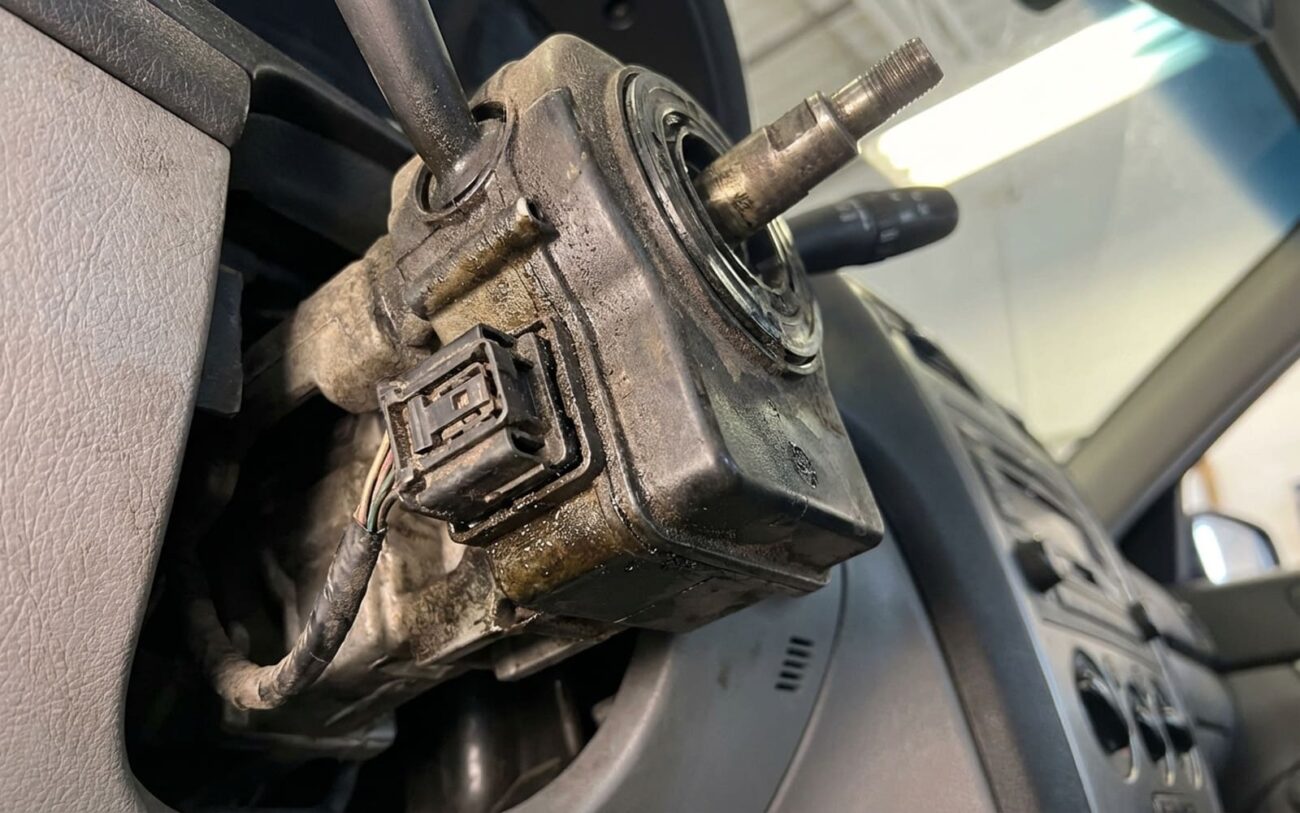
The Steering Angle Sensor: Why It’s More Than Just a Steering Part
After 25 years in the shop, I’ve seen a lot of parts come and go, but the steering angle sensor (SAS) remains one of the most critical, yet often misunderstood, components in modern vehicles. When I tell a customer they need a new one, the first thing I emphasize is this: it’s not just about steering, it’s a cornerstone of your car’s active safety systems.
What does it actually do? Simple. The SAS continuously monitors three key pieces of information: the exact position of your steering wheel, the direction you’re turning, and how fast you’re turning it. All this data gets sent, in real-time, to your car’s Electronic Stability Control (ESC) module. The ESC then uses this information to compare where you intend to go with where the car is actually headed.
Think of it like this: if you’re turning the wheel hard right, but the car’s sensors (like wheel speed sensors and yaw rate sensors) indicate the rear end is sliding left, the ESC knows there’s a problem. It then applies targeted braking to individual wheels to bring the car back in line. Without an accurate SAS signal, the ESC is essentially blind. It doesn’t know what you’re asking the car to do, so it can’t react properly. This is why a bad or miscalibrated SAS often disables not just ESC, but also traction control and sometimes even your anti-lock brakes (ABS).
Offset: 15.5°
The Concept
“It’s like having anti-lock brakes with no wheel speed sensors—technically present, but functionally blind.”
What I See: Common Symptoms of a Bad Steering Angle Sensor
You almost never feel the SAS fail directly. What you’ll notice are the warning lights on your dash. The most obvious sign is a persistent ESC, traction control, or ABS light. If I hook up a scan tool and pull a specific SAS-related diagnostic trouble code (DTC)—like a C0050 or C0051—and it comes right back after clearing, that tells me it’s a hard fault, not just a glitch.
Another big clue, and one I often spot during a road test, is a steering wheel that’s visibly off-center when the car is driving perfectly straight. The car’s computer thinks you’re turning when you’re not, which can cause the stability control to kick in unnecessarily. On vehicles with electric power steering (EPS), a corrupted SAS signal can even lead to a complete loss of power steering assist. I’ve seen it happen on some Ford F-150s and certain Subaru models, where the steering suddenly gets heavy as a brick.
Diagnosing a Faulty Steering Angle Sensor: My Approach
You can’t diagnose an SAS with a cheap code reader from the auto parts store; those generic OBD2 tools won’t cut it. You need a professional-grade scan tool that can access live data from the steering angle sensor. My first step is always to monitor the SAS reading in real-time while slowly turning the steering wheel from full left lock to full right lock. What I’m looking for is a smooth, consistent increase and decrease in the degree reading—it should look like a clean sine wave on the graph. Any sudden drops, flat spots, or erratic jumps in the data tell me the sensor itself is bad.
Key Diagnostic Checks:
- Persistent DTCs (C0050, U0125, etc.): If these codes return after clearing, it often points to an internal sensor failure—maybe a contaminated optical disc or a cracked Hall-effect chip. But don’t jump to conclusions. First, check for an open or shorted wire to the SAS, or corroded connectors. I’ve seen plenty of “bad sensors” turn out to be simple wiring issues.
- ESC Light + Off-Center Steering Wheel: This usually means the SAS has lost its “zero-point” calibration. It thinks the wheels are turned when they’re straight. This can happen after an alignment, or even after a battery disconnect if the proper reset procedure wasn’t followed. I’ll check the live data for a static degree offset when the wheels are physically straight. If it reads 10 degrees left when the wheels are pointed forward, that’s your problem.
- Erratic ESC Activation: If the stability control seems to kick in for no reason, especially during gentle turns, it could be a noisy or intermittent SAS signal. This is where graphing the live data during a full lock-to-lock sweep is crucial. Look for any momentary signal drops or spikes. Of course, this symptom can also be caused by a faulty wheel speed sensor or even severely uneven tire wear, so rule those out first.
- Power and Ground: Always verify your 5-volt reference and ground at the SAS connector. No power, no signal—simple as that.
Why Steering Angle Sensors Go Bad (And What’s More Common)
From my experience, actual SAS failures generally fall into two categories. First, you’ve got mechanical degradation. These sensors often use optical encoder disks or magnetized rings. Over time, heat, vibration, and even dust can contaminate the optical path or crack the magnetic ring, leading to an inconsistent signal. Second, there’s electronic failure. The internal microprocessors can just give up the ghost due to thermal cycling—heating up and cooling down repeatedly—or voltage spikes. I’ve seen voltage spikes from improper jump-starts fry these things more than once, so be careful how you boost a dead battery.
The most common “failure” isn’t a bad part:
It’s a lost calibration. This is huge. Disconnecting the battery, performing suspension work, or even a wheel alignment without properly resetting the sensor can wipe out its “zero” position. The sensor itself is perfectly fine; it just needs to be told where “straight ahead” is again. Always, and I mean always, ask the customer if any battery work or alignment has been done recently. It can save you a lot of diagnostic time and the customer a lot of money.
Replacing and Recalibrating: This is Not a DIY Job
Professional Territory Only
The steering angle sensor is almost always integrated into the clock spring assembly, which sits right behind your steering wheel. This means you’re working directly with live SRS (airbag) components. One wrong move, and you could accidentally deploy the airbag, causing serious injury or damaging the entire SRS circuit. This job demands strict safety protocols and specialized tools.
SRS Safety & Preparation Professional Only
Component Replacement Professional Only
Static & Dynamic Calibration Professional Only
Costs, Prevention, and My Final Word
Recalibration Only
This is for when the sensor is fine but lost its zero point, like after an alignment or battery swap. It’s a quick fix if diagnosed correctly.
SAS / Clock Spring Replacement
This covers the part and labor for most standard passenger vehicles where the SAS is part of the clock spring. Costs vary by vehicle and part availability.
Full EPS Rack Replacement
On some newer vehicles, especially those with electric power steering, the SAS is built into the steering rack itself. If it fails, you’re replacing the whole rack, which gets pricey fast.
To Prevent Recurrence
-
Always recalibrate the SAS after any alignment, battery replacement, or steering column work. This is non-negotiable.
-
Use a quality scan tool capable of SAS initialization. Don’t rely on simple drive cycles alone; they often aren’t enough for a full reset.
-
Follow proper jump-starting procedures. Those voltage spikes can absolutely fry sensitive electronics like the SAS.
-
If the ESC light comes on right after a battery swap, try a simple recalibration first. It’s often all it needs, saving you from replacing a perfectly good part.
Mechanic’s Advice
I’ve seen countless times where a misdiagnosed SAS issue leads to unnecessary repairs—like replacing expensive wheel speed sensors or even control modules—when all the car needed was a simple, $100 calibration. Do your homework, diagnose properly, replace carefully, and always, always recalibrate. It’s good for your customer, and it’s good for your reputation.
