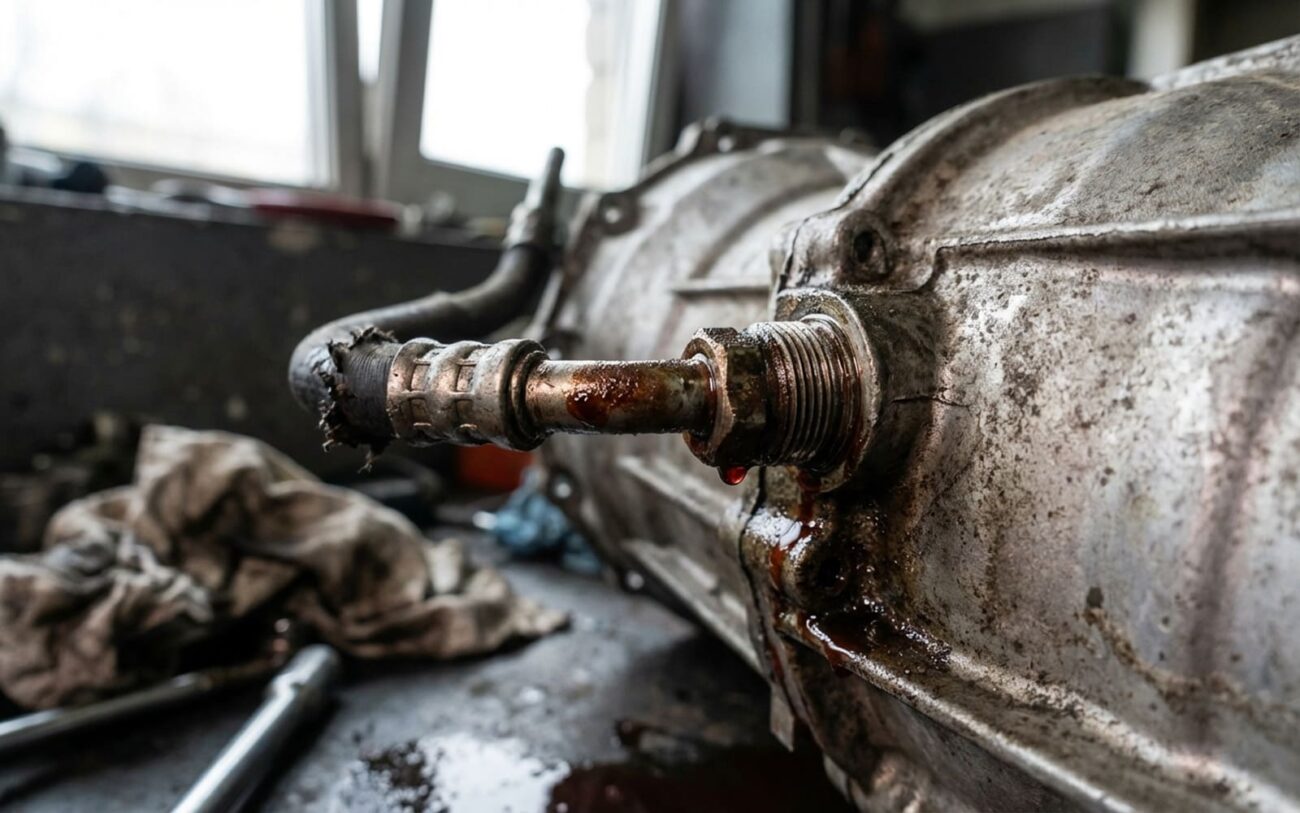
Alright, let’s talk about that dreaded hard shift when your automatic transmission is cold. If you’re feeling a sharp, jarring shift, especially that first 1-2 or 2-3 upshift of the day, and then it smooths out after a few minutes of driving, you’ve hit on a classic symptom. In my 25+ years turning wrenches, that temperature-dependent pattern is the absolute giveaway. It’s not just an annoyance; it’s your transmission telling you something’s not right inside, and ignoring it can cost you big.
What You’ll Feel (And What It Means)
The most common complaint I hear is a harsh, almost violent jolt when the transmission shifts from first to second, or sometimes second to third, right after a cold start. You might also notice a “flare” — that’s when the engine RPMs briefly spike before the gear finally engages — or a noticeable delay when you first put it into drive or reverse. The key here, and I can’t stress this enough, is that it almost always goes away once the engine and transmission warm up, usually after about 5 to 10 minutes of driving. That’s the critical diagnostic clue.
Now, don’t confuse this with a cold downshift clunk. I see that a lot too, but it’s usually a different beast. A downshift clunk, like when you’re slowing down and it bangs into a lower gear, often points to worn engine mounts, transmission mounts, or driveline components like U-joints or CV axles. Those parts stiffen up in the cold and can cause a thud when the load changes. The real tell for an internal transmission problem is that harsh upshift behavior under light to moderate acceleration when everything’s still cold.
Tech Tip: Think of it like this: when the fluid is cold, it’s thick, like molasses. The transmission’s internal parts, especially the delicate valve body, rely on fluid that’s at the right viscosity to move smoothly and precisely. If that fluid is too thick, or the parts are sticky, things don’t happen as they should until everything heats up and loosens.
The Real Culprits: What’s Happening Inside
When I see a vehicle with cold hard shifting, I know we’re almost always looking at one of a few common issues. These are the internal problems that cause those symptoms:
Degraded or Wrong Transmission Fluid
Internal Filter or Screen Blockage
Valve Body “Stiction”
Faulty Pressure Control Solenoids
Important Boundary:
Just a quick note: while a failing torque converter clutch (TCC) can cause a shudder, it usually doesn’t completely resolve once warm. If you’re dealing with known torque converter problems, especially in some Nissan models with the Jatco RE5R05A, that’s a different rabbit hole. You can find more on that here: Common Torque Converter Failures in Nissan Models.
How I Pin It Down: Diagnosis
Before you even think about dropping the pan, you’ve got to rule out other possibilities. I’ve seen too many people jump to conclusions, only to find out it was an engine issue or a simple sensor. Here’s my diagnostic approach:
| Symptom | Likely Transmission Hydraulic Cause | Common External Mimics | Definitive Test I Use |
|---|---|---|---|
| Harsh cold upshifts (1-2, 2-3) | High fluid viscosity, varnish buildup in valve body, sticking spool valves, or restricted filter | Faulty Transmission Fluid Temperature (TFT) sensor or TCM programming glitch |
First thing I do: Hook up the scan tool. Compare the TFT reading to ambient temperature and engine coolant temp at a cold start. If the TFT is way off, that’s your first suspect. |
| Delayed engagement or shift flare when cold | Worn pump, internal leakage in clutch circuits, or slow pressure buildup due to thick fluid | Low idle speed, engine misfire, or vacuum leak affecting torque delivery |
I monitor engine RPM and load through the OBD2 scan tool during the shift events. If the engine is struggling or misfiring, it can certainly feel like a transmission problem. |
| Clunk on cold downshift (e.g., 3-2 when slowing) | Excessive clearance in clutch packs or reaction members, worsened by sluggish fluid flow | Worn engine mounts, transmission mounts, or driveline joints (U-joints, CV axles) |
I’ll put the vehicle on a lift and perform a “torque test.” With the brakes held, gently accelerate in gear. Look for excessive movement in the engine/transmission mounts or play in the driveline. |
And always, always pull OBD2 codes. Even if that check engine light isn’t on, there might be pending or historical codes. Codes like P0700 (transmission control system malfunction) or P0730 (incorrect gear ratio) are direct indicators that the Transmission Control Module (TCM) is seeing shift errors. For more on decoding these, check out: P0700/P0730 Transmission Codes: Sensor Issue or Mechanical Failure?
My Repair Strategy: Start Simple, Work Up
Don’t Throw Parts at It
Your fix depends entirely on what we find. Jumping straight to a valve body replacement or a full overhaul without proper diagnosis is a surefire way to waste thousands of dollars. I always start with the simplest, least invasive, and cheapest options first.
Fluid and Filter Change DIY Feasible
Valve Body Service Professional Only
Transmission Overhaul Professional Only
Keeping It Healthy: Validation and Prevention
My Maintenance Checklist
-
Always follow the severe service fluid change interval, not the “normal” one. That’s typically every 30,000 to 50,000 miles. Ignore any “lifetime fluid” claims—they’re just not true in the real world.
-
Only use the manufacturer-recommended ATF. Dexron VI, Mercon LV, Toyota WS—they are not interchangeable. Using the wrong fluid is a death sentence for your transmission.
-
Check your fluid condition regularly. It should be a clear red, not dark brown or black, and it should never, ever smell burnt. If it does, you’ve got problems.
-
For CVTs, fluid quality is even more critical. If you have one, don’t skimp. See: CVT Fluid Change Intervals Guide.
Pro Tip: Validating the Fix
After any fluid service, you need to drive the vehicle cold a few times. The harsh shifts should be gone within the first 3 minutes of driving. If they persist, the problem is deeper than just the fluid. I’ll always use a scan tool to monitor line pressure commands—cold idle pressure should be within 10% of the manufacturer’s spec.
Costs and When to Walk Away
Here’s a rough idea of what you’re looking at, in my experience:
Fluid & Filter
This is for a professional fluid exchange and filter replacement. It has a high success rate for early symptoms, especially if the fluid is just old.
Valve Body Service
This includes cleaning and replacing solenoids. It’s got a moderate to high success rate if we’re dealing with “stiction” or a faulty solenoid.
Full Overhaul
This is a complete rebuild. If this cost starts to exceed 50% of your vehicle’s current market value, I’ll be honest with you: it’s time to seriously consider replacing the vehicle instead.
