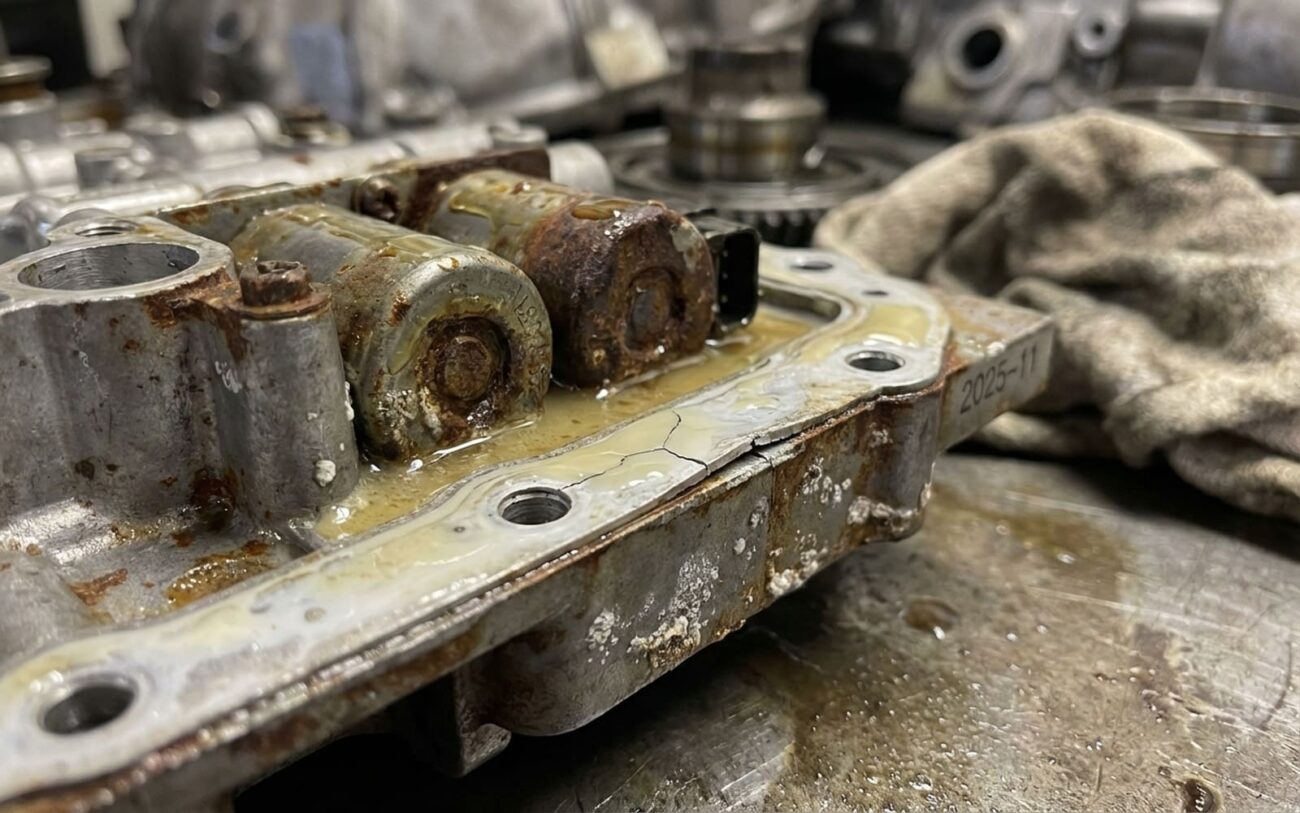
Cold Transmission Acting Up? It’s Probably Moisture.
Alright, let’s talk about those mornings when your automatic transmission just doesn’t want to cooperate, especially when it’s freezing outside. You know the drill: clunky shifts, hesitation, maybe even no movement at all, but then everything smooths out once the car warms up. If that sounds familiar, you’re almost certainly dealing with moisture in the valve body. I’ve seen this countless times over my 25+ years in the shop, particularly on older vehicles or anything that sits outdoors in humid or snowy climates. It’s a classic pattern once you know what to look for.
What’s Really Happening Inside
Here’s the science, plain and simple: Automatic Transmission Fluid (ATF) isn’t just oil; it’s designed to absorb a bit of moisture over time. That’s called being hygroscopic. The problem starts when temperatures drop, especially below freezing. That absorbed water, which usually just floats around harmlessly, turns into microscopic ice crystals. These tiny ice shards are the real troublemakers. They get lodged in the valve body’s super-tight clearances – we’re talking about precision-machined bores, tiny orifices, and spool valve passages. When those passages are blocked, hydraulic flow gets messed up. Since the valve body is the brain of your transmission, controlling all the shift timing and pressures, any restriction there means big trouble for performance.
Once the transmission gets up to operating temperature, that ice melts, the passages clear, and boom – your symptoms vanish. It’s like magic, but it’s just basic physics. And it’ll keep happening every cold snap until you address the root cause.
Symptoms I See in the Bay
Most commonly, you’ll feel erratic, harsh, or delayed shifts right after a cold start. Sometimes it’s a real jolt or a clunk when it finally engages a gear. Other times, it just hangs between shifts, like it can’t make up its mind. That’s usually the ice messing with the smaller shift valve circuits.
A more serious scenario, and one that’ll really get your attention, is a complete loss of drive or reverse when it’s cold. You start the engine, put it in gear, and nothing happens – or maybe just a little bit of movement with severe slippage. This isn’t just a rough shift; this means you’ve got a total or near-total loss of hydraulic pressure. In my experience, this usually points to ice completely blocking a critical passage, like the main line pressure circuit within the valve body itself. Without that line pressure, your clutches can’t engage, and the transmission is effectively dead until it warms up and the ice melts. Sure, a bad pump or a clogged filter can cause low pressure, but if it only happens when it’s cold and then fixes itself, that’s a huge red flag for internal moisture.
Don’t ignore the Check Engine Light, either. If you’re seeing intermittent OBD2 transmission codes, especially in the P0750 to P0770 range (those are usually shift solenoid performance or electrical faults), and they only pop up in cold weather, you’ve likely got corrosion brewing. Moisture trapped in the valve body doesn’t just freeze; it also promotes electrolytic corrosion on the electrical connectors and the solenoid coils themselves. Over time, this eats away at the copper pins and solder joints, leading to those frustrating intermittent electrical failures. Again, a bad wiring harness or a failing Transmission Control Module (TCM) can mimic these codes, but the cold-weather pattern is the key differentiator here.
Tech Tip: I’ve seen this issue frequently on Aisin AW55-50SN and ZF 5HP/6HP series transmissions, especially in vehicles like older Volvos, Saabs, BMWs, and some Ford/GM models that use these units. Their tight tolerances make them particularly susceptible to moisture-related issues.
Ignoring This Problem Will Cost You Big
This isn’t just an annoyance; it’s a ticking time bomb for your transmission. If ice is blocking lubrication passages, critical components like planetary gear bearings and clutch pack steels aren’t getting the oil they need. That leads to rapid wear, scoring, and eventually, catastrophic mechanical failure. Even worse, if a spool valve is frozen solid and you try to force the transmission to engage, you risk shearing that valve stem right off. That sends metal debris throughout the entire hydraulic system – contaminating the pump, solenoids, and cooler lines. At that point, a simple valve body replacement won’t cut it. You’re looking at a full transmission rebuild or even a complete replacement. I’ve personally seen a $600 valve body repair turn into a $3,500 nightmare because a customer ignored the cold-weather symptoms for too long. Trust me, it’s not worth the risk.
My Approach to Diagnosis: Confirming the Valve Body
Okay, so you’ve got cold-weather transmission problems. The valve body is a prime suspect, but you can’t just throw parts at it. You’ve got to rule out other things that can act up when it’s cold. My goal is always to pinpoint the exact cause without unnecessary teardowns. Here’s how I break it down, symptom by symptom.
For instance, a bad transmission fluid temperature (TFT) sensor can trick the TCM into thinking the fluid is colder than it is, causing delayed shifts or early torque converter lockup. Those symptoms look a lot like hydraulic issues, right? Or maybe a worn torque converter clutch (TCC) solenoid causing shudder. The key difference I look for is how dramatically the problem resolves once the transmission warms up. With moisture in the valve body, the improvement is usually immediate and complete. With a failing sensor or solenoid, the symptoms might lessen, but they rarely vanish entirely and predictably.
Same goes for a clogged transmission filter or a failing pump. They’ll cause low line pressure, sure, but they don’t usually “fix themselves” after 15 minutes of driving just because the fluid warmed up. If you’ve got zero movement when cold, but pressure magically returns as it warms, that’s almost certainly ice melting in a passage, not a pump that suddenly decided to start working again.
This table below is pretty much my quick-reference guide in the shop. It helps me match what I’m seeing with the most likely cause and, more importantly, tells me the definitive test to confirm it.
| Symptom I See | Likely Valve Body Issue (Moisture) | Common Mimics | My Definitive Test |
|---|---|---|---|
| Erratic or harsh shifts, only when cold | Ice restricting fluid flow in valve body bores or shift orifices. | Faulty TFT sensor, worn TCC solenoid, low fluid level. |
First thing I do is hook up my scan tool and monitor the Transmission Fluid Temperature (TFT) PID right at cold start. Compare that reading to the ambient air temperature and the engine coolant temp. If the TFT reading is spot on with ambient (say, 20°F on a 20°F morning) but you’re still getting rough shifts, then your sensor is likely fine. That points straight to hydraulic restriction in the valve body. Now, if the TFT reads something crazy like -40°C or it’s stuck at 300°F, then you’ve found your culprit: a bad sensor or wiring. |
| No forward or reverse movement when cold; improves with heat | Ice completely blocking the main line pressure circuit or another critical feed passage in the valve body. | Failed transmission pump, severely clogged filter, critically low fluid level. |
This calls for a transmission pressure gauge. I connect it to the main line pressure test port and start the engine cold. If the pressure is zero, or less than 50% of what the manufacturer specifies, then you’ve got a major blockage. That blockage is most likely in the pump intake, the valve body itself, or the pressure regulator circuit. If you get normal pressure but still no movement, then you’re looking at an internal clutch or servo failure – that’s not a moisture issue in the valve body. |
| Intermittent shift solenoid codes (e.g., P0753, P0776) only in cold weather | Corrosion on solenoid electrical connectors or coil windings, caused by trapped moisture. | Damaged wiring harness, failing TCM, defective solenoid (but not cold-dependent). |
I grab my multimeter and perform a resistance and continuity check on the solenoid circuits, specifically when the transmission is cold. If the resistance is out of spec, or if it fluctuates when I gently tap on the valve body (which can dislodge corrosion), then corrosion is almost certainly the culprit. I also visually inspect the valve body connector bores for any signs of white or green corrosion. If the external harness and the TCM test out fine, then the fault is definitely internal. |
| Transmission shudder or delayed engagement when cold | Sticking TCC or shift solenoid due to ice in its bore. | Worn torque converter, failing TCC solenoid (not cold-dependent), contaminated fluid (from coolant leak). |
Again, the scan tool is your friend here. Monitor the TCC apply timing. If the TCC engagement is erratic or noticeably delayed only when cold, and it directly correlates with the shudder, but then smooths out perfectly after warm-up, I’m leaning towards ice in a solenoid bore. Also, take a good look at the fluid itself. If it’s cloudy or has a slightly milky appearance, that’s a strong indicator of moisture. Just be careful not to confuse this with “milkshake” fluid, which is a mix of coolant and oil – that’s usually from a radiator leak, not just general moisture absorption. |
One final word of advice, and I’ve learned this the hard way: don’t rely solely on how the fluid looks. Yes, “milky” or “milkshake” fluid is a dead giveaway for coolant contamination, but moisture from condensation often doesn’t visibly change the fluid’s appearance until it’s really severe. ATF can actually hold a surprising amount of dissolved water before it starts to look “off.” That’s why those cold-condition tests are absolutely critical – they tell you what’s happening when the problem is actually present.
And just to be clear, we’re talking about conventional hydraulically controlled automatics here. This isn’t the same beast as a CVT slipping under load or a DCT shuddering at startup. Those are different animals with different problems. This issue is specific to the older-style automatics, particularly those with aluminum valve bodies where tight tolerances make them vulnerable to ice and corrosion.
