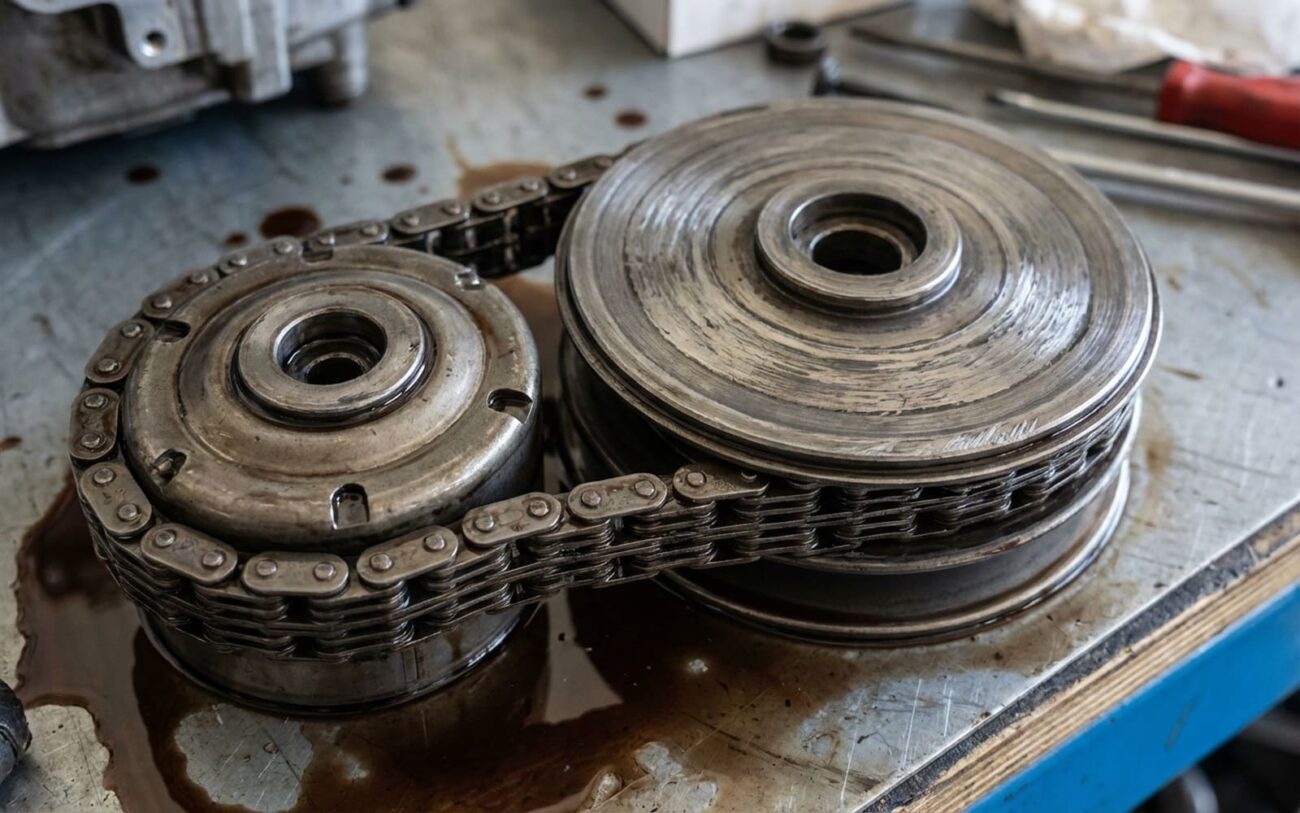
Alright, let’s talk CVTs. If you’ve got one in your driveway, you know they’re a different animal. No traditional shifts, just that smooth, steady climb in RPM as the car picks up speed. That seamless feel? That’s the sound of a healthy Continuously Variable Transmission doing its job. But when that smoothness goes away, when you feel a shudder, a hesitation, or the engine just revs without much going on – you’re not imagining things. Your transmission is talking to you, and usually, it’s screaming about the fluid.
I’ve been wrenching on cars for over 25 years, and I’ve cracked open more than my share of failed CVTs. The story is almost always the same: neglected or degraded fluid. This isn’t just oil; it’s the lifeblood of the transmission. It’s a lubricant, a coolant, a hydraulic medium, and a friction controller all rolled into one. When it breaks down, every single one of those critical functions suffers, and the transmission starts eating itself from the inside out.
How to Spot Trouble: What Your CVT is Really Telling You
The first thing I check, if the car even has a dipstick these days (and fewer do), is the fluid itself. Good CVT fluid should be bright red, sometimes green or blue depending on the manufacturer’s specific blend. It should smell clean, like a refined oil, maybe a little sweet. If you pull that dipstick and the fluid is dark brown or black, and it carries that unmistakable burnt odor – that’s a huge red flag. That smell isn’t just old oil; it’s the base stock and additives that have been cooked by excessive heat and shear stress. Inside the transmission, you’ve got microscopic metal particles from worn clutch packs and pulleys suspended in that fluid, accelerating wear with every revolution. It’s like sandpaper circulating through your transmission.
Out on the road, the symptoms are just as telling. You might describe it as a “rubber band” sensation. You press the gas, the engine revs, and just as power should build, the car hesitates or surges. The engine RPM flares up, then drops, only to repeat the cycle. This isn’t a misfire; this is the steel push belt slipping on the pulleys because the fluid can no longer maintain the precise friction needed to transfer torque. Those friction modifiers, critical for CVT operation, are gone.
Another common sign I see is delayed engagement. You shift from Park to Drive or Reverse, and for a second or two, nothing happens. Then you feel a definite clunk as the transmission finally grabs. Or worse: you hit the gas, the engine screams, but the car barely moves. That’s what we call a “flare,” and it almost always points to low hydraulic pressure. That pressure drop usually comes from varnish-coated valves in the valve body or a pump struggling to move thick, oxidized fluid.
Is It the Fluid, or Just a Mimic?
It’s easy to jump to conclusions and blame bad fluid when a CVT acts up, but you’ve got to rule out other possibilities. A shudder might come from a failing wheel bearing or a warped brake rotor, not the transmission. A delayed shift could be a faulty transmission range sensor. The key is knowing how to tell the difference, and that often comes down to careful diagnosis.
| Symptom | Likely Cause (CVT Fluid Related) | Common Mimics | How I Confirm It |
|---|---|---|---|
| Dark, burnt-smelling fluid | Oxidation and internal wear due to overheating or age. | Coolant contamination from a radiator cooler leak. |
I’ll use coolant test strips on the fluid. Then I’ll pressure test the cooling system to check for internal leaks. |
| Shudder/judder during light acceleration | Loss of friction control from degraded fluid affecting belt-to-pulley grip. | Failing torque converter clutch, wheel bearing noise, driveline vibration. |
I’ll monitor pulley speed sensors via a scan tool during the shudder. Also, I’ll inspect any drained fluid for metallic debris. |
| Delayed engagement or flaring | Varnish buildup in the valve body or low fluid pressure from degraded oil. | Faulty line pressure solenoid, internal pump wear, low fluid level. |
I’ll command line pressure via a scan tool and use a mechanical gauge to verify actual pressure. If pressure is still low with fresh fluid, I’m looking at hardware failure. |
The big difference I’ve seen over the years? Fluid-related issues are systemic. They mess with shift quality, pressure regulation, and cooling across the board. A bad solenoid or sensor, on the other hand, usually causes a single, repeatable fault. If I drain the fluid and it’s black and full of metal, and then the symptoms vanish after a proper fluid exchange, well, I’ve found the root cause.
The “Lifetime Fluid” Myth: Why CVT Fluid Doesn’t Last
Manufacturers love to label CVT fluid as “lifetime fill.” But let’s be real: that “lifetime” often means the end of the factory warranty, not the life of your vehicle. The operating environment inside a CVT is brutal. Unlike a traditional automatic with gears, a CVT uses a steel push belt or chain constantly squeezed between two variable pulleys. This creates extreme shear forces that absolutely shred the long-chain molecules in the fluid over time.
That process, called shear degradation, is unavoidable. Add in the heat from stop-and-go traffic, towing, or just spirited driving, and you’ve got a recipe for accelerated oxidation. As the fluid breaks down, the critical additives that control friction, prevent wear, and resist oxidation get depleted. Once they’re gone, you get metal-on-metal contact, and tiny wear particles start circulating. I’ve seen transmissions come in where the fluid looks like metallic paint.
Those particles act like sandpaper, grinding away at the pulleys and clutch packs. Worse, the oxidized fluid turns into a sticky varnish that coats the valve body. Spool valves and solenoid orifices become sluggish or even stuck, leading to those delayed shifts, flares, and poor pressure control we talked about. This isn’t a failure of the cooling system; it’s the transmission doing its job so effectively that it destroys its own lubricant.
And yes, the manufacturers know this. While they might not advertise it, many have quietly updated their maintenance schedules. For example, some Nissan models with known shudder issues – like certain Altima and Pathfinder variants – had official service guidance recommending CVT fluid changes every 30,000 miles under severe conditions. That’s a pretty clear admission that “lifetime” fluid doesn’t actually last a lifetime.
Your Next Move: What to Do Based on Your Symptoms
Your next step really depends on how far the damage has progressed. There’s a big difference between preventative service and trying to save a dying transmission.
Technical Precision Required
Modern CVTs are incredibly sensitive to fluid type, level, and temperature. Using the wrong fluid or an incorrect filling procedure can lead to immediate aeration or pressure failure. I’ve seen it happen. Always, always follow OEM specifications to the letter.
Preventative Drain & Fill DIY-FEASIBLE
Full Fluid Exchange Professional Only
Additives & Pan Service Last Resort
Transmission Replacement
How I Confirm the Repair Worked
After any CVT fluid service, you can’t just drive off and assume it’s fixed. You need to verify the results thoroughly. This is where a good technician earns their keep.
For a preventative drain and fill, the test is straightforward. After a few drive cycles, shifting from Park to Drive should be immediate and smooth. During a test drive, acceleration should feel linear and uninterrupted, just like it did when the car was new. And critically, you must confirm the fluid level is correct using the manufacturer’s temperature-based procedure. An overfilled transmission can aerate the fluid and cause issues; underfilled means poor pressure and accelerated wear.
If I’m addressing a known shudder with a full fluid exchange, the test gets more specific. I need to recreate the exact driving condition that caused the problem – say, a steady 25–40 mph uphill acceleration. That’s when the belt load is highest, and any friction deficiency will show up. The shudder should be completely gone. A professional shop will often use a bi-directional scan tool to monitor data in real time, watching the primary and secondary pulley speed sensors. If the ratio changes smoothly and follows the Transmission Control Module’s (TCM) commands without erratic jumps, then I know we’ve got a good repair.
CVT Fluid Change Cost vs. Long-Term Value
Let’s talk real numbers, because the cost of maintenance is always, always cheaper than the cost of failure. Here’s how the options stack up in my experience:
| Service Type | DIY Cost (Parts Only) | Shop Cost (Estimated) | Success Rate | Risk of Failure |
|---|---|---|---|---|
| Preventative Drain & Fill | $60–$120 | $150–$300 | 99% | Low. Main risks: wrong fluid or incorrect level. |
| Corrective Fluid Exchange | N/A | $300–$500 | 70–85% | Medium. Depends heavily on existing internal wear. |
| Shudder Additive | $20–$30 | $50–$100 | 30–50% | High. Often temporary relief only; may complicate future repairs. |
| Transmission Replacement | N/A | $4,000–$8,000+ | 100% (of a working transmission) | Financial. Significant cost and downtime. |
Here’s a rule I share with my customers: if a corrective fluid exchange costs more than 25% of your car’s current market value, and the symptoms return, it’s likely time to consider replacement. On the flip side, spending 3–5% of your car’s value on a proper fluid exchange every 30,000 to 40,000 miles is one of the smartest investments you can make in a CVT. It’s not an expense; it’s insurance against a much bigger bill down the road.
My Advice: How to Prevent CVT Fluid Problems
The best repair is always the one you never need. For a CVT, that means treating the fluid with the respect it deserves.
Maintenance Best Practices
-
Always use the manufacturer-specified fluid. No exceptions. Universal fluids often lack the precise shear stability and friction characteristics your transmission was engineered for. Don’t cheap out here.
-
Check the fluid regularly. If your car has a dipstick, inspect it every 10,000 to 15,000 miles for color, smell, and any signs of debris. Even if it doesn’t have a dipstick, stay alert to any changes in driving behavior.
-
Forget “lifetime” intervals. I recommend a CVT fluid exchange every 30,000 to 60,000 miles. If you tow, drive in heavy city traffic, or live in a hot climate, stick closer to that 30,000-mile mark. It’s cheap insurance.
-
Address symptoms early. The moment you feel a hesitation, a shudder, or any unusual behavior, get it checked. Don’t wait for hardware damage to occur; by then, it’s often too late.
Whether you drive a Nissan with a Jatco CVT, a Subaru with a Lineartronic, or a Honda with their belt-driven system, one rule applies: fresh, correct fluid is the absolute key to long-term reliability. Look, CVTs are often misunderstood, but they’re not inherently unreliable. They’re just different. Treat the fluid right, and your transmission will run smoothly for years. Ignore it, and you’ll pay the price – a much bigger one than a fluid change.
