That DPF Light: Your Diesel’s Last Warning Before Things Get Ugly
When that orange diesel particulate filter (DPF) warning light pops up on your dash—you know, the one that looks like a little brick or a muffler with dots—it’s not just a friendly reminder. In my 25 years turning wrenches, I’ve learned it’s the Engine Control Module (ECM) screaming for help. It means the DPF system has caught a fault. The computer has been watching all the data from exhaust temperature sensors, pressure differential sensors, and regeneration cycles, and something’s gone outside the lines.
I’ve seen too many drivers ignore this light, hoping a long highway drive will clear it. But honestly, that rarely works once the light is solid. And delaying action almost always turns a manageable problem into a really expensive one. Trust me, I’ve seen the aftermath.
What Your Truck Is Trying to Tell You
Besides the light itself, you might notice other things going on. The most common symptom I see is reduced engine power, what we call “limp mode.” This isn’t random; the ECM is actively cutting power to protect the engine and the exhaust system from further damage. You might also start seeing more black smoke out the tailpipe, especially if the truck’s been trying and failing to regenerate. And if you catch a pungent, almost sulfur-like smell at idle or after you shut it down? That’s often a sign that an active regeneration is running—or, more concerningly, it’s trying to run and failing.
These clues definitely point towards DPF issues, but here’s the kicker: they can also mimic problems with the turbo, injectors, or EGR system. That’s why we always diagnose before we start tearing things apart.
| Symptom I See | What It Usually Means for the DPF | But It Could Also Be… |
|---|---|---|
| Reduced Power / Limp Mode | A severely clogged DPF, forcing the ECM to protect the engine. | A failing turbocharger, an EGR valve stuck open, or another restriction further down the exhaust. |
| Excessive Black Smoke | Failed active regenerations, leading to over-fueling and a buildup of soot. | Leaking fuel injectors, boost leaks from the turbo system, or a faulty fuel pressure regulator. |
| Hot, Sulfury Smell at Idle | An active regeneration cycle is in progress (normal, but pay attention if it’s frequent). | An exhaust manifold leak, an up-pipe leak, or a catalytic converter that’s breaking down. |
| High Backpressure Reading (on a scan tool) | A strong indicator of a physical DPF restriction. | A faulty differential pressure sensor, blocked or kinked sensor hoses, or the ECM misreading data. |
My Approach: Is It the DPF, or Something Else Hiding?
The first step in my shop is never to replace the DPF. It’s to confirm, without a shadow of a doubt, that the DPF is the actual problem. I’ve pulled out too many “failed” DPFs only to find the real culprit was a faulty sensor, a bad exhaust temperature reading, or some other upstream issue. You need hard data to make these calls, not just a guess.
Here’s how I go about figuring it out:
| What the Scan Tool Shows | Why It Points to the DPF | Common Things That Mimic It | How I Confirm It |
|---|---|---|---|
| High Differential Pressure (Delta P) | The DPF is physically clogged with soot or ash, restricting exhaust flow. | A faulty Delta P sensor, clogged or kinked pressure hoses, or even water in the lines. | I perform a mechanical backpressure test. We install a gauge directly into the exhaust pipe before the DPF. If the scan tool shows high pressure but the mechanical gauge reads normal, then it’s a sensor or hose issue, not the DPF itself. |
| Failed Regeneration Cycles | The DPF is ash-saturated, or the ceramic substrate inside is damaged. | A thermostat stuck open (engine never gets hot enough), faulty exhaust temperature sensors, poor driving habits, or even low-quality fuel. | I use a professional-grade scan tool to read the calculated ash load. Ash can’t be burned off, period. Once it fills the filter’s microscopic pores (typically above 40–50 grams per liter), replacement is the only reliable fix. |
| DPF Efficiency Code (e.g., P2002, P2463) | Often means the DPF’s ceramic substrate is cracked or melted, or the catalyst coating has failed. | An exhaust leak upstream of the DPF, a faulty downstream NOx or oxygen sensor, or wiring problems. | First, I smoke test the entire exhaust system from the turbo outlet to the DPF inlet. If there are no leaks, I use a borescope to visually inspect the DPF’s internal structure for any cracks, melted channels, or signs of physical damage. |
What Actually Fails Inside the DPF
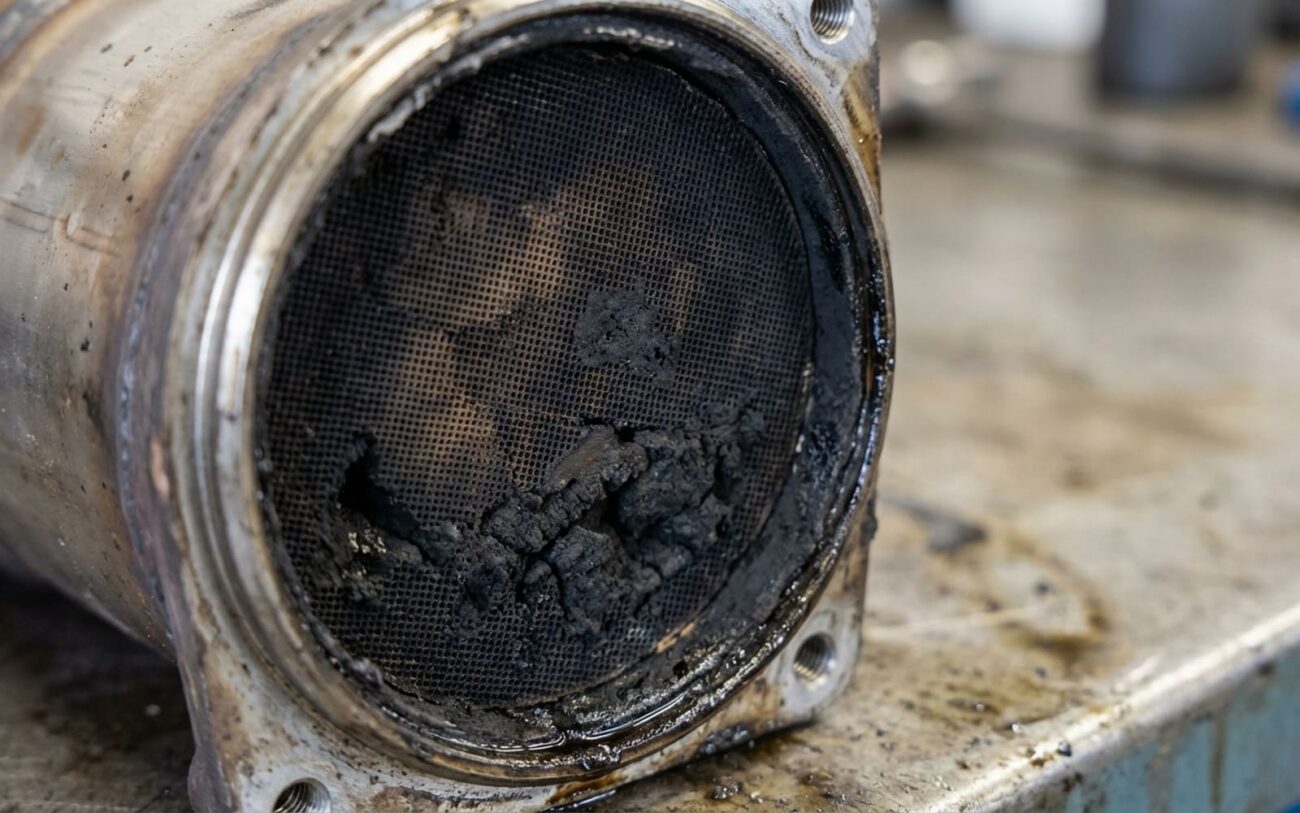
Once diagnostics confirm the DPF is indeed the problem, we can usually pinpoint what went wrong internally. The most common thing I see is thermal damage. The ceramic monolith inside is pretty fragile and can crack from sudden temperature changes—like driving through a deep puddle during an active regeneration cycle. Even worse, if an injector is leaking fuel into the exhaust, that raw fuel can ignite inside the DPF and send temperatures soaring past 1,200°C (2,200°F). That kind of heat will melt the ceramic into a solid, impenetrable mass, completely blocking the exhaust.
Mechanical damage is another possibility. Bottoming out the vehicle, hitting road debris, or even just a hard impact can crack the stainless steel housing or damage the mounting brackets. While the external housing can sometimes be repaired, any internal compromise usually means the entire unit is compromised.
Then there’s chemical degradation. The DPF’s precious metal catalyst coating can get poisoned. For instance, if coolant leaks into the combustion chamber—maybe from a cracked block or a blown head gasket—it can deposit silicone that effectively kills the catalyst. Similarly, excessive engine oil consumption leaves behind phosphorus and zinc, which coat the filter and prevent proper regeneration from happening.
But honestly, the most common failure I see? Simple ash saturation.
This isn’t really a defect; it’s just wear and tear. Every time your engine burns a tiny bit of oil, ash accumulates in the DPF’s microscopic channels. Unlike soot, ash can’t be burned off. Over time, it just fills the filter until exhaust flow is severely restricted. A bad injector, a clogged EGR valve, or chronic short-trip driving all contribute to this. If you replace the DPF without fixing those underlying issues, you’ll be right back in my shop in a year or less.
Your Real-World Fix Options: From Cleaning to Replacement
Once we’ve confirmed the DPF is the problem, here are the options I typically present to customers:
Professional Cleaning
External Housing Repair
Full Unit Replacement
How I Know the Repair Actually Worked
Just clearing a code and handing back the keys isn’t enough in my book. You need proof the system is actually functioning correctly. After a DPF cleaning or replacement, here’s my process:
First, we clear all the fault codes. Then, we initiate a controlled active regeneration cycle. A successful repair meets specific criteria: the differential pressure reading at 2,500 RPM should drop significantly, usually below 25 hPa (check your specific vehicle’s service manual for exact specs). The ash load value in the ECM (if it’s adjustable for that vehicle) needs to be reset to its baseline. And, most importantly, no DPF-related codes should return after the system completes its self-checks and a test drive. This all requires an OEM-level scan tool capable of full module communication and bi-directional controls.
For a weld repair, validation is a bit simpler but no less important. We perform a smoke test on the reinstalled DPF, applying about 1 psi of pressurized smoke to the inlet. Any visible leak at the weld or housing flange means the repair failed. Even a small leak upstream of the oxygen or NOx sensors can cause false readings and trigger new DPF or emissions codes, sending you right back to square one.
The Cold, Hard Math of Fixing It
Let’s be realistic about cost. DPF repairs are rarely cheap, and your decision should always factor in both the repair cost and the current value of your vehicle.
| Repair Type | DIY Cost (Parts Only) | Professional Shop Cost | Typical Success Rate | Biggest Risk if it Fails |
|---|---|---|---|---|
| Professional Cleaning | N/A (not a DIY job) | $500 – $800 | 85% | Rapid re-clogging if the original root causes (like bad injectors) aren’t corrected. |
| DPF Replacement (OEM) | $1,500 – $3,500 | $2,500 – $5,000+ | 100% (if root cause fixed) | The new unit fails prematurely if underlying engine issues (like oil burning) persist. |
Here’s how I advise my customers: if the total repair cost starts to approach or exceed 50% of your vehicle’s current wholesale value—especially if it’s got high mileage—it’s time to consider the long-term outlook. Is the engine burning oil? Are the injectors getting old and tired? Pouring thousands into a DPF on an engine that’s already on its last legs often means you’ll just be chasing one problem after another. Sometimes, it’s better to cut your losses.
Keeping That Light Off For Good
My Prevention Strategy
-
Always, always use the factory-specified low-ash engine oil (ACEA C3 or API CK-4). Using the wrong oil is a death sentence for a DPF. And remember, a cracked head or worn piston rings that lead to oil burning will destroy a DPF faster than anything.
-
Understand how regeneration works. If you notice higher idle RPMs or that distinct burning smell, it means the truck is trying to clean itself. Don’t shut it off! Take a 15–20 minute highway drive to give the process a chance to complete.
-
Avoid chronic short trips. Diesels need to get hot. Short trips prevent passive regeneration and lead to rapid soot buildup, which is a DPF’s worst enemy.
A Proactive Owner’s Best Friend
A capable OBD2 scanner that can read live DPF data—things like soot load, regeneration status, and ash level—is worth its weight in gold for a diesel owner. Checking these values at every oil change lets you spot rising soot levels long before that warning light ever comes on. Catching it early means a good long drive might resolve it, saving you a trip to the shop. It’s a small investment that can save you from a costly forced regeneration or an early DPF replacement down the road.
