EGR Port Cleaning: The Real-World Scoop from My Shop
Alright, let’s get straight to it: “Clean EGR ports” isn’t on any manufacturer’s maintenance schedule. It’s not like changing your oil or rotating your tires. This is a wear-and-tear issue, pure and simple, and it sneaks up on you over time. Most folks don’t even think about it until the check engine light pops on or the engine starts acting funny.
But here’s the deal: if you drive your car daily, especially if you’re stuck in a lot of stop-and-go traffic or only make short trips, you’re basically setting the stage for carbon buildup. In my 25+ years turning wrenches, I’ve seen that there’s no fixed interval for cleaning these things. It depends on a bunch of factors: what kind of engine you’ve got, the quality of fuel you’re running, your driving habits, and honestly, whether your specific model has a known design flaw in the EGR system. Some engines will need it by 75,000 miles; others might roll past 150,000 without a whisper of a problem. The trick is knowing what to look for and jumping on it before you’re dealing with poor performance or, worse, secondary damage.
Why Do These Ports Get Clogged Anyway? It’s Just Physics.
It’s not a design failure, not really. It’s just how the system works. The EGR (Exhaust Gas Recirculation) system is there to route a small amount of exhaust gas back into the intake manifold. This cools down the combustion temperatures, which in turn cuts down on harmful NOx emissions. Good for the environment, right?
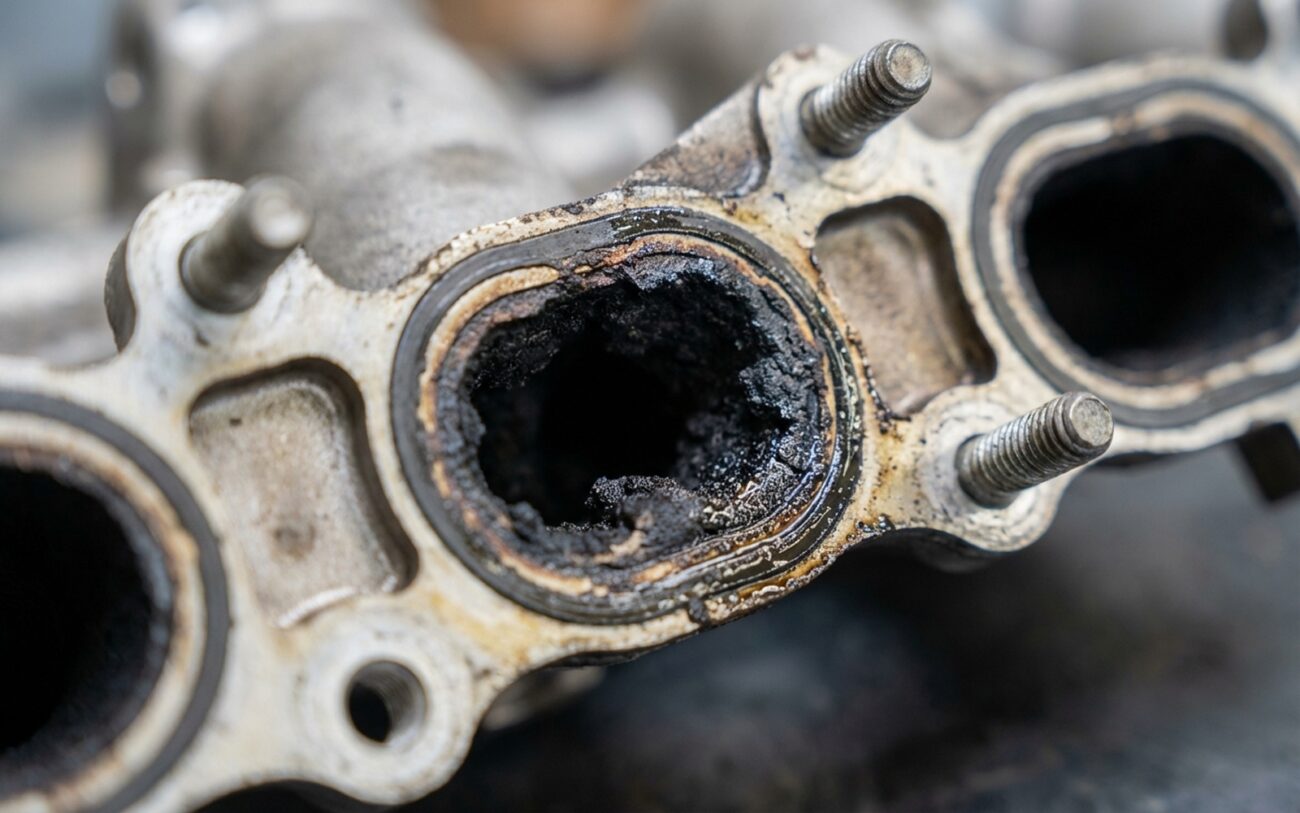
The problem is, exhaust gas isn’t clean air. It’s full of carbon, soot, and unburned hydrocarbons. Now, mix that with the oil vapor that gets pulled in from the PCV (Positive Crankcase Ventilation) system, and what do you get? A nasty, tar-like sludge that bakes and hardens in those EGR passages over time. It’s like plaque building up in an artery – slow, steady, and eventually, it chokes things off.
The Concept
“Think of it like plaque in an artery: gradual, predictable, and preventable to some degree. Eventually, flow gets restricted.”
Short trips, cold weather, and a lot of idling really make it worse. The engine never gets hot enough to burn off those deposits, so they just keep accumulating. And if your engine is burning a little oil or you’re using crummy fuel, that just speeds up the whole process. Some engines are just built to clog, too. Ford’s old 5.4L Triton V8s, for instance, had these narrow, poorly angled EGR passages that would pack solid in no time. Ford even put out a service bulletin on it. Diesels are even more susceptible because of all the soot they produce, especially if DPF regeneration cycles get interrupted.
Just to be clear: we’re talking about carbon buildup in the intake manifold ports here, not a failed EGR valve or a clogged EGR cooler. Those are separate issues, though they can all contribute to EGR system problems.
What to Watch For: Symptoms of Clogged EGR Ports
You don’t service EGR ports by the calendar; you react to symptoms or do it preventatively on high-mileage engines that you know are prone to clogging. The most common, telling sign I see is a rough idle, but only once the engine is fully warmed up. Here’s why: the EGR system needs to recirculate a precise amount of exhaust. If those ports are blocked, that flow is restricted or inconsistent. The engine’s computer can’t adjust fast enough, so your air/fuel mixture goes out of whack, and the engine starts to stumble.
Another big one is hesitation or a flat spot when you gently accelerate from a stop. That’s exactly when the EGR valve normally opens. If the exhaust flow isn’t there, the engine momentarily starves for that inert gas, and you feel a dip in power until the PCM catches up.
And of course, the check engine light is often the first hard evidence. You’ll typically see codes like P0401 (Insufficient EGR Flow), P0404 (EGR Circuit Performance), or P0406 (EGR Sensor Circuit High). These codes point pretty directly to a flow problem in the system.
Sometimes, if the blockage is partial, you might even hear a hissing or whistling noise coming from the intake manifold under a light load. That’s just exhaust gas being forced through a tiny, partially blocked opening – the turbulent flow creates that sound. If you ignore this for too long, those higher combustion temperatures (because there’s no exhaust gas recirculating to cool things down) can lead to detonation, or knocking. Over time, that’s how you damage pistons, rings, and rod bearings. On diesel engines, a clogged EGR system will throw off your NOx readings and can even cause problems with DPF regeneration, leading to premature DPF failure.
Diagnosing the Problem: Don’t Guess, Test.
Look, a P0401 code doesn’t automatically mean clogged ports. I’ve seen plenty of faulty EGR valves, clogged EGR coolers, vacuum leaks, or even wiring issues that mimic the exact same symptoms. You have to isolate the root cause before you start tearing into anything.
My first step is always to grab a good bidirectional scan tool. I’ll command the EGR valve open while the engine is idling. If the ports are clear, you should see the engine RPM drop by 50–150 RPM. That’s because the inert exhaust gas is diluting the air/fuel mixture. If there’s no change in RPM, then you know flow isn’t happening – but that still doesn’t tell you where the blockage is.
Next, I’ll pull the EGR valve and use a borescope (a small camera) to inspect the ports directly. If they’re packed solid with hard, shiny carbon, then you’ve got your answer. Don’t rely on guesswork here; seeing those deposits with your own eyes is the confirmation you need. And if you heard a hissing noise, a smoke test on the intake manifold can quickly rule out any gasket leaks. I see this misdiagnosed all the time: people replace the EGR valve, only to have the same code come right back because the real issue was the clogged ports or a cracked gasket.
| Symptom | Often Points to EGR Ports | Common Mimics | My Go-To Diagnostic Test |
|---|---|---|---|
| Rough Idle When Warm | Partial or full carbon blockage in EGR passages. | Vacuum leak, dirty throttle body, failed EGR valve. |
Command EGR open with a scan tool. If RPM doesn’t drop, pull the valve and borescope the ports. |
| DTC P0401 (Insufficient EGR Flow) e.g., P0401, P0404, P0406 |
Severe or complete blockage in intake manifold ports. | Stuck-closed EGR valve, clogged EGR cooler tube, faulty position sensor. |
Command the valve open, then visually inspect the port with a borescope through the mounting hole. |
| Hissing/Whistling from Intake | Turbulent exhaust flow through a restricted port. | Intake manifold gasket leak, cracked vacuum line. |
Smoke test the intake. If no external leaks appear but the noise is still there, the restriction is internal. |
How I Clean EGR Ports: Your Options Based on Severity
Manual Clean (Intake Manifold Removal) DIY-Feasible for Some
Chemical Cleaning (In-situ) Temporary Fix at Best
Professional Blasting or Replacement Shop Job
Verifying the Repair: Did It Actually Work?
Never assume the job is done just because the engine restarts. You absolutely have to verify that flow is restored. Use your scan tool again to command the EGR valve open at idle. This time, you should see the RPM drop and the engine stumble slightly before smoothing out. That’s actually a good sign – it means exhaust gas is flowing again as it should.
Clear all stored and pending codes, then take the vehicle for a good test drive. Make sure you include some light-throttle cruising, as that’s when the EGR system is most active. That hesitation you felt should be gone. If your scanner allows, monitor live data for EGR flow feedback or differential pressure readings to confirm the system is operating correctly. Over the next few drive cycles, keep an eye out to make sure that P0401 or any similar code doesn’t return. That’s your true pass/fail test. If the code comes back, either your cleaning wasn’t complete, the EGR valve itself is faulty, or there’s still a sensor issue lurking.
What’s This Going to Cost? Breaking Down Your Options
Money always matters, especially when you’re deciding between a repair and a full replacement. Here’s a realistic breakdown based on what I see in the shop, and what you might face if you DIY:
| Repair Type | DIY Cost (Parts/Supplies) | Shop Cost (Parts + Labor) | Success Rate (My Experience) | Potential Secondary Risk |
|---|---|---|---|---|
| Chemical Clean (In-situ) | $20 (solvent) | $150 (labor + chemicals) | Low (10–30%) | Carbon ingestion into cylinders, incomplete cleaning. |
| Manual Clean (Manifold Removal) | $100 (gaskets, tools) | $400–$800 (labor-intensive) | High (90%+) | Stripped bolts, damaged manifold surfaces if not careful. |
| Intake Manifold Replacement | $300–$600 (parts) | $900–$1500 (parts + labor) | Very High (~100%) | Vacuum leaks from improper gasket seating. |
My Mechanic’s Rule of Thumb
If the repair cost starts creeping past 30% of your car’s current market value, especially on a high-mileage vehicle, you really need to look at the big picture. Is the rest of the engine healthy? Are other major systems, like the transmission or suspension, starting to show their age? On a well-maintained car you plan to keep for years, a proper cleaning or replacement absolutely makes sense. But on an older vehicle with a laundry list of issues, this might just be the first sign of bigger problems down the road. Sometimes, biting the bullet and investing in a new manifold is actually cheaper in the long run than constantly chasing recurring codes and poor performance.
How to Prevent Clogged EGR Ports in the First Place
So, back to that original question – how often should you clean EGR ports? The honest truth is, you don’t schedule it. But you can definitely extend the interval significantly with some smart, proactive maintenance. First off, always use Top Tier detergent gasoline. It’s got stronger fuel additives that really help prevent deposits on intake valves and ports. And stick to your regular oil changes with the correct viscosity and API rating; that cuts down on the amount of oil vapor the PCV system pulls into the intake. For diesel owners, it’s critical to avoid interrupting DPF regeneration cycles. Let the truck finish them, or you’ll get a lot more soot accumulating in that EGR system.
Proactive Maintenance & Early Detection
For early detection, you’ve got to pay attention to the subtle stuff. A slight roughness at warm idle? A faint hiss under light load? Those are your early warnings. If you have an OBD2 scanner, check for pending codes regularly – they often show up long before the check engine light actually turns on. On engines known for clogging – like certain Ford V8s, older VW TDIs, or GM EcoTec3 engines – I’d seriously consider a proactive inspection around 75,000 to 100,000 miles. If you’re planning to keep that car to 200,000 miles, cleaning those ports now is going to be far cheaper than dealing with knock sensors, damaged pistons, or DPF issues later on. Think of it like changing your coolant to prevent overheating and internal corrosion: it’s preventative maintenance on a known weak point.
