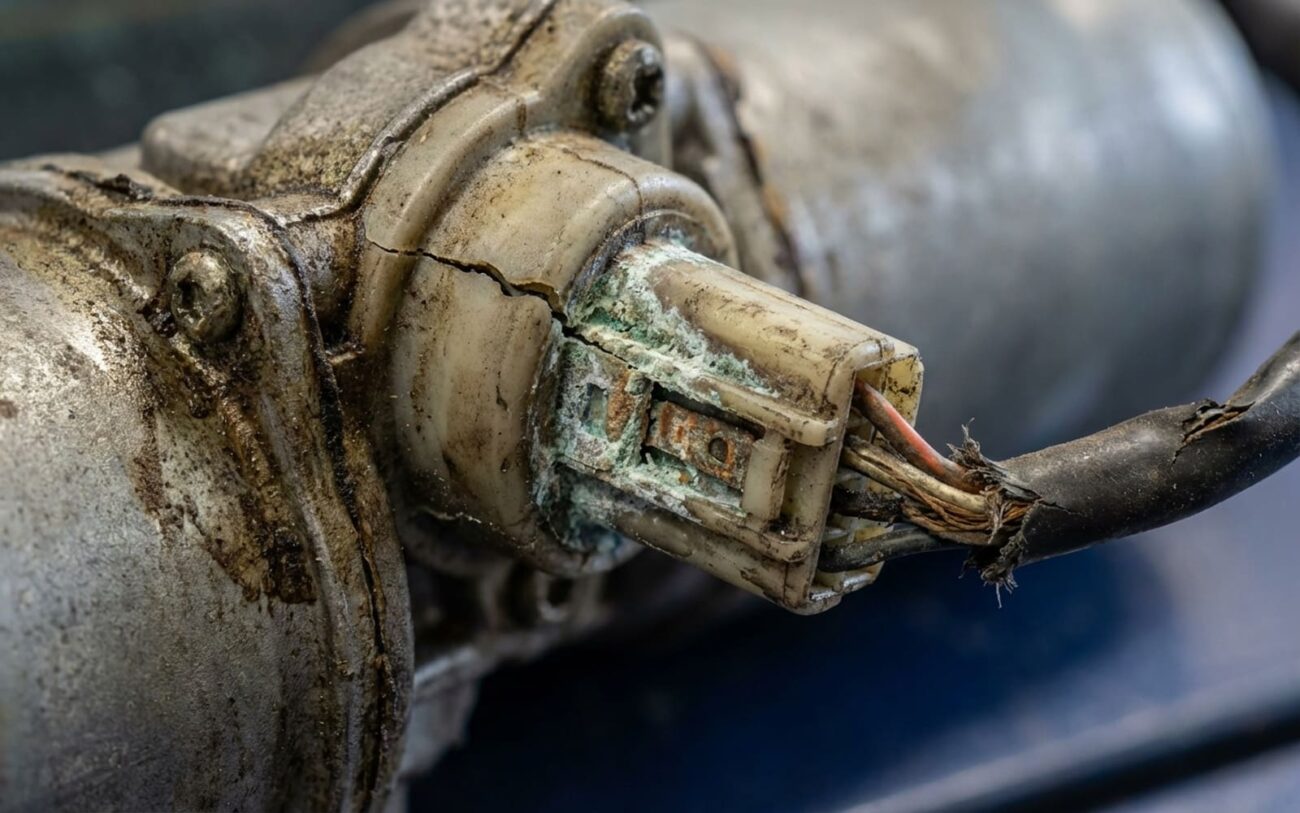
Rear wiper dead? Don’t yank the motor yet. I’ve been turning wrenches for 25 years, and I can tell you—most people replace the wrong part. On SUVs and hatchbacks like the RAV4, CR-V, or Escape, the problem’s usually not the motor. It’s what feeds it. Blown fuse, fried switch, or wires cracked inside the tailgate harness—those are the real killers. Diagnose first. Replace later. Saves time, money, and headaches.
What’s it doing—or not doing?
Start here. The symptom tells you where to look.
Nothing at all? No click, no hum, no movement. That’s not a motor issue—it’s a power issue. Could be a $2 fuse, a failed relay, or a broken wire where the tailgate harness bends every time you open it. I see this weekly on 2012–2018 Ford Explorers. Wires fatigue in that rubber boot between the body and tailgate. Ground wire usually snaps first.
Quick check: does the rear washer work? If yes, the circuit has power and ground. That means the problem is downstream—likely the switch or motor. If the washer’s also dead, start upstream: fuse, relay, wiring.
Humming but not moving? Motor’s getting power but can’t turn. Could be seized internally, but more often it’s mechanical. Ice on the glass, frozen pivot, or corroded linkage. I’ve pulled motors that tested fine—only to find the wiper arm was jammed solid. Keep forcing it, and you’ll burn the motor. Seen it too many times.
Intermittent? Works when it feels like it. That’s usually a failing switch or a broken wire in the tailgate harness that only connects when the hatch is closed just right. Or—less common—a motor brush losing contact. But don’t assume it’s the switch. I’ve back-probed switches with a DMM and found perfect signal, only to trace it to a cracked wire in the boot.
How to test—no guessing
You need a digital multimeter (DMM), a wiring diagram (Chilton, Alldata, or OEM service manual), and 20 minutes. Here’s how I do it.
Step 1: Check for power at the motor. Unplug the motor connector. Turn the ignition on, activate the rear wiper. Test for 12V on the power pin. No voltage? The motor’s fine—the issue is upstream. Voltage present? Then check ground. Bad ground kills more motors than age.
And don’t just check for voltage—do a voltage drop test. Connect DMM between the motor’s ground terminal and the battery negative. Activate the wiper. If you see more than 0.2V, you’ve got resistance. Corroded connector, loose splice, or broken ground strap. I’ve found 1.8V drops on “good” grounds—no wonder the motor struggled.
Step 2: Isolate mechanical vs. electrical. If the motor’s getting power but won’t turn, disconnect the wiper arm from the motor shaft. Then power the motor directly with jumper wires (fuse it—10A max). If it spins free, the problem isn’t the motor. It’s the linkage, pivot, or arm. If it still drags or stalls, the motor’s toast.
I’ve saved customers $300 this way—found a seized linkage, cleaned it, lubed it, done. Motor was perfect.
Step 3: Test the switch. If no power at the motor, back-probe the switch output with the DMM. Cycle the switch. You should see clean 12V when activated. Fluctuating signal? Switch is failing. Consistent signal but no motor action? Then the break is in the harness—most likely in that tailgate boot.
Why it failed—because it didn’t just “die”
Motors don’t fail from old age. Something killed them.
Water intrusion is huge. The motor mounts through the tailgate, and if the rubber gasket is cracked or pinched, moisture gets in. I’ve pulled motors on 2010–2015 Subaru Outbacks with rust inside the gear housing. PCB corroded, brushes gummed up. Same on some Mazdas. Fix the seal when you replace the motor—or the new one will die in a year.
Thermal overload is another. If the wiper blade is frozen, or the linkage is binding, the motor draws max current trying to move. Heat builds. Solder joints crack. Windings burn. I’ve seen motors with melted internal connectors—clear sign of repeated stalling.
Switches fail from contact wear. Every time you press it, a tiny arc forms. Over years, the contacts pit and carbon builds up. Resistance increases. Signal degrades. Spills help—coffee or soda down a dash switch? Corrosion city. Steering column switches last longer, but wet floor mats can wick moisture up into them over time.
And a blown fuse isn’t a failure—it’s a warning. Replace it without finding the cause, and you’ll blow another. Same with a motor: replace it without fixing the binding linkage or bad ground, and the new one won’t last.
How to fix it—right the first time
Rear wiper motor replacement DIY-feasible
Rear wiper switch replacement DIY-feasible
Can you rebuild the motor?
Temporary fixes?
Did it really work? Test it like I do
Don’t just turn it on and call it done.
Cycle through all modes—intermittent, low, high. Watch for hesitation or noise. Then turn it off—does it park fully? If it stops halfway, the park switch in the motor or the body module isn’t getting the signal. That’s a whole other issue.
If the rear defroster shares the tailgate harness (common on Toyotas and Fords), test it too. I’ve seen techs pinch the harness during reassembly and kill both systems. Open and close the hatch a few times—make sure nothing cuts out.
What’s it going to cost?
| Repair Type | DIY Cost (Parts) | Shop Cost (Parts & Labor) | Success Rate | Secondary Risk if Failed |
|---|---|---|---|---|
| Motor Assembly Replacement | $80 – $200 | $250 – $450 | Near 100% if root cause addressed | Repeat failure if binding or electrical issue remains |
| Switch Replacement (Dash) | $50 – $150 | $150 – $350 | Near 100% if installed correctly | Electrical fault if wiring disturbed |
| Switch Replacement (Steering Column) | $100 – $250 | $300 – $600 | High, but risk of airbag or steering issues if done wrong | Airbag system malfunction |
| Circuit Repair (Fuse, Wiring) | Under $50 | $100 – $250 | Over 98% if repair is solid | Low, if connections are properly sealed |
Real talk: if the repair costs more than 20% of the car’s value, especially on a high-mileage model, you might just live without it. I’ve had customers decide to wipe the glass by hand. Not ideal, but honest. The rear wiper isn’t like headlights or brakes—it’s convenience, not safety.
Keep it working—because prevention beats repair
-
Lube the linkage yearly. A dab of white lithium grease on the pivot and joints keeps it moving easy. Takes 5 minutes, saves motors.
-
Inspect the tailgate harness. Open the hatch, look at the rubber boot. If wires are exposed or cracked, repair now. Splice in new wire, don’t just tape it.
-
Clear ice before using. Never run the wiper on frozen glass. It’s the fastest way to kill a motor.
-
Check the motor gasket. When replacing, make sure it’s seated right. No pinching, no gaps. A dry motor lasts longer.
-
Listen to changes. Slowing down? New noise? Don’t wait. Diagnose early.
And if you’re chasing other gremlins—like headlights that stay on or cargo shelves that rattle—check out our guides on why headlights stay on after shutdown or cargo shelf rattles. Ground issues and tailgate harnesses pop up in more places than you think.
