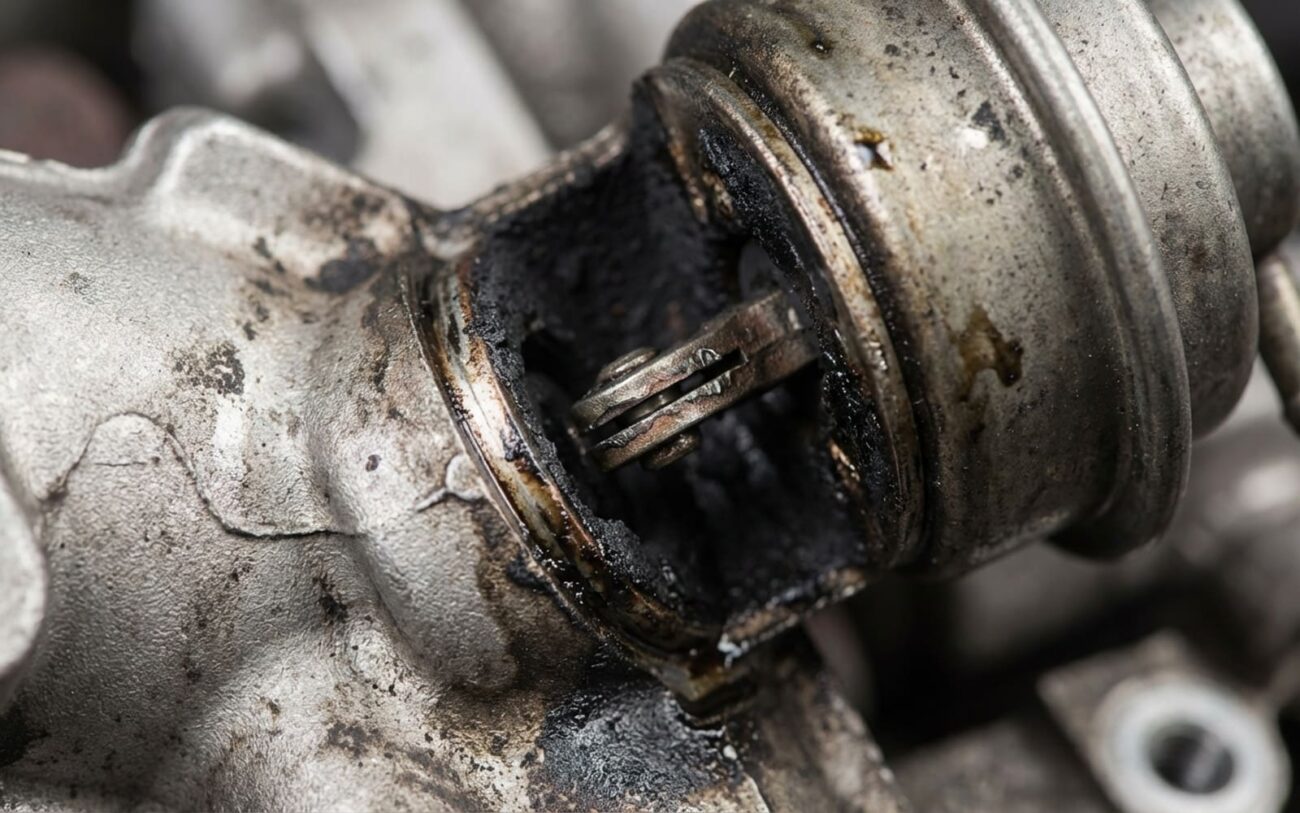
A stuck-open EGR valve? Oh, I’ve seen plenty of those in my 25+ years under the hood. It’s one of those problems that can really make a car feel sick, especially at idle. What happens is, the valve is letting exhaust gas into your engine’s intake manifold when it shouldn’t be there, messing with the air-fuel mixture. And that’s bad news for smooth operation.
What You’ll Feel: Symptoms of a Stuck-Open EGR Valve
The first thing you’ll notice is usually a really rough, uneven idle. I mean, it’s not just a little shaky; it can feel like the engine’s about to quit, especially when you’re coming to a stop or just sitting there in traffic. I’ve had customers describe it as feeling like the engine is “choking” or “loping.” If it’s bad enough, it’ll stall completely when you come to a stop.
This behaves a lot like a big vacuum leak, and in some cases, it even sounds similar. Listen closely near the intake manifold or the EGR valve itself – you might hear a distinct hissing or sucking noise. And it’s not just idle. You might feel a hesitation or stumbling when you try to accelerate gently from a stop. The engine just feels sluggish, like it’s fighting itself because that air charge is diluted with exhaust gas, leading to weak combustion.
EGR MONITOR
Actual: OPEN
Eventually, if it goes on long enough, that Check Engine Light is going to pop on. You’ll usually see diagnostic trouble codes (DTCs) like P0403 (EGR circuit malfunction), P0401 (insufficient EGR flow), or P0404 (EGR flow not within expected range). Now, don’t just jump to conclusions based on the code alone. P0403 points to an electrical issue with the valve, while P0401 or P0404 usually mean the computer thinks there’s a flow problem. But sometimes, a mechanical issue can trigger an electrical code, or vice-versa. That’s why you gotta dig deeper.
Why It Happens: Root Causes of EGR Actuator Failure
The Concept
“Think of carbon buildup like glue: it accumulates on the valve pintle and seat, preventing a tight seal.”
So, why do these things fail? In my experience, it almost always boils down to a couple of things, with carbon buildup being the big one. Exhaust gas is dirty stuff – soot, oil vapor, unburned hydrocarbons. It all builds up on the EGR valve pintle and its seat. Think of it like a sticky, tar-like glue that just won’t let the valve close all the way. This is super common on high-mileage cars or those that mostly do short trips, where the engine never really gets hot enough to burn off those deposits.
Mechanical & Electrical Failure Modes:
But it’s not just carbon. These valves have small electric motors and plastic gears inside. Over time, those motors can wear out – brushes go bad, windings short out, or magnets lose strength, reducing torque. And those plastic reduction gears? They can strip out, especially if the valve is fighting against heavy carbon. Heat cycling makes the plastic brittle, too. So, you can have a perfectly clean valve that just won’t move because its guts are shot.
My Diagnostic Approach: Is It the Valve, Wiring, or Something Else?
Alright, so you’ve got the symptoms, maybe a code. How do I figure out what’s really going on? My first step is usually to get out the scan tool. Just seeing a P0403 or rough idle doesn’t mean the EGR valve itself is faulty. The real challenge is determining whether the issue lies in the valve assembly, the control circuit, or elsewhere in the system. Misdiagnosing this can lead to unnecessary part replacements and wasted money.
| Symptom/DTC | Likely EGR Actuator Fault | Common External Mimics | My Definitive Test |
|---|---|---|---|
| P0403 DTC (EGR Circuit Malfunction) | Internal motor failure, stripped gears, or binding valve pintle preventing movement. | Open or shorted wiring, poor connector contact, failed PCM output driver. |
Use a bidirectional scan tool to command the EGR valve. Listen for movement. Back-probe the signal wire to verify PCM output. Check for frayed wires in the harness. |
| Rough Idle with P0401 or P0404 | Valve pintle stuck partially open due to carbon buildup or mechanical binding. | Clogged EGR passages in the intake manifold, faulty EGR position sensor. |
Remove the valve and inspect the pintle and seat for carbon buildup. Use bidirectional control to actuate the pintle and check for smooth movement and full travel. |
When I’m using my scan tool, I’m commanding the EGR valve to open and close. I’m listening for it to move, and I’m watching the EGR position sensor data. Does it respond smoothly? Does it reach 0% closed and 100% open? If it’s erratic or doesn’t move at all, that tells me a lot. If the scan tool shows issues, I’ll pull the valve off. This lets me visually inspect the pintle and seat for carbon buildup. Is it caked on? Can I manually push the pintle in and out smoothly? If it’s sticky, that’s a strong indicator.
If I’m seeing a P0403 (circuit malfunction), I’m grabbing my multimeter. I’ll check for power and ground at the connector, and then back-probe the signal wire while commanding the valve. I’m looking for opens, shorts, or poor connections. Don’t forget to check the wiring harness itself – I’ve seen plenty of frayed wires inside the conduit that cause intermittent issues.
Now, a quick note: sometimes a clogged EGR passage in the intake manifold can mimic a stuck valve. So, even if the valve looks good and moves freely, you might still have a flow problem that requires cleaning the passages, not just the valve.
Repair Options: Cleaning vs. Replacement
Professional Calibration Required
After installation, some vehicles require a relearn procedure using a professional scan tool. Without this, the PCM may not recognize the valve’s full range of motion, and you might still get codes or poor performance.
Cleaning a Carbon-Fouled Valve DIY Feasible
Full Assembly Replacement Professional Recommended
Fuel Additive Approach Last Resort
Post-Repair Verification: Did It Really Work?
After any EGR repair, whether it’s cleaning or replacement, you have to verify the fix. Don’t just clear the codes and send it. Here’s what I do:
-
Perform a bidirectional test: Command 0% to 100% and ensure the actual position follows smoothly and accurately on your scan tool.
-
Conduct a smoke test: With the valve commanded closed (or just installed), introduce smoke into the intake manifold to ensure there’s no leakage through the EGR seat when it’s supposed to be shut.
-
Road test: Take the vehicle for a good drive. Monitor long-term fuel trims and knock sensor activity under various loads. You want those trims to normalize and no knock activity.
Cost, Risk, and Economic Decision Guide
| Repair Type | DIY Cost (Parts Only) | Shop Cost (Parts & Labor) | Success Rate (My Experience) |
|---|---|---|---|
| Cleaning Valve | $15–$25 | $150–$300 | ~70% |
| Replace Assembly | $200–$600 | $400–$1,000+ | >95% |
When it comes to cost, cleaning is obviously the cheaper route if it’s just carbon. You’re looking at maybe $15-25 for cleaner and a gasket if you do it yourself. A shop might charge $150-300 for the labor. But if you need a new valve, parts alone can be $200-600, and a shop will charge $400-1000 total, sometimes more depending on the vehicle and how hard the valve is to get to.
My advice? If cleaning doesn’t work, don’t waste time trying it again. Just replace the assembly. The success rate for cleaning is maybe 70% in my experience; replacement is almost guaranteed to fix the valve problem, assuming your diagnosis was correct.
Prevention Tip
To keep this from happening again, especially if you’re prone to carbon buildup, use Top Tier gasoline. Those detergents really do help. And if you’re mostly doing short trips, consider following your car’s “severe service” maintenance schedule. It’s often overlooked, but it makes a difference.
