They’re Flashing You for a Reason — Your Lights Are Blinding
If oncoming drivers are flashing their high beams at you, don’t assume it’s road rage. That’s a distress signal. You’re blinding them. I’ve seen this a thousand times: someone drops “upgraded” bulbs into their factory halogen housings, thinks they’ve improved visibility, and ends up creating a hazard. The irony? Their own vision down the road gets worse, not better.
It’s not about brightness. It’s about beam control. A proper low beam has a sharp horizontal cutoff — light stays below eye level for oncoming drivers. When that line disappears and you’ve got light flaring up into the sky, you’ve failed the most basic safety test. And no, “everyone else is doing it” doesn’t make it right — or legal.
Symptom → Test → Fix: The Real Diagnostic Path
Let’s cut through the noise. Glare isn’t random. It’s a symptom with specific causes. I don’t guess — I test. Here’s how I break it down in the shop.
| What You’re Seeing | Most Likely Cause (Halogen Housing) | What It Might Look Like But Isn’t | How to Confirm It |
|---|---|---|---|
| Oncoming traffic flashing or swerving | Xenon (HID) bulbs in halogen housing — light scatters uncontrollably; reflector damage from UV/heat. | Rear of car sitting high (loaded trunk), misadjusted aim screws. |
Test: Wall check at 25 ft. Reinstall factory halogen bulbs. If glare stops and cutoff returns — problem was the bulbs.
|
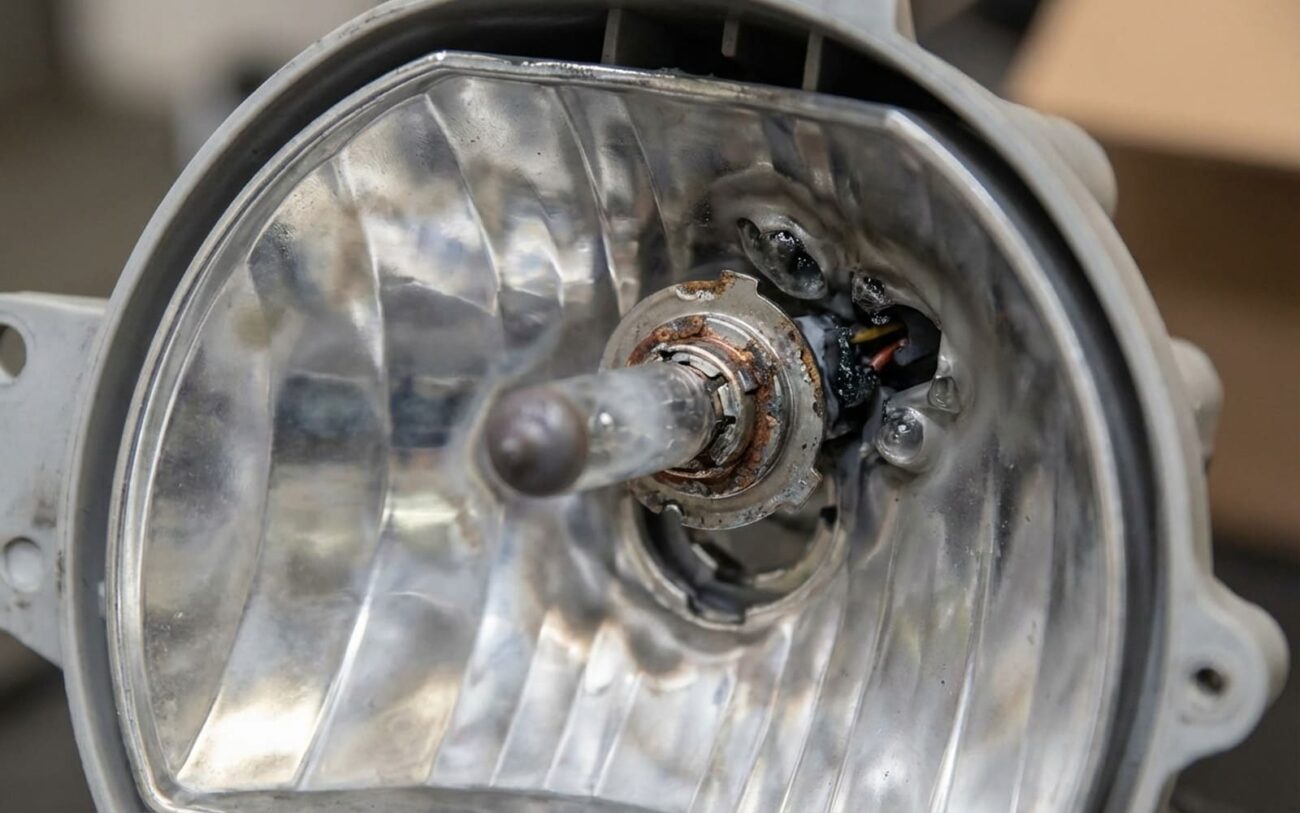
| Beam pattern looks washed out or has no cutoff | Reflector coating degraded — browned, frosted, or bubbling from HID heat/UV. | Bulb not seated right; melted connector; lens oxidation. |
Test: Remove headlight. Shine flashlight inside. Reflector must be mirror-smooth silver. Any discoloration? It’s toast.
|
| Headlights look blue-white, not warm yellow | Aftermarket “xenon” bulbs (4300K–6000K) in halogen housing. | Blue-tinted halogens; actual factory HID system (if equipped). |
Test: Compare to a factory halogen (3200K). If it looks like a BMW from 2005, it’s wrong for your housing.
|
Why HID Bulbs in Halogen Housings Are a Disaster
It’s not just “not ideal.” It’s fundamentally broken by design. Halogen housings — whether reflector or projector — are engineered around one thing: the exact position and shape of the halogen filament. That filament is a pinpoint light source, and the reflector bowl is shaped to capture and direct it with precision.
HID bulbs don’t have a filament. They have an arc between two electrodes — a longer, brighter, hotter light source that sits in a different physical location. So when you plug one into a halogen housing, the light doesn’t hit the reflector where it’s supposed to. It scatters. You get hot spots, glare, and zero cutoff control.
And the heat? That arc pumps out UV radiation and radiant heat halogen housings were never designed to handle. I’ve torn down headlight assemblies where the reflector coating has turned brown, bubbled, or peeled off completely. Once that happens, the housing is optically dead. No bulb swap will fix it. Period.
Don’t kid yourself — this isn’t a tuning issue. There’s no tape, shield, or “beam corrector” that makes it safe. If the housing wasn’t certified with HID bulbs, it’s illegal under FMVSS 108. And yeah, that matters if you’re in an accident and the other side’s lawyer finds out you were running unapproved lighting.
What You Actually Need to Do (Based on What You Find)
Reflector is clean and mirror-smooth: DIY-FEASIBLE
Reflector is damaged: PROFESSIONAL-ONLY / REPLACE ASSEMBLY
Only the outer lens is hazy: DIY-FEASIBLE
How to Know It’s Actually Fixed
Don’t trust your eyes. Test it.
For bulb replacement: park 25 feet from a flat wall on level ground. Turn on low beams. The horizontal cutoff should be at or below headlight center height. Passenger side should have a sharp “kick-up” but no light projecting above the line. No hot spots. No glare.
For new assembly: same wall test, plus check fit. Gaps between housing, fender, and bumper should be consistent — within 3mm. Misalignment means uneven beam or potential moisture leaks.
For lens restoration: shine a flashlight from behind. Light should pass through evenly. Surface should be smooth and clear from all angles. But again — this doesn’t fix internal damage.
Cost, Risk, and What I’d Do
| Repair Type | DIY Cost | Shop Cost | Success Rate | If It Fails |
|---|---|---|---|---|
| Reinstall Halogen Bulbs | $20–$100 | $150–$250 | Near 100% (if reflector good) | None — if aim is verified. |
| Replace Assembly | $300–$1,500 | $500–$2,000+ | 100% (if installed right) | Moisture ingress or misalignment if not sealed/torqued. |
| Lens Restoration Only | $50–$100 | $150–$300 | 80% surface clarity; 0% if reflector damaged | Glare continues; clear coat fails in 1–2 years. |
Quick tip: if a new OEM headlight costs more than 40% of your car’s private-party value, consider a verified used unit from a reputable dismantler. I check for water marks, lens clarity, and reflector condition before installing. Saves money — and works just as well.
How to Not Screw This Up Again
Your headlights are safety equipment — not fashion accessories. FMVSS 108 is real. Any mod that changes beam pattern or creates glare is illegal for road use. That includes every “plug-and-play” HID kit ever sold online.
Stick to factory-specified halogen bulbs. And skip the “xenon-white” halogens — that blue tint filters light, reducing usable output. You’re trading visibility for a color that looks cool in a parking lot but hurts you at 60 mph on a dark road.
To Keep It Right
-
Do a quick wall check once a month. Takes 5 minutes.
-
Get aim verified annually — often included with alignment or state inspection.
-
Before any mod, ask: was this system tested and certified as a complete unit? If not, don’t do it.
I’ve fixed hundreds of these. Every time, the car performs better — for the driver and everyone else on the road — when it’s back to factory spec. That’s not a downgrade. That’s engineering doing its job.
