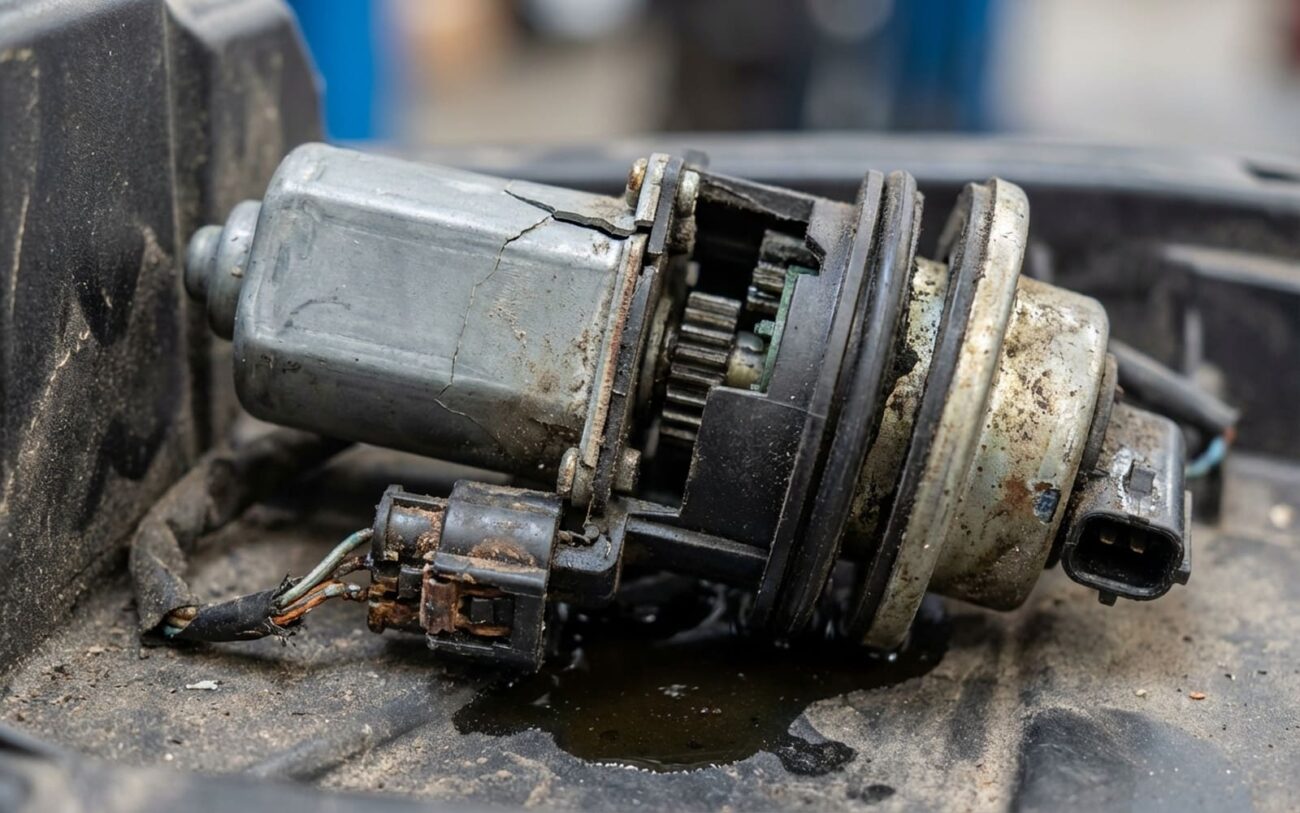
You hit a curb or took a parking stop too hard, and now one headlight won’t move. It’s either buried into the road or blasting oncoming traffic like a spotlight. Don’t guess. I’ve seen this a hundred times—especially on BMWs, Audis, and Mercedes after even minor front-end bumps. The problem usually isn’t the headlight housing, the bulb, or your aim screws. It’s the leveling motor. But—and this is critical—not every frozen light means a dead motor. Replace the wrong part, and you’re just throwing money into a hole.
First: Confirm It’s a Leveling Issue
Not every headlight that looks misaligned has a failed motor. Start simple. Park on level ground, 25 feet from a wall. Turn on low beams. The horizontal cutoff line should be even across both sides. If one side is higher or lower, and it doesn’t change when you bounce the front end or add weight to the trunk, then yeah—you’ve got a leveling system fault.
Now watch what happens at startup. Most cars with adaptive lighting run a self-test. The headlight reflector dips down and sweeps back up in about a second. If one side does that and the other doesn’t budge? That’s your red flag. If it moves sluggishly or only halfway, that’s a warning sign. And if you hear a buzz or grind from inside the housing—like a tiny gear spinning but not catching—that’s the motor trying to work but failing.
And before you go tearing into anything: check the fuses. I’ve had techs in my shop spend an hour diagnosing a “dead motor” only to find a blown 7.5A fuse in the TIPM (Totally Integrated Power Module) on a Ram. It happens.
Don’t Replace the Motor Yet—Test the Whole System
Here’s where most shops get it wrong. They see no movement, assume the motor’s dead, and slap in a new one. Then the customer comes back a week later with the same symptom. Why? Because the motor wasn’t the problem.
The leveling system is a chain: ride height sensor → control module → wiring → motor. Break any link, and the light won’t move. And after a crash, any of those can fail.
So here’s how I test—step by step:
Step 1: Scan for Codes
Hook up a real scan tool—not a $50 code reader. Look in the Headlight Control Module (HCM) or AFS module for codes like B1215 (LIN Bus Fault), B1234 (Rear Level Sensor Implausible), or U0416 (Lost Communication with Suspension Module). These tell you where to look. If you’ve got a LIN bus code, it might be wiring or communication, not the motor.
Step 2: Command the Motor Directly
Use the scan tool’s bidirectional controls. Tell the left headlight to move up. Then down. Watch the live data. If the module says “Command Sent” but nothing happens, and you’ve got power and ground at the motor connector (check with a multimeter), then the motor is likely toast. But if the scan tool won’t even let you command the motor? That’s a control module or sensor issue.
Step 3: Check the Ride Height Sensor
These are fragile. A small impact can bend the linkage arm or knock the sensor off its mounting point. On Mercedes, they’re often on the rear control arms. On Audis, sometimes on the air springs. Visually inspect. Move the arm by hand—should pivot smoothly. If it’s stiff or disconnected, that’s your problem.
Step 4: Listen and Feel
If you hear noise but no movement, grab a mechanic’s stethoscope. Press it against the motor housing. If you hear grinding or buzzing, the motor’s trying. Then check current draw: set your multimeter to measure amps in series with the motor leads. Command movement. If current spikes to 1.5–2A but no motion, gears are stripped. If no current, either the motor’s open-circuit or the signal isn’t getting through.
What Actually Dies Inside the Motor
These aren’t your grandpa’s headlight motors. They’re tiny precision gearmotors with feedback circuits. Most use a plastic planetary gear train and a potentiometer or Hall sensor to report position. They’re built for 100,000 cycles—not for surviving a 5-mph impact.
The #1 failure I see? Shock-damaged gears. The plastic gears crack or strip when the car hits something. Even if the housing looks fine, the internal gears can be shattered. I’ve cracked open motors that looked perfect from the outside—inside, the sun gear was split in half.
Second most common: rotor seizure. The shaft binds in the bearing due to misalignment from impact. Motor draws current, hums, but won’t turn.
And don’t forget the electronics. Some motors have a small PCB with a LIN transceiver. A jolt can crack solder joints or damage the chip. No communication. No movement. But the motor itself is fine.
Repair Paths: Know Your Headlight Design
This is where it gets expensive. Some cars let you replace just the motor. Most modern ones don’t.
Motor Replacement (If Serviceable)
Full Headlamp Assembly Replacement Non-Repairable
Manual Adjustment (Last Resort) Temporary / Last-Resort
Did It Really Work? Validate Like a Pro
Just because the light moves doesn’t mean it’s fixed. I’ve seen too many “repaired” headlights still aimed like they’re from a monster truck.
Here’s what I do after any repair:
-
Verify the self-test runs fully on startup—full down, then up.
-
Clear codes and re-scan. No pending or stored faults in HCM.
-
Command up/down via scan tool. Movement should be smooth, no stuttering.
-
Perform basic setting. If it fails, check for binding or incorrect motor installation.
And if you replaced the headlight: you must aim it optically. Tape on a wall isn’t good enough. Use a headlight aimer—Hella, Bosch, or even a decent digital unit. Follow the manufacturer’s specs. European cars? They’re picky. A 15mm deviation on a BMW E60 can trigger a fault or blind oncoming traffic.
Is It Worth Fixing?
Let’s be real. A new OEM headlight on a 2016 Audi A4 can cost $2,200. If your car’s worth $8,000, that’s 27% of its value. I tell customers: if the repair exceeds 40% of the car’s KBB private-party value, consider a certified remanufactured unit. Same optics, same calibration, 60% of the cost. Just make sure it comes with a warranty and hasn’t been in a flood.
And if this was an insurance claim? Push for proper calibration. I’ve seen adjusters deny claims because the shop didn’t document the post-repair aim check. Get it in writing.
Final Tip: Prevent It Next Time
After any front-end work—frame straightening, suspension repair, radiator support replacement—insist on a full headlight leveling calibration. The ride height sensors get recalibrated, the control module relearns the car’s stance, and the headlights adjust accordingly. Skip it, and you’re setting up the system to fail.
And make the startup sweep part of your routine. Turn the key. Watch the lights. One doesn’t move? Don’t wait. Diagnose it now. Catch it early, and you might save the motor before it seizes completely.
