You pull out at night and your lights are either blinding oncoming traffic or barely hitting the pavement. You twist the manual knob—nothing. That’s not just a bad aim; that’s a failed auto-leveling system. And if you’re driving anything with HID or LED headlights from the last 15 years—especially European—this isn’t rare. It’s predictable. I’ve fixed hundreds of these, from BMWs to Audis to Land Rovers, and I’ll tell you exactly what’s broken, how to prove it, and whether it’s worth fixing.
What’s Actually Broken? (Spoiler: It’s Not the Bulb)
Let’s cut through the noise. When your headlights won’t adjust, and the beam is stuck pointing at the moon or the curb, you’ve got one of three things failing: a sensor, an actuator, or the control module. And no, it’s not “just needs alignment.” If the auto system is down, no wall test or tape measure fixes the root cause.
I see this most on vehicles with adaptive front-lighting systems (AFS) or automatic leveling—common on BMW, Mercedes, Audi, Lexus, and Volvo. These systems use real-time data from suspension height sensors to keep the beam cutoff line stable, no matter if you’re loaded up with gear or driving uphill. When they fail, the lights freeze in place.
The dashboard warning light—a headlight icon with arrows or an exclamation mark—is your first hard clue. That’s not a suggestion. The system ran its self-check and found a fault it can’t ignore. Ignore it, and you’re not just risking a failed inspection—you’re risking liability in a collision. Beams too high blind others; beams too low blind you. Either way, you lose.
Symptoms That Tell You Where to Look
Don’t guess. Match the symptom to the likely fault—then prove it.
| Symptom | Likely Fault | What Else Could Fool You | How to Confirm It |
|---|---|---|---|
| Beam stuck too high or too low, no movement | Failed level sensor, seized actuator, or control module error | Damaged headlight housing, manual adjuster tampered with, or rear-end collision |
Use a scan tool to command actuator movement. If the motor runs but the beam doesn’t move, the internal linkage is broken. If no motor response, check sensor signal and wiring. |
| Beams “dance” up and down on flat road | Failing level sensor or binding actuator | Faulty air suspension height sensor, CAN bus glitch, or wheel speed sensor feeding bad data |
Monitor live data from the headlight level sensor while gently moving the linkage. If voltage jumps erratically, the sensor is bad. If other suspension sensors show the same noise, suspect network issues. |
| Warning light on, system disabled | Electrical fault in sensor/actuator circuit or control module failure | Bulb out, power supply issue, or CAN bus communication fault |
Pull DTCs with a capable scan tool. Code B3672? That’s a height sensor circuit fault. U1000? That’s a network issue—don’t replace parts yet. |
What Actually Fails (And How Often)
After 25 years in the bay, here’s what I see:
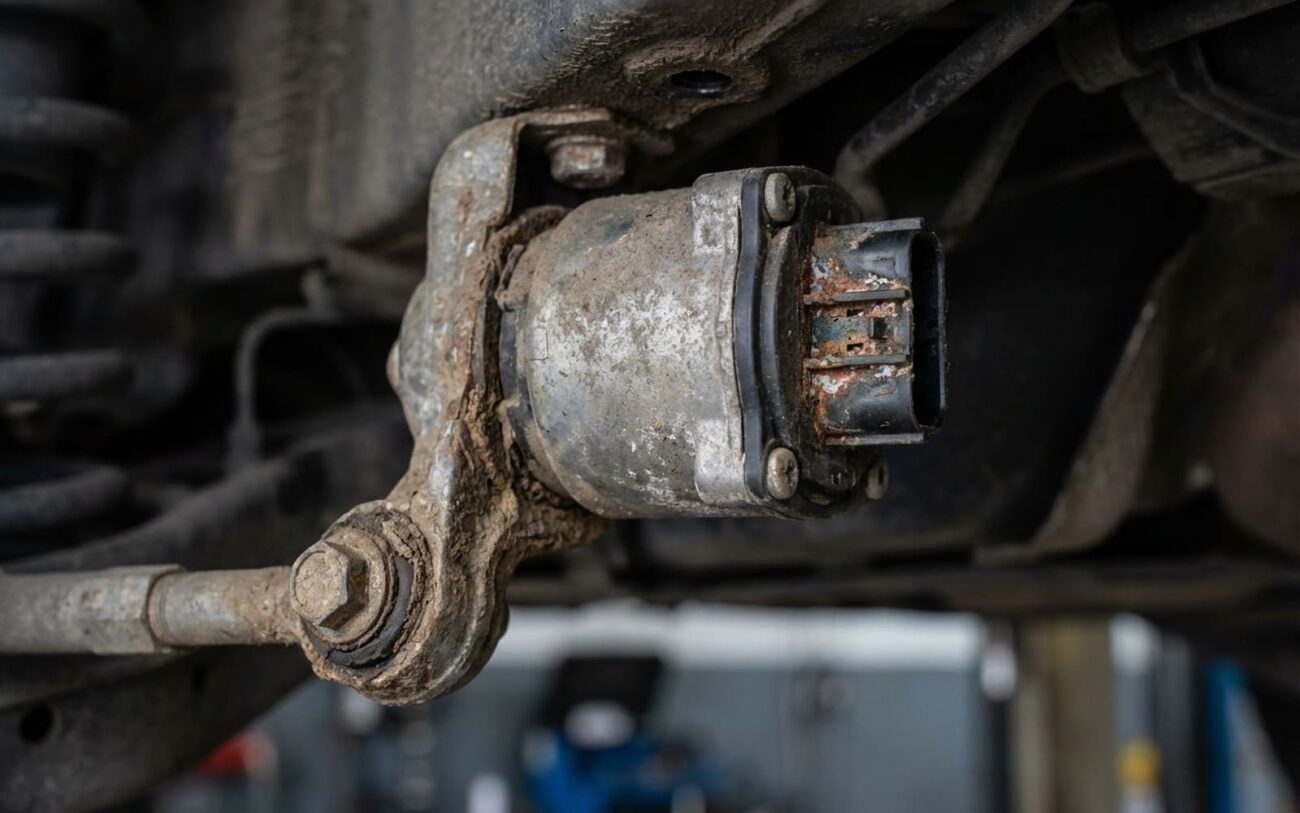
Level sensors — these are the weak link. Mounted on the control arms, usually front and rear, they’re potentiometers with a little plastic arm that moves with suspension travel. Salt, dirt, and moisture eat the bushings. The arm binds. The internal track wears. Signal goes haywire. On a 2010–2016 Audi A6? I replace these monthly. OEM only—aftermarket units have wrong resistance curves and cause calibration errors.
Actuator motors — sealed inside the headlight. Tiny DC motor, plastic gears. Water gets in (usually from a failed seal), corrodes the motor, strips the gears. I’ve opened headlights where the actuator was frozen solid. These aren’t serviceable. You can try to swap it, but resealing the lens is a gamble. One pinhole leak, and you’re fogging up in a week.
Control modules — less common, but when they go, they go hard. Usually from voltage spikes during jump-starts or alternator issues. Some need coding, VIN matching, security PINs. Don’t plug in a used one from eBay and expect it to work. It won’t.
And don’t forget the wiring. Harnesses run through wheel wells, tied to suspension arms. Vibration, chafing, corrosion—especially at the sensor connectors. I’ve found broken wires inside what looked like a perfect rubber boot.
How I Fix It (And What I Tell My Customers)
Sensor Replacement DIY-Feasible
Actuator Repair Advanced DIY or Pro
Control Module Shop-Only
Temporary Fix Last Resort
How I Know It’s Fixed (And Will Stay Fixed)
Clearing the code isn’t the end. I verify three things:
- No DTCs after a full drive cycle.
- Live data shows smooth, linear voltage changes as I move the sensor arm.
- Beam aim is stable and within spec on an optical aligner—after the system runs its self-leveling routine.
For module replacements, I also confirm: module is coded, adaptations are learned, and beam height changes when I lift the front of the car (simulating load change). If it doesn’t react, something’s still wrong.
Is It Worth Fixing? Here’s My Rule
I don’t sugarcoat it. On a 12-year-old luxury car, spending $1,200 to fix one headlight actuator when a new OEM unit is $2,000? That’s a tough sell. But here’s my rule: if the repair cost hits 40% of a new headlight’s price, consider full replacement—especially if the lens is hazy, the housing is cracked, or the other side is due.
| Repair | DIY Cost | Shop Cost | Success Rate | Risks if Done Wrong |
|---|---|---|---|---|
| Level Sensor | $80–$250 | $300–$600 | 95%+ | Bad calibration = recurring codes, misalignment |
| Actuator | $100–$400 per side | $500–$1,200 per side | 90% (seal failure risk) | Moisture ingress can kill the whole headlight |
| Control Module | $200–$600 + programming | $500–$1,000 | 98% | Wrong coding = system dead, possible tow to dealer |
And if you’re doing one side, check the other. These systems age together. Fix one, the other fails in six months? Now you’re paying twice.
How to Keep It Working
I tell every customer: when you get new shocks, struts, or control arms, make sure the tech checks the level sensor linkage. That little plastic arm gets bent, disconnected, or lost all the time. One loose clip, and the system throws a code.
Use OEM sensors. I don’t care how cheap the aftermarket part is. I’ve measured resistance curves on $40 units—they’re off by 15%. The module sees that as “impossible” suspension movement and disables the system.
And check your beam pattern monthly. Park facing a wall. Look at the cutoff line. If it’s creeping up or down, you’ve got early failure. Catch it now, save money later.
One last thing: if your car has advanced displays or CAN bus issues, don’t assume the headlight fault is isolated. A failing gateway module or power supply glitch can mimic a sensor failure. Diagnose the network, not just the symptom.
