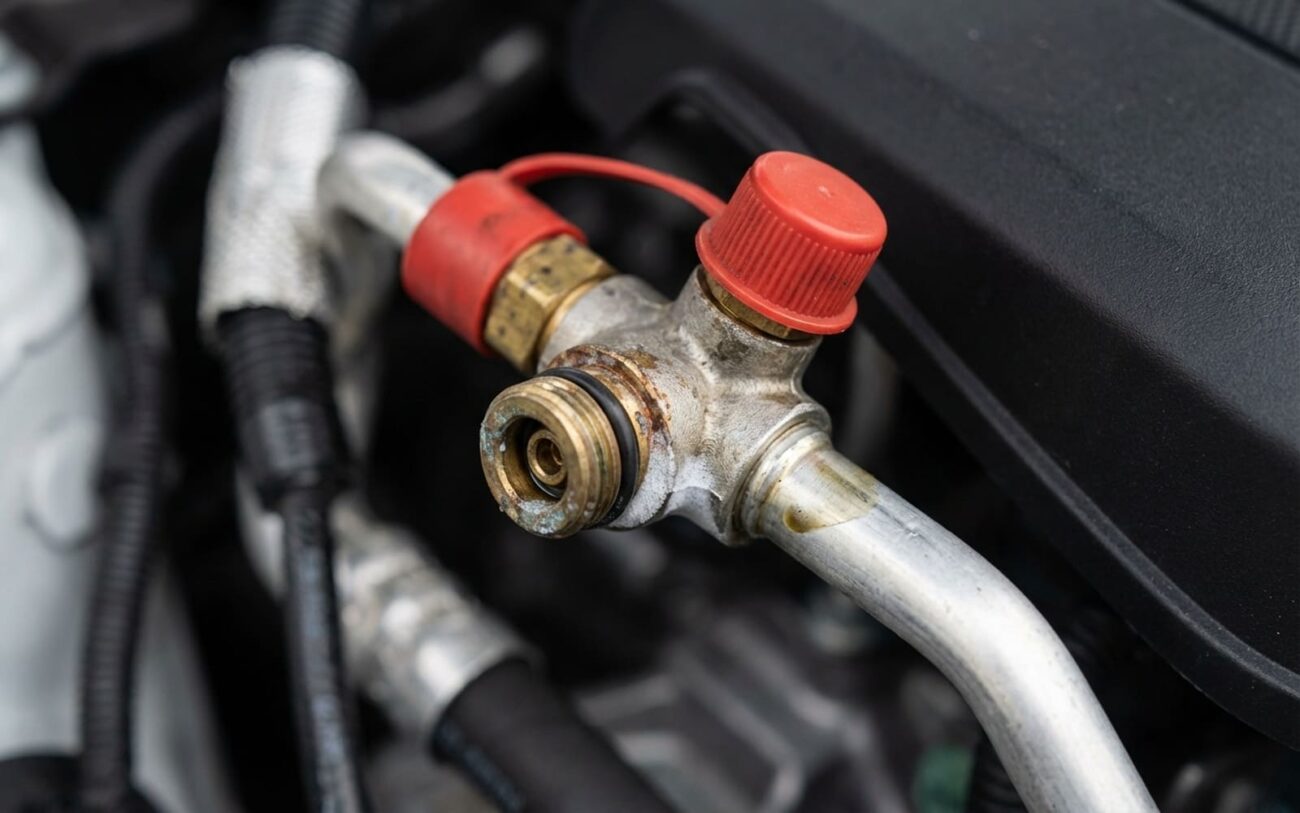
The Porsche Taycan’s R744 AC System: A Technician’s Guide to Diagnosis and Repair
Alright, let’s talk about the Porsche Taycan’s AC system. If you’re reading this, your cabin probably isn’t cooling like it should, and you’re wondering what’s going on. After 25 years in this business, I can tell you that the Taycan’s R744 (carbon dioxide) system is a whole different beast compared to the R1234yf systems we’ve been seeing for years. It runs at drastically higher pressures—we’re talking over 130 bar (nearly 1900 psi) under normal operation. That’s a lot of force, and it means when things go wrong, they tend to go wrong fast and hard.
This isn’t a system you can just “top off” with a can from the auto parts store. In fact, trying to DIY anything here is a recipe for serious trouble, both for your car and potentially for your safety. Porsche designed this system for very specific performance, and that means it needs specialized tools, specific training, and a meticulous approach to diagnosis and repair.
What I Look For: Symptoms and Initial Clues
When a Taycan rolls into my shop with AC problems, the first thing I do is listen to the customer. Their description of the symptoms is often the best starting point. Here’s what I typically hear and what it usually points to:
- Gradual Loss of Cooling: If the AC just slowly stopped blowing cold over weeks or months, that often points to a slow refrigerant leak. It could be a small seal, a fitting, or even a tiny crack in a heat exchanger.
- Sudden, Complete Loss of Cooling with a Loud Whoosh: This is a big red flag. That “whoosh” sound usually means the Pressure Relief Device (PRD) activated. The system hit its maximum safe pressure—around 140 bar—and dumped all the refrigerant to prevent a rupture. When I hear this, I know we’re not just looking for a leak; we’re looking for what caused that massive overpressure.
- Metallic Particles or “Glitter” in the Filter-Drier: This isn’t something you’d see without opening the system, but if another tech has been in there and mentions it, pay attention. “Glitter” is a clear sign the compressor is failing internally and shedding metal. Once metal starts circulating, it contaminates everything—lines, heat exchangers, valves. At that point, a proper repair gets exponentially more complex and expensive.
- Strange Noises from Under the Vehicle: A failing compressor might make unusual grinding or whining noises. Don’t ignore them.
My Diagnostic Approach: Cutting Through the Noise
One of the biggest headaches with these modern systems, especially the Taycan’s, is that the HVAC control module relies heavily on electronic sensors. A faulty sensor can easily mimic a catastrophic internal fault. That’s why I never rely on just a single fault code or a quick gauge reading. Real diagnosis means cross-checking electronic data with physical measurements using calibrated, R744-specific tools.
Common Symptoms and How I Confirm the Root Cause:
Here’s how I break down some common issues:
If I see High Discharge Pressure (over 130 bar):
This could be a few things. It might be an internal condenser blockage, or the compressor could be over-compressing. But often, it’s something simpler, like air (non-condensable gas) in the system, a cooling fan that’s not running at full speed, or even a faulty electronic expansion valve that’s stuck open.
My Test: First, I’ll recover and weigh the refrigerant charge. If the charge is correct but the pressure is still high, I’ll perform a flow test using my scan tool, monitoring commanded vs. actual fan speeds. I always use a calibrated R744 manifold gauge set to validate what the car’s pressure sensor is telling me. If the sensor is off by more than 5%, that’s a problem right there.
If the PRD Activated (complete refrigerant loss):
This is serious. The most common internal causes are a stuck-closed electronic expansion valve or a severe internal restriction in a heat exchanger. But don’t jump to conclusions. I’ve seen faulty high-pressure sensors send false signals to the control module, making it think there’s an overpressure event when there isn’t.
My Test: I connect my diagnostic scan tool to read the high-pressure sensor PID (Parameter ID) in real time. Then, I compare that to a mechanical gauge reading using my R744-rated equipment. If there’s a discrepancy over 5%, I know I’m dealing with a sensor or control issue. If both readings agree at around 140 bar, then yes, it was a true overpressure event, and we need to find the restriction.
If there’s a Lack of Cooling with Low Suction Pressure:
This usually points to a leak or a compressor issue. It could be an internal evaporator leak or the compressor’s internal bypass or valves failing. On the simpler side, it might just be an external Schrader valve leak or, again, a faulty low-pressure sensor.
My Test: I perform a static pressure decay test with dry nitrogen, pressurized to about 100 bar. I’ll isolate sections like the evaporator and compressor using service valves. I monitor for any pressure drop greater than 1 bar in 15 minutes. If I find a drop, I then use an electronic leak detector, specifically rated for R744, to pinpoint the exact leak location. You can’t use an old R134a leak detector here; it won’t work.
Why These Systems Fail: The Enemies Within
The extreme operating pressures of the R744 system put incredible stress on every single component. Most failures aren’t sudden catastrophic events; they develop slowly over time due to material fatigue or contamination.
Take the condenser and evaporator, for example. They’re aluminum with very thin walls, designed for weight savings and efficient heat transfer. But those thin sections are vulnerable. A microscopic casting flaw or a weak braze joint can develop a fatigue crack under repeated pressure cycles, especially if the cooling fans aren’t doing their job to keep temperatures in check. These cracks often start internally and you won’t see them until the system completely fails.
The compressor is another common failure point. It’s engineered for high-density CO₂, but that also means higher mechanical loads on its bearings and scroll mechanism. The biggest enemy here, in my experience, is moisture. If the system ever ingests moisture—say, during a poorly executed repair—carbonic acid forms when water mixes with R744. That acid eats away at internal aluminum surfaces and degrades the special POE oil, leading to bearing wear and eventual seizure. I’ve seen compressors fail this way with surprisingly low hours on the clock, simply because the system wasn’t properly evacuated and dried after being opened.
Quick Note on Misdiagnosis: Not every leak is an R744 component failure. A leaking Schrader valve at a service port is a seal issue, not a condenser problem. Also, the Taycan’s high-voltage battery cooling loop is completely separate from the HVAC refrigerant circuit. Issues there won’t cause AC cooling loss. I’ve seen techs chase their tails (and customers’ wallets) misdiagnosing these.
Repair Realities: What’s Possible, What’s Not
Professional Territory Only. Seriously.
Let me be absolutely clear: repairs on the R744 system are not for the faint of heart, and they are definitely not a DIY project. Every single procedure requires specialized R744-rated tools, proper refrigerant handling certification, and strict adherence to Porsche workshop manual procedures. There is no safe or legal path for a home mechanic here.
External, Accessible Defects Professional Only
External, Hard-to-Reach Defects Professional Only
Internal Defects Non-Repairable
The Proof Is In The Pudding: Validating The Fix
A proper repair isn’t done until it’s thoroughly verified. After recharging, I always perform a static pressure decay test using dry nitrogen, pressurized to about 100 bar. I let it hold for 30 minutes; a drop of less than 1 bar confirms the system is sealed. But that’s just the first step.
Performance validation is critical. Using both R744 manifold gauges and a diagnostic scan tool, I monitor real-time pressure, compressor operation, and all relevant sensor data. I also use a thermometer in the center vent, looking for air at least 15°C cooler than the ambient temperature. Stable high-side pressure (typically 80–120 bar depending on ambient conditions and load) and no active HVAC fault codes are the final pass criteria. Skipping these checks leaves you vulnerable to repeat failures—especially if contamination was present.
The Hard Truth: Cost vs. Value
Let’s be honest: R744 repairs are expensive. Specialized equipment, labor intensity, and high part costs all contribute. And because the system is so sensitive, even a well-executed repair carries some inherent risk, especially if contamination was an issue.
| Repair Type | DIY Feasibility | Professional Repair Cost (Typical) | My Success Rate | Secondary Risk if Improperly Repaired |
|---|---|---|---|---|
| Service port core replacement | Not feasible – requires $20k+ in specialized equipment | $300 – $500 | 98% | Continued refrigerant loss if core or cap not sealed properly |
| Condenser replacement | Not feasible – involves high-pressure line disconnection and calibration | $2,000 – $3,500 (parts, labor, recharge) | 95% | Contamination from improper flushing or moisture ingress |
| Compressor & evaporator replacement (full system contamination) | Not feasible – full system flush required | $8,000 – $12,000+ | 90% (highly dependent on thoroughness of flush) | New compressor failure due to residual metal debris or poor oil return |
Before you authorize a major repair, take a hard look at your vehicle’s market value. As a rule of thumb, if the repair cost exceeds 40% of the Taycan’s current resale value, it’s worth evaluating whether the investment truly makes financial sense. For high-mileage or older models, sometimes replacement is more economical than a full AC system overhaul.
Keeping It Cool: My Prevention Playbook
Prevention is the Best Medicine (and the Cheapest)
Look, the most cost-effective strategy for these systems is prevention. The single biggest threat to the R744 system is contamination—whether it’s from moisture, incorrect oil, or the wrong type of refrigerant. Never, ever allow R1234yf or PAG oil into an R744 system. The chemistry is totally incompatible, and even a tiny amount can cause sludge formation or valve failure. Moisture is just as dangerous: it leads to carbonic acid, which corrodes aluminum heat exchangers and clogs expansion valves.
That’s why Porsche mandates a deep evacuation (below 500 microns) and filter-drier replacement every single time the system is opened—even for something as simple as replacing a Schrader core. If a shop tells you they can skip that, walk away. They don’t understand these systems, and they’re setting you up for a much bigger bill down the road.
I recommend an annual AC performance check at a shop that’s specifically equipped and trained for R744 service. Have them monitor cooling output, pressure readings, and overall system integrity. A gradual decline in performance is often the first sign of a slow internal leak. Always insist on proper procedures: correct refrigerant weight, calibrated R744 gauges, OEM parts, and full documentation of the service. Cutting corners today can cost you thousands tomorrow. For more on moisture risks in AC systems, see Can moisture in the A/C system cause an ice blockage in the TXV? and Why does the receiver-drier need to be replaced whenever the AC system is opened?.
