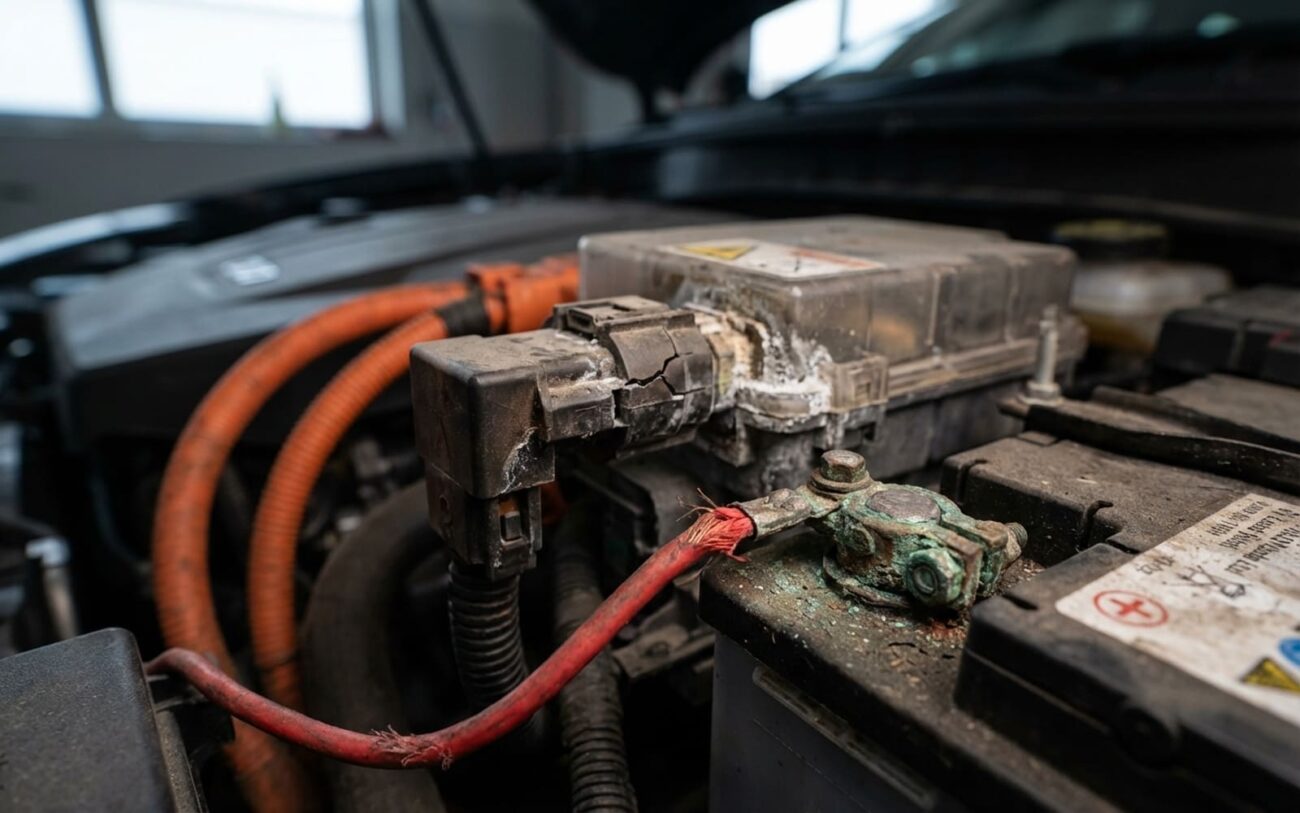
Alright, let’s talk about the dreaded “dead EV.” You walk out to your electric car, hit the unlock button, and… nothing. No dash lights, no chimes, no response at all. It feels like the whole car is bricked, completely lifeless. In my shop, when I see this, nine times out of ten, it comes down to one thing: a failed 12-volt auxiliary battery.
Now, I know what you’re thinking: “But it’s an EV! Doesn’t it run on a huge high-voltage battery?” And yes, it does. But that big battery, the one that powers the motor, it needs a brain to tell it when to wake up. And that brain, the control modules, they run on a little 12-volt battery. If that small battery is dead, the car can’t “boot up,” and the high-voltage system stays offline as a safety measure. It’s not that your main power source is gone; it’s that the computer isn’t getting power to turn on.
My Diagnostic Approach: Where to Start
Before you even think about buying a new battery, you need to figure out if the 12V battery is the actual problem or just a symptom of something else. A dead 12V battery can be old, sure, but it could also be drained by a parasitic draw or, more commonly in EVs, a failed DC-to-DC converter. That converter is the EV’s equivalent of an alternator; it charges the 12V battery from the high-voltage pack. If it’s not working, even a brand-new 12V battery will eventually die. That’s why diagnosis comes first, always.
Your best friend here is a digital multimeter. You can pick one up for under $30 that’s perfectly accurate for this job. First thing I do is measure the 12V battery voltage right at the terminals. If you see anything under 10V, that battery is deeply discharged or has an internal failure. But voltage alone isn’t the whole story, especially with how EVs manage loads through software. The real proof comes from a load test.
| What You See | Likely Culprit (12V Battery) | Other Possibilities | My Go-To Test |
|---|---|---|---|
| Car completely dead, no power | Internal battery failure (open circuit, deep discharge) | Blown low-voltage fuse, failed BMS wake-up circuit, parasitic drain overwhelming the DC-DC converter |
Measure battery voltage at terminals with a multimeter. Anything under 10V is a red flag. Then, perform a load test: the voltage needs to stay above 9.6V under a 50% CCA load for 15 seconds (that’s the SAE J537 standard). |
| Jump-start doesn’t work | Battery internal resistance is too high to accept a charge | Incorrect jump procedure, failed DC-DC converter, high-voltage isolation fault preventing system activation |
Monitor 12V voltage during a proper jump attempt using a known-good, regulated 12V source (like a quality portable jump pack). If the DC-DC converter is working, you should see the voltage steadily climb to 13.5V or higher. If it doesn’t, the problem is likely upstream. |
If that battery voltage doesn’t climb when you apply external power, then the fault isn’t the battery itself. It’s either the DC-to-DC converter, or there’s a high-voltage system lockout preventing the car from waking up. And if you suspect a parasitic drain, the diagnostic process is pretty much the same as any modern vehicle. I’ve got another article on that if you need it: Can a Parasitic Drain Kill Your Car Battery Overnight?
Why Do These 12V Batteries Fail in EVs?
So, let’s say your 12V battery truly failed the tests. Why? For traditional lead-acid or AGM batteries, it’s often heat-related grid corrosion, electrolyte depletion, or chronic undercharging. Lithium-based auxiliary batteries, which are becoming more common, can suffer from cell imbalance or management circuit faults. But in EVs, the duty cycle of that 12V battery plays a much bigger role than in a gas car.
Short trips are particularly brutal on the 12V system. If the vehicle isn’t “on” long enough, the DC-to-DC converter doesn’t stay active long enough to fully recharge the 12V battery. Over time, this leads to sulfation in lead-acid types and a significantly reduced lifespan. I’ve seen EVs with less than 30,000 miles needing new 12V batteries simply because they were only used for short commutes and never got a full charge cycle.
The “Sleep and Wake” Cycle:
Frequent “sleep and wake” cycles—which are common in EVs with always-on connectivity, remote apps, or features like Sentry Mode—can really wear down the 12V battery faster than you’d expect. Some manufacturers, like Tesla, actually track these cycles in the Battery Management System (BMS) logs. I’ve seen service bulletins for Model 3 and Y vehicles that specifically noted high cycle counts correlating with earlier 12V battery failures. It doesn’t mean the battery was defective; it just means the usage pattern was harder on it.
So, while a dead 12V battery is the symptom, it doesn’t automatically mean the battery itself is the root cause. A failed DC-to-DC converter will absolutely mimic the same symptoms. And if the high-voltage contactors won’t close due to a fault in the main traction battery or its BMS, the 12V system never gets power to begin with. So, my advice is always the same: don’t assume it’s the battery—test it.
My Recommended Fixes & What to Avoid
[DIY First Step] Check & Clean Terminals
[DIY Replacement] Replacing the 12V Battery
[CRITICAL WARNING] Don’t Jump an EV with a Gas Car
I can’t stress this enough: conventional jump-starting from a running ICE vehicle is NOT safe for most EVs. As I mentioned earlier, the alternator in a gas car can produce voltage spikes well above 16V. EV control modules are incredibly sensitive and expect clean, regulated power. Feeding them raw alternator output risks damaging expensive components like the Body Control Module (BCM), Gateway module, or the DC-DC converter itself. I’ve seen it happen, and it’s a very costly mistake.
[LAST RESORT ONLY] If You Absolutely Must Jump-Start
Post-Repair Validation: Confirming the Fix
Replacing the battery isn’t the end of the job. You need to verify that your repair actually worked and that the entire system is functioning as designed. This step is often overlooked, but it’s crucial.
First, with the car in “Ready” mode (meaning the high-voltage system is active), check the 12V battery voltage again with your multimeter. You should see it charging, typically between 13.5V and 14.8V. This confirms the DC-to-DC converter is active and charging the battery. Let the vehicle run for a while, maybe a full charge cycle if you can, then perform another load test to ensure the battery can handle demand.
Next, test all your system functions: windows, door locks, infotainment, and make sure the car is ready to drive without any delays or warning lights. Finally, and this is where a lot of DIYers fall short, use an OBD-II scanner capable of reading manufacturer-specific data. You need to check the BMS-reported 12V battery state-of-charge and health. This is the only way to truly confirm that the battery registration was accepted and that the charging algorithm is engaged and working correctly.
Cost, Risk, and Making Smart Decisions
Ignoring proper procedure can cost you a fortune. Here’s how I break down the numbers for my customers:
| Repair Type | DIY Cost | Shop Cost | My Success Rate (if root cause) | Secondary Risk if Failed |
|---|---|---|---|---|
| Terminal Clean/Tighten | <$20 | $75–$150 | 98% | None if done correctly |
| 12V Battery Replacement | $200–$600 (part) | $400–$1000 | 100% | BMS not reset, leading to premature new battery failure |
| Improper ICE Jump-Start Attempt | $0 (attempt) | $2000+ | 0% for intended outcome | High risk of damaging EV BCM, Gateway, or DC-DC converter |
If your diagnosis points to a failed DC-to-DC converter instead of just the battery, repair costs can climb quickly—often $1,500 to $3,000, sometimes more depending on the vehicle. If that starts to exceed 35% of your car’s current market value, then it’s worth taking a hard look at whether the repair makes economic sense. And keep in mind: a failed DC-to-DC converter can sometimes signal deeper issues in the high-voltage system, especially if it’s tied to a BMS fault or a thermal event. That’s when you really need a professional opinion.
Prevention & Monitoring: Keeping Your EV Alive
Preventing 12V battery failure starts with understanding its role. Unlike in gas cars, the 12V battery in an EV is always partially active—even when parked—powering modules for connectivity, security, and battery management. It’s working harder than you think.
My Proactive Maintenance Tips
-
Plug your car in regularly, even if the main traction battery is already full. This gives the DC-DC converter a chance to maintain the 12V battery at its optimal charge.
-
When it’s time for a replacement, use only the OEM-specified battery type. Substitutes might fit, but they won’t last, and you’ll be back here sooner than you want.
-
Pay attention to early warning signs: a slow key fob response, sluggish power windows, or a delayed infotainment system boot-up. These are often the first hints that your 12V battery is getting weak.
-
If you have an EV-capable OBD-II scanner, use it to monitor the BMS-reported 12V battery state-of-charge and health over time. It’s a great way to catch problems before they leave you stranded.
