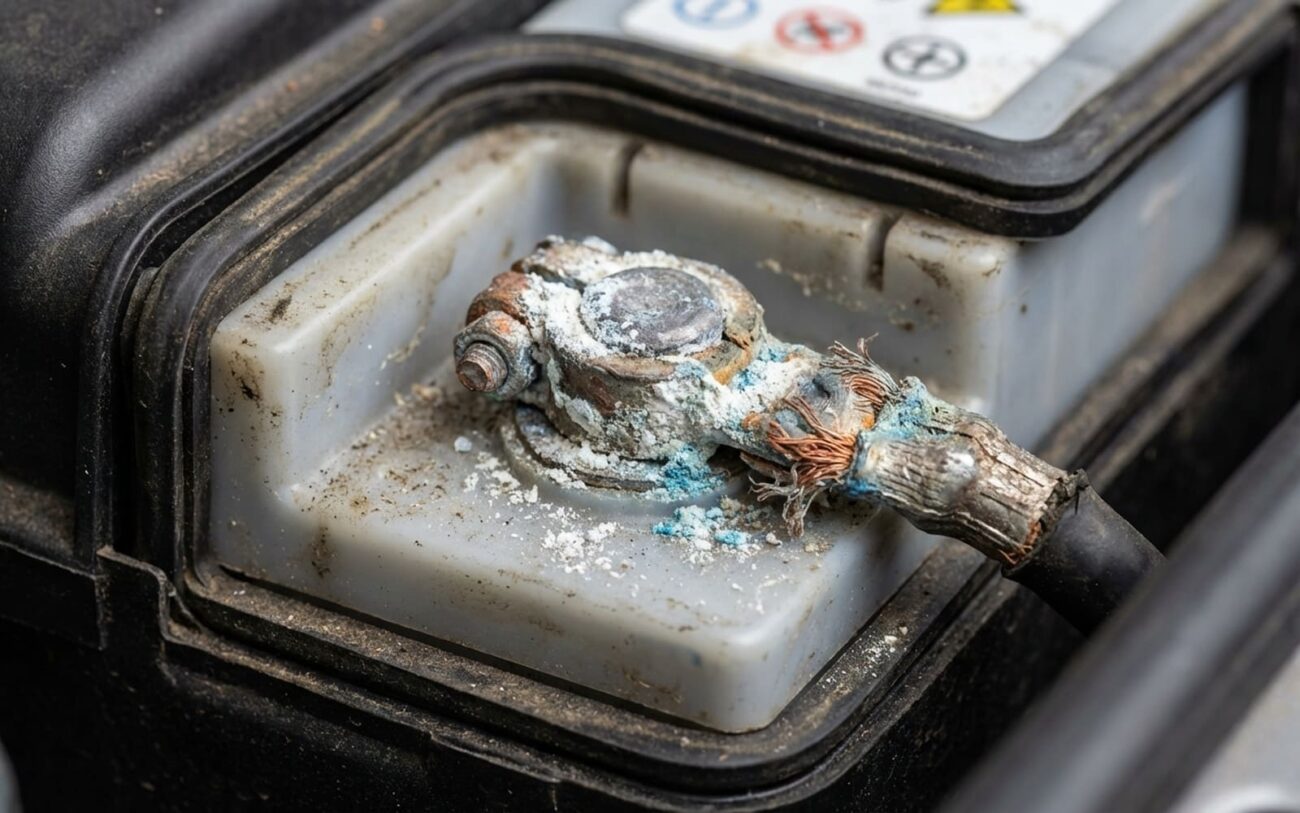
That Dead EV Feeling: When Your 12-Volt Battery Gives Up
Alright, let’s talk about something I see all the time in the shop: an EV that’s completely dead, even though the big traction battery is showing a full charge. You walk up, hit the door handle, nothing. No lights, no screens, no hum from the charge port. It’s like the car just ceased to exist. That, my friends, is almost always your 12-volt auxiliary battery saying “I’m out.”
Here’s the kicker, and it’s what most folks don’t get: that little 12-volt battery? It’s the brain of the whole operation. It powers all the control modules, the computers that tell the high-voltage system to wake up. Specifically, it energizes the contactors—those heavy-duty relays that connect the massive high-voltage battery to the rest of the drivetrain. No 12V power, no contactor closure. Period. That means no driving, no charging, and you can’t even pull diagnostic codes. Your fancy electric car is, for all intents and purposes, a very expensive paperweight.
You might hear some rapid clicking from the frunk or under the floor if you try to “start” it. That’s just the modules trying desperately to get enough juice to engage, and failing. This isn’t some minor glitch; it’s a total shutdown of the low-voltage system. And until you get that 12V battery back online, nothing else matters.
Diagnosing the 12V System: Is It Just the Battery?
A completely dead 12V system usually points to a failed battery, but don’t just assume. I’ve seen plenty of cases where replacing the battery didn’t fix a thing because the real problem was a blown fuse, a bad connection, or a failed DC-DC converter. The trick is to isolate the fault: is the battery genuinely bad, or is something else killing it?
Start simple. Grab your digital multimeter (DMM). Check the voltage directly at the 12V battery terminals. If you’re seeing anything less than 10.5 volts with no load, that battery is most likely toast internally. But if you read, say, 11.5 volts or higher, then the issue might be “upstream”—a blown main fuse, a corroded ground cable, or even a problem with the Battery Energy Control Module (BECM) on some models. After that, always verify that power is actually getting to the rest of the car. Check a known 12V circuit, like the OBD-II port or a 12V accessory outlet. If you have voltage at the battery but nowhere else, you’ve got a break in the circuit.
Now, here are a few common scenarios I run into:
- “It starts with a jump, but dies immediately when the cables come off.” This is classic. The battery can’t hold a charge, plain and simple. But don’t just condemn the battery yet. This could also mean your DC-DC converter isn’t charging it, or you’ve got a massive parasitic drain sucking it dry. You’ll need to test the charging system and check for excessive current draw after the car goes to sleep.
- “The charging port lights up, but the car says there’s a fault when I plug it in, and the 12V system is dead.” This one throws people off. A deeply discharged 12V battery can be so weak it can’t even power up the onboard charger’s control logic. It’s like trying to start a big factory with a dead AA battery. Jump the car first. If the AC charging then initiates normally, your 12V battery was the bottleneck.
| Symptom | Likely 12V Battery Fault | Common External Mimics | My Go-To Test to Confirm |
|---|---|---|---|
| Complete 12V system loss (no interior lights, no dash) | Deeply discharged or internally failed 12V battery | Blown main 12V fuse, severed 12V ground cable, failed BECM (Battery Energy Control Module) |
Tool: DMM. Test: Measure voltage at 12V battery terminals (no load). If <10.5V, battery’s shot. If >11.5V, check for voltage at a known 12V accessory circuit (like the OBD-II port) to rule out a cable or fuse issue. |
| Vehicle “wakes” with jump-start but dies immediately after jumper cables are removed | 12V battery cannot hold a surface charge; internal cell failure | Failed DC-to-DC converter (not charging 12V system), massive parasitic drain |
Tool: DMM & DC clamp meter. Test: With vehicle in “Ready” mode, measure voltage at battery. Should be 13.8–14.8V (charging). If not, DC-DC converter fault. If charging voltage is present, perform a parasitic draw test (should be <50mA after vehicle sleeps). |
| Charging port lights/vehicle indicates fault when plugged into AC charger, but 12V system is dead | 12V battery too weak to power onboard charger control logic | Faulty EVSE, damaged charge port, failed onboard charger |
Tool: DMM. Test: Successfully jump-start the vehicle. If AC charging then initiates normally, the root cause was the weak 12V battery. If the charging fault remains, then you’re looking at the charger or port. |
Tech Tip: Parasitic Draws
I see this constantly: a car jumps fine, runs for a bit, then dies again after sitting overnight. That’s a textbook sign of a parasitic drain. Some module—like the telematics unit, infotainment, or even a faulty door switch—isn’t going to sleep properly. It’s constantly drawing power, slowly killing your 12V. For a deep dive on how to find these, check out our article on Can a Parasitic Drain Kill Your Car Battery Overnight?
Why These 12V Batteries Fail in EVs
So, what’s actually happening inside that battery? Most EVs use AGM (Absorbent Glass Mat) 12V batteries. They’re sealed, handle vibration well, and can deal with deeper discharges than traditional flooded lead-acid batteries. Some newer, higher-end EVs are even moving to small lithium-ion 12V units, which are lighter and last longer. But no matter the chemistry, they all degrade.
The most common killer I see is sulfation. This is where lead sulfate crystals harden on the battery plates when the battery stays undercharged. And in an EV, this happens more often than you’d think. See, in a gas car, the alternator is constantly topping off the 12V battery whenever the engine is running. But in an EV, the DC-DC converter only charges the 12V intermittently, usually when the car is “on” or plugged in. If you do a lot of short trips, or if the car sits for weeks unplugged, that 12V battery never gets a full, consistent charge. Over time, that sulfation builds up, chokes the battery, and kills its capacity.
I’ve also seen internal shorts develop, especially if the separators between the plates break down after repeated deep discharges. AGMs are particularly sensitive to that. Grid corrosion and electrolyte stratification are more common in older flooded types, but those are rare in modern EVs.
The duty cycle in an EV is just plain harsher. That 12V battery is always working, even when the car is “off.” It’s powering the gateway module, telematics, the alarm system, and all those remote wake-up functions. It’s doing constant micro-cycles, which wears it out faster. I’ve had cars come in where repeated false alarms or leaving the car in valet mode for too long drained the battery to the point of failure. Some manufacturers have even put out service bulletins about this—there are software updates that reduce unnecessary 12V loads during sleep mode.
But here’s the crucial point, and I can’t stress this enough: a dead 12V battery isn’t always the root cause. If the DC-DC converter fails, the battery will die from undercharging. If there’s a short circuit or a persistent parasitic drain, it gets overworked. So when you pull that battery, always ask yourself: did it fail on its own, or was something else in the car killing it?
Getting Your EV Back on the Road: Jump-Starting and Replacement
First things first, getting the car awake again usually means a jump. But this ain’t your grandpa’s gas car jump. One wrong move and you’re looking at some seriously expensive damage to sensitive electronics. You have to follow the specific EV jump start procedure for your vehicle.
Jump Start Procedure DIY-FEASIBLE (WITH CAUTION)
Most EVs have designated jump-start terminals, and they’re often not the battery terminals themselves. You’ll usually find them in the frunk (front trunk) or behind a small service panel. Check your owner’s manual. Using the wrong point can absolutely fry a module. You’ll need heavy-duty jumper cables (I recommend 4 AWG or thicker) or a high-capacity jump starter pack rated for AGM batteries. And for Pete’s sake, wear safety glasses.
- Make sure the donor vehicle or jump pack is completely off. Seriously.
- Connect the red (+) clamp to the EV’s positive jump terminal.
- Connect the other red (+) clamp to the donor’s positive terminal.
- Connect the black (–) clamp to the donor’s negative terminal.
- Now, this is critical for EVs: Connect the other black (–) clamp to the EV’s designated chassis grounding point. This is usually a bare metal bolt on the frame. Do NOT use the 12V battery’s negative terminal unless your owner’s manual explicitly says it’s okay.
- Turn on the jump pack or start the donor vehicle.
- Attempt to wake the EV—press the start button or use the key fob.
- Once the car is in “Ready” mode, disconnect the cables in the reverse order: black clamps first, then red.
A Jump is NOT a Fix!
Understand this: a jump-start is only a temporary measure. It gets the car awake so you can drive it to a shop or run diagnostics. It does not repair a failed battery. In fact, repeatedly jump-starting a deeply discharged AGM battery can put undue stress on your DC-DC converter and other low-voltage modules. Think of it as emergency access, not a solution.
Battery Replacement DIY-FEASIBLE (IF YOU’RE CAREFUL)
You’ll need a socket set, a terminal cleaner, and maybe a memory saver to keep your radio presets and seat settings. Disconnect the negative terminal first, then the positive. When reinstalling, reverse that order: positive first, then negative. Torque those terminal bolts to 5–7 Nm (44–62 in-lb). Overtightening is a common mistake and can crack the battery post or damage the terminal. After installation, some EVs need a specific relearn procedure or a module reset. Check your service manual for that.
Did It Work? Verifying Your Repair
After a jump-start, the test is pretty straightforward. Success means the car stays in “Ready” mode after you disconnect the jump source, and you can initiate AC charging without any fuss. That confirms your DC-DC converter is alive and kicking, and the 12V system is getting properly replenished.
Failure? If the voltage drops below 12.0V within 10 minutes of being powered on (but not driving), that battery can’t hold a charge. Time for a new one.
After installing a new battery, the validation needs to be more thorough. The car should power up consistently every single time. All your 12V accessories—windows, lights, infotainment—should work normally. Most importantly, with the vehicle in “Ready” mode, measure the voltage at the battery terminals again. You should see a steady 13.8–14.8V. This confirms that the DC-DC converter is doing its job and charging the new battery correctly.
For an extra layer of confidence, I always recommend using a battery conductance tester. This tool checks the battery’s internal resistance and capacity against its rated specs. A good reading means your new battery is healthy and properly integrated into the system. If the voltage isn’t rising, or if the car throws a “12V battery low” warning again after replacement, then you need to dig deeper—you’ve likely got a charging system fault or maybe even a software issue.
What This is Going to Cost You (And What Could Cost More)
Costs can vary wildly, but here’s a realistic breakdown based on what I see. A jump-start is cheap if you’ve got a buddy with cables or your own jump box. But if you’re calling roadside assistance, you’re looking at $100 or more for a service call, especially if you’re stuck somewhere tricky like a parking garage.
Jump-Start
Free with a donor vehicle; $50-$150 for a quality jump pack.
12V Battery
Typical cost for OEM-spec AGM or lithium auxiliary batteries.
DC-DC Converter
If the charging system itself has failed, costs escalate significantly.
A new 12V battery for an EV usually runs $200–$500, depending on the type and capacity. AGM is more common and affordable; lithium units are pricier but generally last longer. If you take it to a shop, labor adds another $150–$300. That’s not just for swapping the battery; it includes diagnostics, checking for underlying issues, and performing any necessary system resets or relearns that some EVs demand after a battery change.
The real financial risk isn’t just the battery itself—it’s what might have killed it. If your DC-DC converter failed, replacement can easily cost $800–$1,500, sometimes more. A failed Battery Energy Control Module (BECM) or gateway module could run even higher, potentially thousands. And if the car has a persistent parasitic drain from a faulty control unit, you’re looking at diagnostic time (which isn’t cheap) and potentially more parts.
Here’s my advice, based on decades in this business: if the repair cost for the charging system or a control module starts to creep up past 30–35% of the car’s current market value, you need to pause and seriously evaluate. Factor in the age of the vehicle, the health of the high-voltage battery, and any other known maintenance risks. Sometimes, the math just doesn’t work out, especially on older EVs with declining resale value.
| Repair Type | DIY Cost | Shop Cost | Success Rate | Secondary Risk |
|---|---|---|---|---|
| Jump-Start (Temporary) | $0 (w/ donor) / $50–$150 (jump pack) | $100 (service call) | 100% for regaining 12V power | None if procedure is correct. High risk of module damage if polarity is reversed. |
| 12V Battery Replacement | $200–$500 (parts) | $400–$800 (parts & labor) | 100% if battery is sole fault | Low. Incorrect battery type/spec may cause charging system faults or premature failure. |
Keeping That 12V Alive: Prevention is Key
Prevention really boils down to understanding that the 12V battery in an EV works harder than in any gas car. It’s always on, always doing something, even when the car is just sitting there. To keep it healthy and avoid that “dead EV” feeling:
-
Stay on top of firmware updates. Manufacturers frequently release software patches that optimize sleep mode and cut down on unnecessary 12V loads. These can seriously extend your battery’s life.
-
Don’t ignore early warnings. If your car is slow to respond to the key fob, the touchscreen takes forever to boot, or you get intermittent “12V battery low” alerts, those are red flags. Get it checked out.
-
Test the battery annually after Year 3. Use a proper battery conductance tester. Voltage alone won’t tell you the full story about its health and capacity.
-
Limit long-term parking without charging. If you’re leaving the car for more than a couple of weeks, plug it in. The DC-DC converter will cycle on and maintain the 12V system.
-
Consider proactive replacement. Honestly, I recommend replacing the 12V battery every 3 to 4 years, even if it seems fine. It’s a relatively small cost compared to the headache of being stranded with a dead EV, especially if you’re far from home.
