The Hybrid Charging Mystery: What’s Really Going On?
Alright, let’s cut to the chase. If your hybrid won’t start, the dash is lit up like a Christmas tree, or that little 12-volt battery keeps dying on you even though you’re driving it every day, you’re almost certainly looking at a charging system failure. Now, this isn’t your grandpa’s car. The key here isn’t just a dead battery; it’s that your 12V system isn’t getting recharged while the vehicle is actually running. You jump-start it, drive it around, shut it off, and the next morning? Flat as a pancake again.
You’ll probably see some pretty scary messages pop up: “Check Hybrid System,” “Hybrid System Malfunction,” or just a generic “Service Required.” Sometimes, the car won’t even go into “Ready” mode, which means the whole high-voltage system never even wakes up. That’s a big red flag right there.
Here’s where most folks get completely turned around. In a conventional gasoline car, a dead 12V battery that won’t charge means one thing: bad alternator. Simple. But hybrids? They don’t have alternators. Instead, they use something called a DC-DC converter. Think of it as a specialized power supply, a solid-state module that takes the big juice from your main hybrid battery—we’re talking 200 to 300 volts, usually—and steps it down to a nice, manageable 14 volts. That 14V is what charges your little 12V auxiliary battery and powers every single standard electronic component in the car. If that converter goes out, your 12V battery is running on borrowed time, and it’ll drain fast, even when you’re driving.
The First Test: Is It Charging, Or Just Sitting There?
Before you do anything else, here’s the quickest way I check things in the shop. It’s a simple field test that tells you a lot:
Now, that’s a strong indicator the converter isn’t working, but don’t condemn it just yet. We still need to rule out other problems before we start swapping expensive parts. And let me be absolutely clear: driving around with a failing DC-DC converter is a huge risk. That 12V system powers everything critical—the hybrid vehicle control unit (HVCU), the brake booster, power steering, and all your key safety systems. If that 12V battery drops too low while you’re driving, the car can just shut down unexpectedly. I’ve seen it happen, even at highway speeds. This isn’t just an inconvenience; it’s a serious safety hazard.
Digging Deeper: Is It the Converter, Or Something Else?
Before you drop a grand or more on a new converter, you absolutely have to confirm that’s where the fault lies. The symptoms of a truly failed converter, a weak 12V battery, a parasitic draw, or even just a bad wire can all look exactly the same: low system voltage, no start, dash warnings. That’s why I always follow a systematic approach.
A factory-level scan tool is a huge help here, especially for pulling live data from the hybrid power control module. But honestly, even with just a good multimeter and some patience, you can narrow this down effectively. The goal is to separate an internal converter failure from all those external issues that just mimic it.
My Go-To Diagnostic Flow:
- Check the 12V Battery Itself: Make sure it’s fully charged and load test it. A weak 12V battery can cause all sorts of headaches.
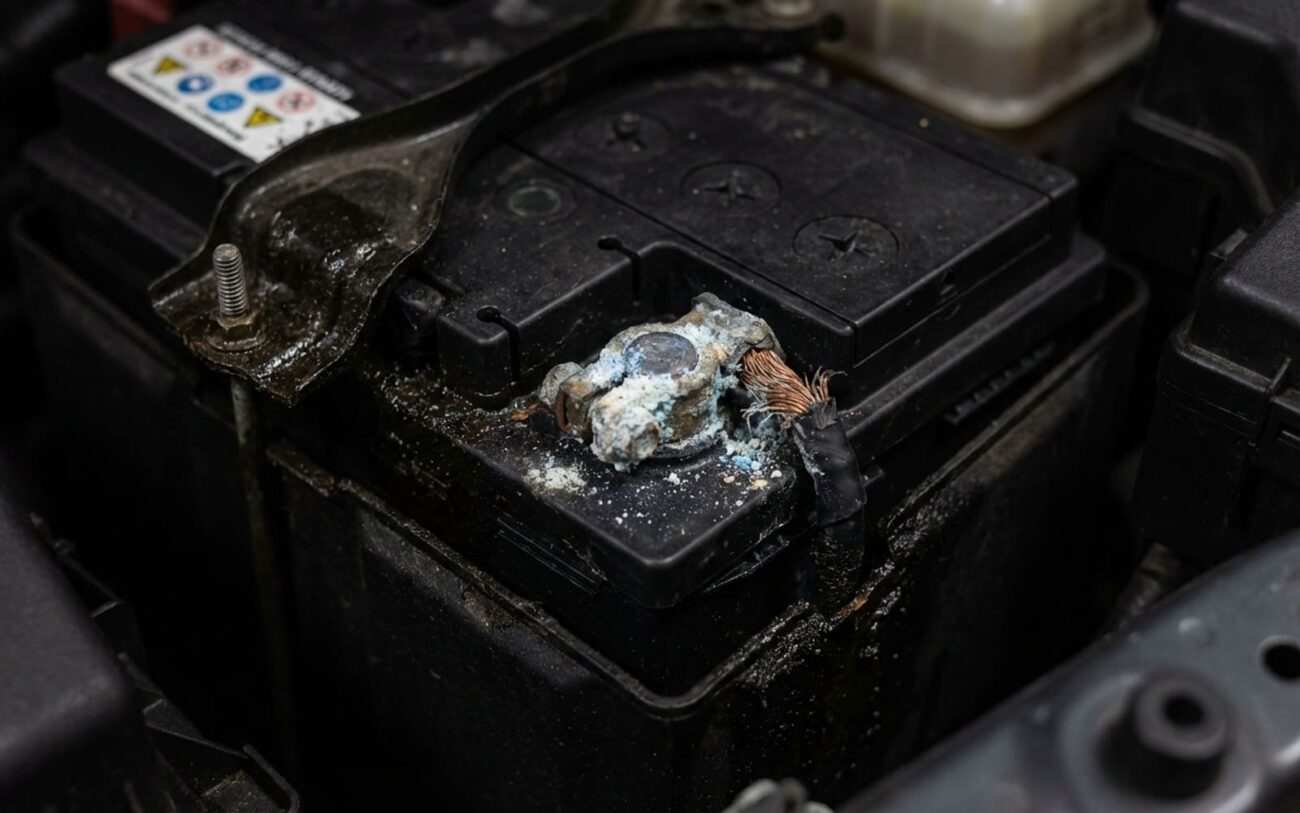
- Inspect Terminals and Grounds: Clean both 12V battery terminals. Look for corrosion. Check the main chassis ground for tightness and corrosion.
- Test the Main Fuse/Fusible Link: There’s often a big 120A or 150A fusible link near the 12V battery. Use your multimeter to check for continuity. If it’s blown, the converter can’t charge.
- Parasitic Draw Test: Disconnect the negative 12V terminal. Set your meter to amps and measure current draw with everything asleep. Anything over 50mA after 15–20 minutes means something’s staying awake and draining the battery.
- Scan Tool Check (if available): Look for DTCs. P0A80 (Hybrid Battery Module Deterioration) is common, but also look for manufacturer-specific DC-DC codes. Check live data PIDs like “DC/DC Converter Output Voltage,” “Duty Cycle,” and “Status.” If the duty cycle is pegged at 100% but the output voltage is still low, that converter is struggling internally.
- The Definitive Converter Output Test: This is the big one. With the vehicle in READY mode, measure voltage directly at the DC-DC converter’s 12V output terminal. If you see anything below 13.5V, but you know the high-voltage input is present (because the car is in READY mode), then the converter itself is faulty.
Don’t forget about the high-voltage system contactors. If they’re not engaging, the DC-DC converter won’t even get the high-voltage input it needs to operate. That’s a whole other can of worms, but it’s important to remember the converter can’t make 14V out of nothing.
Inside the Box: What Fails and Why
Once you’ve done your due diligence and confirmed the DC-DC converter is indeed the culprit, the next question is always: what actually broke inside? These converters are sealed, high-efficiency power supplies, packed with sensitive electronics. They live a tough life, dealing with high voltage, high current, and a lot of thermal stress. Over time, that takes its toll.
What I see most often are failures in the power semiconductors—things like MOSFETs and diodes. These are the workhorses, responsible for switching and rectifying all that current. They degrade from constant thermal cycling. Every time the car runs, the converter heats up; when you shut it off, it cools down. This expansion and contraction fatigues solder joints and the bonds within the semiconductors themselves. Eventually, a joint cracks, or a MOSFET fails short, and the converter simply stops regulating voltage.
Another common failure point is the large electrolytic capacitors on the control board. They’re there to smooth out the stepped-down voltage, but they lose capacitance or develop internal resistance over time. Sometimes you’ll see them bulging or even leaking, which is a dead giveaway, but often the failure isn’t visible without actually opening the unit up.
If your converter is liquid-cooled, you’ve got another potential failure point. Internal coolant channels or seals can degrade. If coolant leaks into the electronics compartment, it’s a recipe for disaster—corrosion on busbars, connectors, and circuit traces. I’ve personally seen this happen on a number of Ford Escape Hybrids and older Honda Insights.
Air-cooled units aren’t immune, either. If the intake vents get clogged with leaves, road grime, or even rodent nests (yes, this happens more than you’d think), the converter can’t cool itself. Sustained high temperatures dramatically accelerate component aging. And while physical impact damage is rare, it’s not impossible, especially if the converter is mounted low on the chassis.
A Note on Manufacturer Tendencies:
I’ve seen some manufacturers issue service bulletins for specific DC-DC converter failures. For example, some Toyota and Lexus hybrids from the late 2010s had known issues with converter overheating, often due to an inadequate cooling design. But here’s the crucial point: a failed 12V battery or an open high-voltage contactor circuit doesn’t mean the converter itself is bad. If the high-voltage system isn’t active, the converter has no input—and it simply can’t function. It’s like trying to run your TV without plugging it into the wall.
Getting It Fixed: Repair Paths and Safety First
How you fix this really depends on what your diagnosis revealed. Not every issue means you need a whole new converter, and frankly, not every repair is safe for a DIYer.
Internal Converter Failure Professional Only
External Terminal or Connection Repair DIY Feasible with Caution
Emergency Life Support Temporary / Last Resort
The Proof is in the Puddin’: Post-Repair Validation
Replacing the converter isn’t the end of the job. You absolutely have to validate that your repair actually fixed the root cause. With the vehicle in READY mode, measure the voltage at the 12V battery terminals again. You should see a stable 14.0 to 14.5 volts. If it’s still lower, you’ve still got a problem—either with the new unit, your installation, or another part of the circuit you might have missed.
Clear all diagnostic trouble codes using a scan tool. Then, drive the car for a few cycles and monitor for any codes to return. If you have access to live data, verify that the DC-DC converter’s duty cycle adjusts normally under load and that no fault flags appear. It should be working smoothly, not struggling.
Also, confirm the hybrid system engages reliably every time. The car should enter READY mode consistently, and all those annoying warning lights should stay off. If that 12V voltage fluctuates or drops significantly after shutdown, go back and check for parasitic draws again—especially if the vehicle sits for several days. This validation step is critical. Don’t just assume the part was bad; verify the entire circuit is now functioning correctly.
Dollars and Sense: Cost, Risk, and When to Walk Away
Let’s talk about the money, because DC-DC converter repairs aren’t cheap. You really need to weigh the cost against your vehicle’s current value and how much reliability you expect to get out of it.
| Repair Type | DIY Cost | Shop Cost | Success Rate | Secondary Risk if Failed |
|---|---|---|---|---|
| DC-DC Converter Unit Replacement | $800–$1,500 (OEM part only) | $1,200–$2,200 (parts and labor) | 98% | Improper HV handling can damage the inverter or hybrid battery, leading to repairs exceeding $5,000. |
| External Terminal Cleaning/Repair | Under $50 | $150–$300 (labor) | 80% | Intermittent connection can cause sudden power loss, risking safety systems during operation. |
Here’s my rule of thumb: if the repair cost starts to climb over 50% of the vehicle’s current running value—what it’s actually worth to you as a functional daily driver—it’s time to seriously reconsider. For older hybrids, the next big ticket item could easily be the high-voltage battery, which often costs more than the entire car is worth. You don’t want to throw good money after bad.
Also, do a little research on your specific make and model. Some hybrid models have known DC-DC converter issues, while others are pretty bulletproof. I’ve seen higher failure rates on certain Ford Escape Hybrids and some early Prius models, for instance. Knowing your vehicle’s history can help you make a better economic decision.
Keeping It Running: Prevention and Monitoring
Prevention starts with understanding why these things fail. Most DC-DC converter breakdowns I see are tied to heat, contamination, or just plain poor maintenance. If your vehicle has an air-cooled converter, make it a habit to inspect the intake and exhaust vents regularly. Leaves, dirt, road grime, or even rodent nests can completely block airflow, leading to overheating. Clean them out during your routine underhood checks.
For liquid-cooled units, you absolutely have to follow the manufacturer’s coolant service interval. Religiously. And use only the specified hybrid coolant type—mixing or using the wrong fluid can cause internal corrosion and lead to premature failure. I’ve seen multiple cases where skipping coolant changes led directly to a converter replacement at just 80,000 miles. Don’t cheap out on this.
My Monthly Check-Up Habit:
Build this into your routine: once a month, with the car in READY mode, pop the hood and check the 12V battery voltage. You should consistently see 14.0–14.5V. If it’s only 12.6V, your DC-DC converter isn’t charging. That’s your cue to investigate immediately. Catching this early can save you a roadside breakdown and prevent stressing out other expensive electrical components.
Finally, don’t ignore the little things. If your smart key isn’t working right, warning lights flash on startup, or accessories seem slow, those are often early signs of low 12V voltage. Run a parasitic draw test if the battery drains overnight, and consider checking the trouble codes even if no check engine light is on. Many hybrid control modules will store “soft faults” long before they trigger a dashboard warning. Being proactive can save you a lot of grief down the road.
