EV Charge Port Door Stuck? Let’s Get It Sorted.
Alright, let’s talk about those finicky EV charge port doors. I’ve been turning wrenches for over twenty-five years, and trust me, I’ve seen more of these stuck, jammed, or just plain refusing to cooperate than I can count. Whether it won’t pop open when you hit the button, or it opens fine but just won’t latch shut, it’s a common headache for EV owners. You might hear a little whir or click, but nothing happens. Or maybe it flops open and hangs there, exposing all the sensitive bits. These aren’t just minor annoyances, either; they can lead to some bigger, much more expensive problems if you ignore ’em.
The good news? Most of the time, the fix isn’t some deep, dark electrical mystery. We’re usually looking at a mechanical issue, sometimes an electrical hiccup, or just plain old environmental wear and tear. The trick is figuring out which one it is, and that’s what we’re going to do right now, step-by-step.
First Things First: What’s Really Going On Here?
When I talk about the charging port door assembly, I mean the whole shebang: the door itself, its hinges, the latch mechanism, and that inlet where your J1772 or CCS connector plugs in. This is separate from the actual actuator motor that opens it, the control module that tells it what to do, or even your charging cable. Knowing that distinction is your first step to a correct diagnosis.
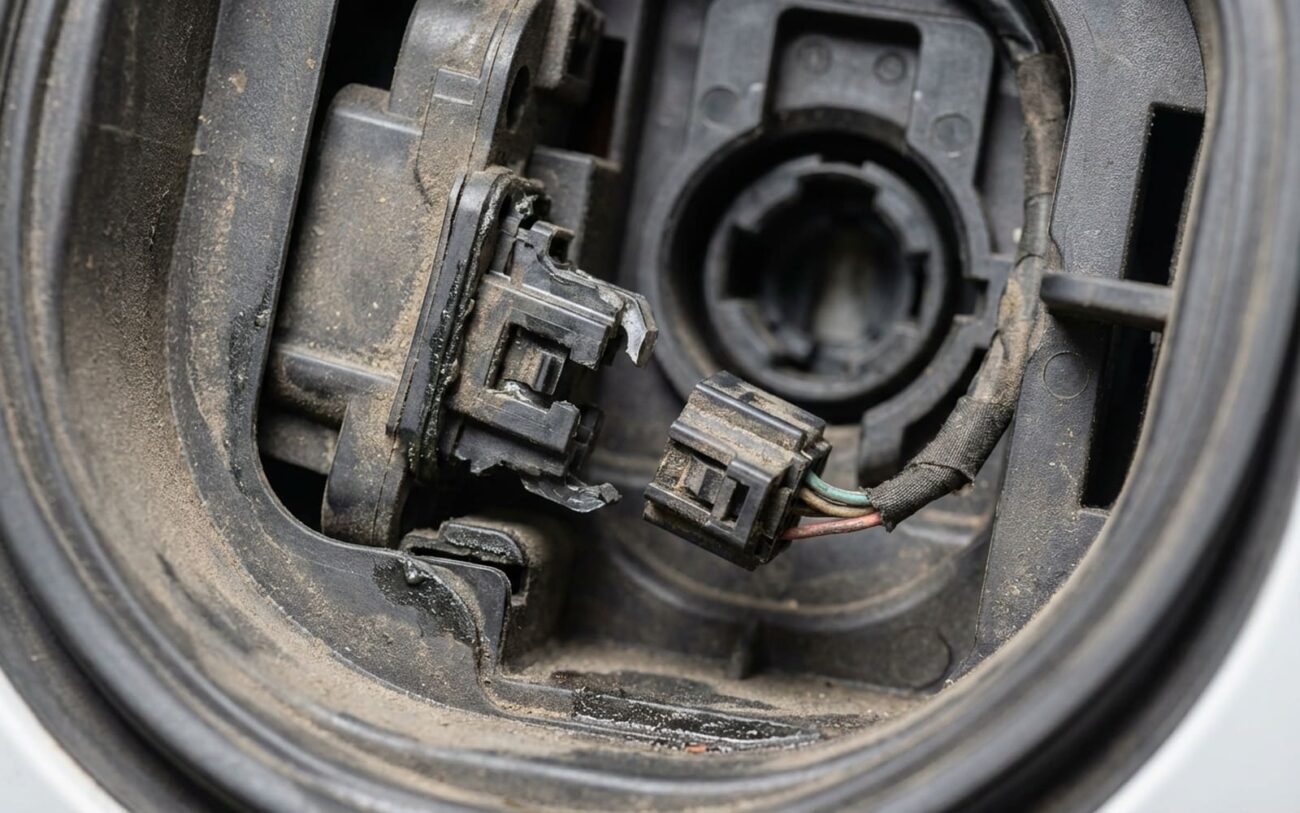
Now, if you see obvious damage—a cracked housing, a bent hinge, or the door just looks crooked—that’s your first clue. But often, the door looks perfectly fine, yet won’t open. Try giving it a gentle pry with your fingers. If it feels completely frozen, you’re likely dealing with something binding up mechanically in the hinge or latch. If it opens easily but won’t stay closed, then the internal latch mechanism inside the door is probably worn or broken.
Here’s where it gets tricky, though: these symptoms can often fool you into thinking it’s an electrical problem when it’s not. A bad charge port actuator, a weak 12V battery (yes, even EVs have one, and it’s critical!), or a communication glitch from the body control module (BCM) can all make the door act like it’s dead. And if your charger won’t latch into the port, the fault might not even be with your car’s door, but with the charging cable itself. I’ve had plenty of customers replace the entire door assembly, only to find out their old J1772 plug was just worn out. Always check the simple stuff first.
My Diagnostic Roadmap: Pinpointing the Real Problem
The key here is to figure out if the problem is actually inside the door assembly itself, or if something external is causing the grief. This table is my go-to for guiding the diagnosis:
| Symptom | Likely Door Assembly Issue | Common External Causes | How I Confirm It |
|---|---|---|---|
| Door won’t open (switch, app, fob) | A seized hinge pin, a bent pivot, or internal mechanical binding. Could be gunked up. | Faulty actuator motor, weak 12V battery, BCM command failure, or a wiring problem. |
Locate and use the manual override (it’s usually a cable or pull tab hidden behind some interior trim). If the door opens smoothly with the override, your mechanical path is clear – the fault is definitely electrical. If it’s still stiff or jammed, the door assembly itself is binding. |
| Door opens but won’t stay closed | A worn, broken, or fatigued internal latch mechanism. Plastics get brittle over time. | A misaligned or damaged striker pin on the car body, or a faulty door-closed sensor. |
Visually inspect the striker pin for damage or misalignment. Use a feeler gauge to check its position against specs if you have them. If you can, remove the door and manually operate the latch to feel its engagement. Compare it to a new part if you have one handy. |
| Charger plug won’t latch into inlet | Damaged guide fins, something obstructing the latch surface, or a deformed inlet housing. | A worn or broken latch on the charging cable itself, debris jammed in the connector, or a fault with the cable’s internal ECU. |
Give the inlet a good visual inspection for any physical damage or foreign objects. Then, try plugging in a different, known-good charging cable. A healthy connector should slide in smoothly and give you a satisfying click when it latches. |
Why Do These Doors Give Up the Ghost?
When the problem is truly inside the door assembly, it almost always boils down to one of these four things:
-
Material fatigue: Think about it – that door cycles open and closed hundreds, maybe thousands, of times over the life of the vehicle. Those little plastic hinge points and tiny spring-steel latches just wear out. You’ll see hairline cracks develop, especially if you live in a colder climate where thermal contraction makes plastic brittle.
-
Impact damage: It doesn’t take much. A bump from a clumsy charger handle, a rogue shopping cart, or even just parking too close to something can bend the door or damage those delicate guide fins inside the inlet. Those fins are critical for proper alignment when you plug in; if they’re bent, your connector won’t latch, simple as that.
-
Corrosion: If the rubber seal around the door starts to fail, moisture gets in. Over time, that moisture starts to corrode metal latch components and hinge pins. I’ve pulled apart doors where the latch was nearly seized solid with rust and crud.
-
Manufacturing variation: It’s rare, but it happens. Sometimes, early production runs have parts that just aren’t quite up to snuff. For instance, I’ve seen service bulletins for certain 2022 model-year GM EVs where the charge port door hinge pins didn’t meet spec, causing them to bind up prematurely. Always worth checking for TSBs (Technical Service Bulletins) if you suspect this.
And just to be crystal clear: if your actuator motor fails or the door-closed sensor goes bad, that’s not a “door failure.” That’s an electrical or control system issue. The door assembly is the physical piece you can hold in your hand. Knowing that distinction saves you time and money when you’re troubleshooting.
Getting It Fixed: Your Options, From Simple to Shop-Level
Clean and Lubricate the Hinge DIY-FEASIBLE
Full Door Assembly Replacement Professional Only
Cracked Housing or Corroded Mechanism Non-Repairable
Door Won’t Latch – Quick Field Fix Last-Resort
Don’t Skip This: Validating the Repair
A repair isn’t truly done until you’ve verified it. Here’s how I confirm the job is actually fixed:
-
For a simple clean/lubricate: The door should open and close manually with smooth, consistent resistance. No grinding, no catching, no uneven travel. It should feel “right.”
-
For a full replacement: Test every single open/close command you have – the key fob, the touchscreen, the mobile app. Then, hook up your scan tool and confirm that the BCM (Body Control Module) is reading “CLOSED” and “LATCHED” in the data stream. Finally, grab a known-good charger. It should insert fully, latch with a solid click, and when you press the release button, the connector should disconnect cleanly without any fuss.
If any of those steps fail, you need to go back and double-check your alignment, the initialization process, or your wiring connections. A misaligned striker pin is probably the most common oversight I see after a replacement.
What This Repair Will Cost You
Here’s a breakdown of what you can expect to pay, depending on how you tackle the repair:
| Repair Type | DIY Cost | Shop Cost | Success Rate | Secondary Risk if Failed |
|---|---|---|---|---|
| Clean/Lubricate Hinge | $15–$25 (contact cleaner, silicone lubricant) | $90–$120 (about 0.5 hr labor) | High | None if done correctly. Risk of damaging interior trim if you’re not careful with your tools. |
| Full Door Assembly Replacement | $300–$800 (OEM part cost) | $500–$1,200 (part + 1.0–1.5 hr labor + programming) | Very High | Improper torque can strip mounting points. Incorrect relearn/initialization often requires dealer-level scan tool access to fix. |
My Two Cents (Expert Advice)
Here’s something I tell every single customer in my shop: if the repair cost starts creeping up towards 40% of your EV’s current market value, especially on an older model, you need to step back and look at the bigger picture. Is it truly worth sinking that money into? On a newer car with a healthy battery and no other issues, absolutely. But on an older one that might have other problems lurking, this could just be the first domino in a chain of costly repairs. Make that call based on your long-term plans for the vehicle.
Keeping It From Happening Again: Simple Prevention
Preventing these issues is usually pretty simple, but it’s effective. When you’re washing your car, take an extra second to wipe down the charge port area with a damp cloth – that removes grit and grime that loves to work its way into the hinge and latch. And whatever you do, never blast high-pressure washers directly at the door. If you start hearing a squeak, use only the manufacturer-recommended lubricant; don’t just spray whatever you have handy. Every time you charge, take half a second to observe: does the door open and close smoothly? Does it close with a firm, solid thunk? Any new grinding, whining, or hesitation is an early warning sign that something’s not right.
Also, keep a close eye on your 12V battery. A weak one can absolutely prevent the actuator from having enough juice to open or close that door properly. If your EV has a known history of 12V battery issues – like some of the older BMW or Mini models, for example – the charge port might just be the first symptom you notice.
