EV Suspension Wearing Out? You’re Not Crazy.
Alright, let’s cut to the chase. If you’ve got an EV and you’re noticing your suspension feels a bit… tired… sooner than you’d expect, you’re not imagining things. I’ve had more electric cars roll into my shop with this exact issue than I can count over the last few years.
See, everyone talks about that low center of gravity giving your EV great handling, and it does. But that benefit comes with a cost: a whole lot of extra weight from that big battery pack mounted in the floor. We’re talking hundreds, sometimes over a thousand pounds more than a comparable gas car. And that extra mass isn’t just affecting your range; it’s constantly beating up every single suspension component.
Sure, the engineers designed these systems to handle it. But physics is a stubborn beast. More mass means more stress, more deflection, and ultimately, wear that shows up a lot faster than most folks are used to. Specifically, I’m seeing struts and especially bushings taking a real beating.
Delta: +35% Load
What to Look For: Signs Your EV’s Suspension is Crying for Help
When suspension components start wearing out prematurely from all that EV weight, the signs aren’t usually subtle. But here’s the kicker: they can sometimes be mistaken for other problems if you’re not paying close attention. In my experience, these are the most common red flags:
Abnormal Tire Wear
This is often the first thing I see. You’ll notice excessive wear on the inner or outer edges of your tires, often with a scalloped or feathered pattern. And it’ll happen even if you just had an alignment done. What’s going on? Those bushings have permanently deformed under the constant load, shifting your wheel alignment just enough to start scrubbing the tires away. It’s a dead giveaway.
Shocks and Struts Giving Up Early
Next up, your shocks and struts might start failing a lot sooner than you’d expect. If your car keeps bouncing like a pogo stick after hitting a bump, or if you spot any oily streaks down the side of the shock body, those dampers are done. They’re cycling under much heavier loads, so their internal seals degrade faster and the fluid breaks down under all that repeated stress.
Unpleasant Noises
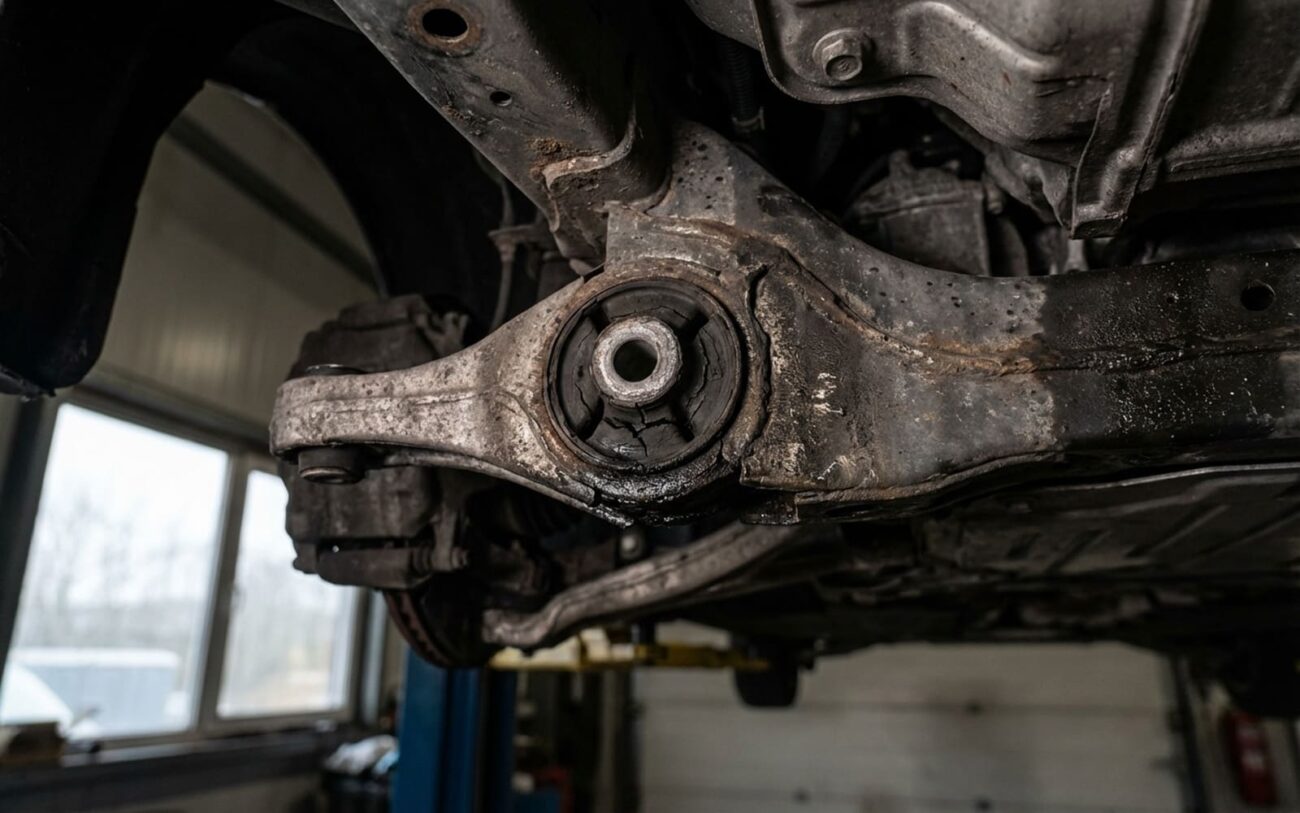
Then come the noises. We’re talking clunks over bumps, rattles during hard acceleration, or even during strong regenerative braking. These often point straight to fatigued control arm or sway bar bushings. That rubber can crack, split, or even get squeezed right out of its metal housing. And trust me, once you hear it, you can’t un-hear it.
Sagging Ride Height
Finally, if your EV sits noticeably lower than its factory ride height – especially if it’s lower in just one corner – your coil springs might have “taken a set.” That means they’ve compressed permanently from the constant heavy load, and they’re not providing the support they should.
Okay, So How Do We Figure Out What’s Really Wrong?
Now, just because your EV is heavy doesn’t mean every single suspension problem it develops is directly caused by that battery weight. You could hit a nasty pothole and bend a control arm, or a ball joint could just fail on its own. The trick here is accurate diagnosis. You’ve got to match the symptoms you’re seeing to the most likely cause, but then – and this is critical – you always verify it with proper testing.
Here’s a breakdown of what I usually see, what it could be mistaken for, and how I confirm the real issue:
| Symptom | Likely from Mass-Induced Wear | Common External Mimics | My Go-To Test to Confirm |
|---|---|---|---|
| Premature tire wear | The wear pattern is caused by a persistent alignment shift. This happens because bushings are deflecting under continuous, heavy load. | Could be incorrect alignment (from a bad shop), underinflated tires, other worn ball joints, or just uneven cargo loads. |
First, a full 4-wheel laser alignment. Then, and this is key for EVs, recheck that alignment with simulated passenger and cargo weight. That extra load can tell you a lot. |
| Frequent damper failure | Seeing multiple struts or shocks fail before 50,000 miles, especially under normal driving conditions. | A single unit could be damaged from a specific road impact, you might have worn strut mounts, or sometimes, you just get faulty replacement parts. |
I always do a classic bounce test and a thorough visual inspection for leaks. For real precision, a shock dyno test can confirm damper performance. |
| Bushing clunks & degradation | You’ll see visible cracking, splitting, or the rubber actually being forced out of the metal sleeve due to constant pre-load and dynamic stress. | Could be worn ball joints, loose sway bar links, or even failing strut mounts. (I’ve got a whole guide on telling those noises apart if you need it.) |
Get the car on a lift, then use a pry bar to carefully load and unload the suspension components. Watch the bushings directly for any excessive movement, cracking, or rubber extrusion. |
The Science Behind the Wear: Why All That Weight is a Killer
So, you’ve seen the symptoms, and you know it’s happening. But why does this extra weight cause such a headache? It really comes down to two main forces: static load and dynamic load.
Static Load: The Constant Downward Pressure
Static load is just the constant, unrelenting weight of that battery pack pressing down on your suspension, 24/7. Think about it: a Tesla Model Y battery weighs around 990 pounds, and a Hyundai Ioniq 5’s pack can exceed 1,100 pounds. That’s a lot of mass that never, ever unloads. Your springs and especially your rubber bushings are under continuous compression, even when the car is just sitting in your driveway. Over time, that rubber undergoes what we call “stress relaxation”—it loses its elasticity, develops tiny micro-cracks, and just gets tired.
The Concept
“Think of it like a hiker carrying a 100lb pack: the legs (suspension) wear out long before the heart (motor) does.”
Dynamic Load: The Impact Multiplier
Then there’s dynamic load. This is where things get really brutal. Every bump, every pothole, every sudden stop or acceleration (even regenerative braking!) multiplies the force on your components. Remember F = ma? Force equals mass times acceleration. When your mass is significantly higher, even a small acceleration (like hitting a speed bump) creates exponentially higher loads on your shocks, springs, and bushings. They’re just working harder, all the time.
Real-World Data:
This isn’t just theory. Engineering studies have actually shown that a 20% increase in curb weight can reduce the service life of a bushing by up to 70% under identical driving conditions. That’s a massive difference.
Alright, How Do We Fix It? Your Repair Options
Seriously, Safety First Here.
Look, suspension work on these heavy EVs is absolutely not a DIY job for the casual wrench-turner. You’ve got high-tension springs, incredibly heavy components, and often high-voltage lines nearby. It requires specialized tools, specific safety protocols, and a solid understanding of the vehicle. There are no safe shortcuts; a compromised suspension isn’t just uncomfortable, it’s a major safety risk.
Direct OEM Replacement The Standard Path
Performance-Grade Upgrade Heavy Duty Option
Okay, We Fixed It. But Did We Really Fix It? (Validation is Key)
Look, after any suspension repair, especially on an EV, you absolutely cannot skip the validation step. This is where a lot of shops cut corners, but it’s crucial for long-term reliability and your safety. Here’s my process:
The Road Test
I always take the car for a thorough road test. I’m driving over known bumps, through turns, hitting the brakes, accelerating—listening for any new noises, feeling for vibrations, or any steering pull. The vehicle should ride smoothly, without that excessive bounce or float you had before.
The Alignment Printout
Next, you must get a full printout from a 4-wheel laser alignment. Every single value—camber, caster, toe—has to be within factory specifications for your specific model and trim. Don’t let anyone tell you “it’s good” verbally; ask for the actual alignment report. It’s your proof, and it tells me if everything is sitting correctly after the repair.
Post-Drive Inspection
Finally, I tell my customers (and I do this myself) to bring the car back after 50–100 miles of driving. I’ll get it back on the lift and inspect under the car. I’m looking for any fresh oil leaks on the shocks, or any signs of movement at the mounting points. Sometimes things settle, and you want to catch that early.
The Hard Numbers: What You’re Looking At for Cost and Risk
Let’s be realistic about what you’re investing here. EV suspension repairs generally cost more than their ICE counterparts. That’s due to the weight, the inherent complexity, and the need for specialized tools and precise alignment. Here’s a general idea of what you can expect:
| Repair Scope | DIY Parts (Est.) | Professional Cost (Est.) | Success Rate | Secondary Risk |
|---|---|---|---|---|
| Replace Dampers & Springs | $1,200 – $2,500 | $2,800 – $4,500 | High | Component separation during installation, or accidental damage to brake lines/wiring. |
| Full Bushing Refresh | $600 – $1,500 | $2,000 – $3,500 | Moderate | Rapid re-wear and fast tire wear if the pre-load isn’t set correctly during installation. |
Staying Ahead: My Tips for Extending Your EV’s Suspension Life
My Proactive Maintenance Checklist
-
Rotate your tires every 5,000 to 6,000 miles, no exceptions. This is non-negotiable for managing uneven wear on heavy EVs.
-
Always use components rated for your vehicle’s actual load. Never, ever downgrade to lighter-duty parts to save a few bucks. You’ll pay for it later.
-
Do visual inspections of your control arm bushings every six months. Get under there with a flashlight and look for cracks, splits, or bulging rubber.
-
Monthly “hand-feel” checks across your tire treads. Run your hand across the tread to detect early edge feathering or cupping. It’s a simple trick that can save you a lot.
