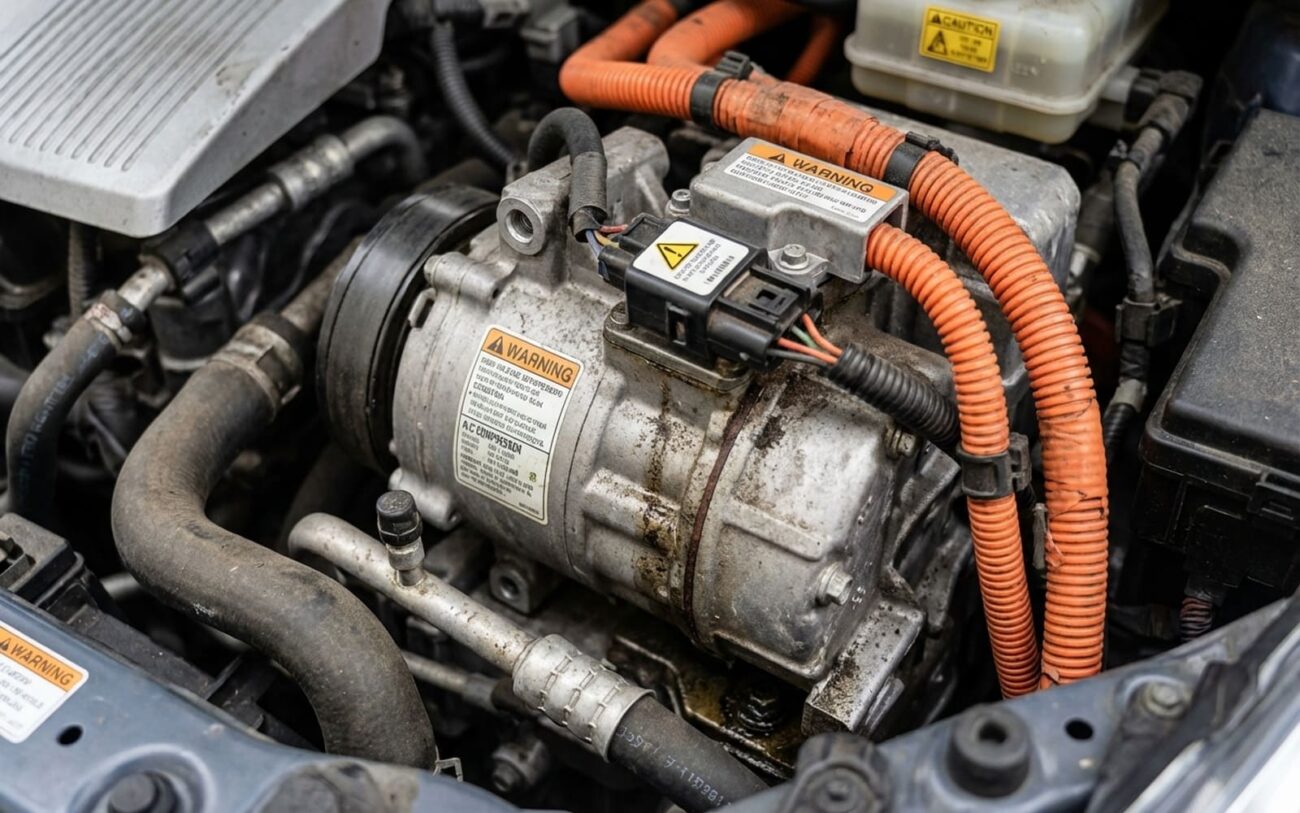
Alright, let’s talk hybrid A/C. You hop in, turn the knob, the fan kicks on, but there’s no cold air. The engine might be humming along, but your cabin just keeps getting warmer. Pop the hood, and you listen for that familiar compressor engagement, but… silence. That silence is usually the first big clue, especially in hybrids like a Prius or an Insight. See, these aren’t your grandpa’s A/C compressors. They’re electric, powered directly by the high-voltage (HV) system. If it’s dead silent – no click, no hum, no bearing noise – it’s probably not getting juice. And that, my friends, often points to a problem deep in the HV circuit or its control system.
Now, sometimes it’s more dramatic. The A/C cuts out suddenly, and boom – you get a red “Check Hybrid System” warning or a Master Warning light. That’s the car’s brain detecting a fault and shutting down high-voltage accessories to protect itself. This kind of shutdown usually means there’s a problem with the HV inverter, the DC-DC converter, or an internal fault right inside the compressor’s own electronics. And here’s the kicker, something a lot of owners don’t realize: ignoring this, or trying to just keep driving, can lead to much bigger headaches. I’ve seen a simple A/C issue turn into a full hybrid system meltdown – a shorted compressor winding or a failing inverter can overload the Power Management ECU or even the main hybrid inverter. That’s how you end up on the side of the road, waiting for a tow truck. Believe me, I’ve towed in more than a few cars where a small A/C problem escalated because it was overlooked.
What I Check First: Diagnosing the Real Problem
You can’t just throw parts at these systems; it’s too expensive and frankly, it’s just guessing. The trick is figuring out if the problem is truly in the high-voltage A/C circuit, or if something else is just mimicking those symptoms. Over my years, I’ve seen a few common patterns, and I’ve got a pretty solid way to test them.
Symptom 1: Compressor is Dead Silent, No Trouble Codes
This is the classic “A/C just quit” scenario. The blower works, but no cold air, and no compressor sound. And here’s the important part: no check engine light, no hybrid warnings. What I’m looking for here are things that would prevent the compressor from being commanded on, or a simple power delivery issue before it gets to the smart stuff.
First, I’ll check the basics: Is the refrigerant charge good? A low charge will trip the pressure switch and prevent the compressor from running, and that’s not an HV issue. I’ll also check the cabin A/C request signal – is the climate control module even asking for cold air? Sometimes it’s something as simple as a faulty evaporator temperature sensor telling the system it’s already cold enough.
If those are good, then I grab my professional scan tool. I’ll command the A/C compressor ON and watch the compressor speed PID (Parameter ID). If the command goes out, but the speed reads zero, then we know the issue is likely power or control to the compressor. Next up, I’m verifying 12V control power and ground at the compressor’s low-voltage connector using a multimeter and the wiring diagram. An open circuit in the 12V control side, a blown fuse (yes, there’s usually a 12V fuse for the control logic), or a failed relay can cause this.
Symptom 2: Compressor is Dead, WITH High-Voltage System Trouble Codes
Now we’re talking serious business. If you’ve got codes like P0A0D, P0A78, or P3004, that’s the car telling you there’s a problem with the high-voltage system itself. This isn’t just a simple control issue; it’s often an internal failure within the compressor’s integrated inverter, a short in the HV cables, or degraded insulation somewhere in that circuit.
This is where I immediately think about an insulation fault. I’ll perform a high-voltage system insulation resistance test using a dedicated insulation tester – often called a megohmmeter. You have to follow OEM safety protocols to the letter here. That means insulated gloves (Class 0 at minimum, with leather protectors), safety glasses, and proper lockout procedures to de-energize the HV system. I’ll disconnect the compressor’s HV connectors and measure the resistance between the terminals and chassis ground. If I see a reading below 1 MΩ, that’s a red flag for a fault in the compressor or its wiring. Let me be absolutely clear: this is PROFESSIONAL-ONLY work. If you don’t have the training and the right safety gear, do NOT attempt this.
Just to be thorough, I’ll also consider if it could be a failing hybrid battery contactor, a DC-DC converter malfunction, or a broader HV system isolation fault that’s mimicking a compressor issue. The codes usually help narrow that down, but a full system scan is always necessary.
Symptom 3: Intermittent A/C with “Check Hybrid System” Warning
Intermittent problems are always the toughest, but when it’s tied to a “Check Hybrid System” warning, it usually points to something overheating or failing under load. I’ve seen this often with the power transistors inside the compressor’s inverter module.
For this, I rely heavily on live data from my hybrid-capable scan tool. I’ll monitor compressor current draw, inverter temperature, and system voltage during operation. I’m looking for a sudden current spike or a voltage drop that happens right before the A/C cuts out. If I see that, it’s a pretty strong indicator of an internal inverter issue – it’s trying to work, but something inside is failing under the electrical load.
Sometimes, a weak or imbalanced hybrid battery can cause voltage instability across the entire HV system, which can then trigger shutdowns of accessories like the A/C. So, while I’m looking at the compressor data, I’m also keeping an eye on the overall battery block voltages.
What Actually Fails Inside These Compressors
Once you’ve confirmed the fault is indeed within the high-voltage A/C circuit, you’re usually dealing with one of three internal failures. And none of them are “mechanical” in the traditional sense – you’re not looking at a seized bearing or a worn clutch. It’s almost always about the electronics or the insulation.
The most frequent culprit I see is an Internal Inverter Failure. Unlike old-school compressors driven by a belt, these hybrid units use an electric motor powered by high-voltage DC. That DC power has to be converted to three-phase AC, and that’s done by an integrated inverter – basically, a compact box of Insulated-Gate Bipolar Transistors (IGBTs) and capacitors built right into the compressor. These components just wear out over time, especially with all the heat cycles they go through. When an IGBT fails (either shorts or opens), the inverter can’t generate the right waveform, and the motor just won’t spin. The actual scroll mechanism and bearings inside the compressor might be perfectly fine, but the electronics are toast.
Second, and more common than people realize, is High-Voltage Connector Degradation. That big orange connector on the compressor carries hundreds of volts. If it’s not seated perfectly, if moisture gets in, or if there’s even micro-movement over time (what we call fretting corrosion), resistance builds up. That resistance creates heat, which then accelerates oxidation, and eventually, you get arcing or intermittent loss of power. I’ve pulled apart connectors that looked absolutely fine on the outside, but inside, they had clear carbon tracking – a dead giveaway of internal arcing.
Third, you can have an Internal Motor Winding Failure. This happens when the copper windings inside the compressor motor short or open. Thermal breakdown is a common cause, but critically, it can also be caused by contamination from incorrect refrigerant oil. The insulation on those windings is designed for specific dielectric properties. If you use the wrong PAG oil – especially one not rated for high-voltage systems – you’re asking for insulation failure. That’s why using the OEM-specified oil, like ND-OIL 8 or its exact equivalent, isn’t just a recommendation; it’s absolutely essential for the compressor’s longevity.
Here’s a specific example I’ve run into: on some Prius models, there’s a known issue where a shared fuse in the junction block powers both the A/C compressor inverter and the motor electronics coolant pump. So, a failure in one circuit (say, a short in that pump) can blow the fuse and take out your A/C system too. This is why reading all the system data – not just the A/C codes – is so important.
And just to clear up a couple of things: if your A/C is out because of a low refrigerant charge tripping the pressure switch, that’s not a high-voltage fault; that’s a standard refrigerant issue. Also, there’s no clutch on these electric compressors to engage. They run only when the A/C control module commands them on via the hybrid system. If your engine is overheating despite normal coolant levels, that’s a whole different ballgame – you’ll want to check out Engine Overheating with Normal Coolant Level for that one.
Your Repair Options (and My Advice)
External Issues: Fuse, Relay, or 12V Control Wiring DIY-FEASIBLE (with extreme caution)
High-Voltage Connector Repair Professional Only
Full A/C Compressor Assembly Replacement
Making Sure the Fix Actually Worked
Verification is absolutely critical. You don’t just put it back together and hope for the best. For a fuse or relay replacement, success means the compressor runs across all A/C settings, your scan tool data shows commanded vs. actual RPM within 5%, and no codes return after a full drive cycle. That’s the minimum.
For connector repairs or a full compressor replacement, the validation is more involved. First, I always perform a post-repair insulation resistance test. OEM standards typically require greater than 10 MΩ between HV terminals and ground after any HV component work. Then, it’s a full A/C performance test: engine at 1,500 RPM, A/C on max in recirculation mode. I expect the center vent temperature to drop to 4°C–10°C (40°F–50°F) within about five minutes. To do this right, you need a professional scan tool, an HVAC manifold gauge set, a thermometer, and a proper refrigerant charging station. Skipping these steps is just asking for a repeat failure or missing a hidden fault that could cause bigger problems down the road.
The Cost and That Hard Decision
Let’s be realistic about the numbers. Here’s a breakdown of typical costs and outcomes I see in my shop:
| Repair Type | DIY Cost (Parts) | Shop Cost | Success Rate | Secondary Risk if Failed |
|---|---|---|---|---|
| HV Fuse/Relay Replacement | $5 – $50 | $100 – $200 | High, if root cause is accurately identified | If misdiagnosed, repeated fuse failure can damage the inverter or Power Management ECU, leading to much higher costs. |
| Compressor HV Connector Service | Not Recommended | $300 – $500 | High, when done correctly | Improper torque or seal failure can lead to arcing, which may cause future HV system faults or intermittent shutdowns. |
| A/C Compressor Assembly Replacement | $800 – $1,500 | $1,800 – $2,800 | High, when installation is precise | Incorrect oil charge or type can destroy the new compressor. Mishandling high-voltage components risks personal injury or system damage. |
Here’s the hard truth: if your hybrid is older and the repair cost starts to approach half its market value, you really need to weigh that investment carefully. A full compressor replacement is a significant expense. But, if the rest of the car is solid – a healthy hybrid battery, good body condition, reliable drivetrain – then it may absolutely still be worth it. I’ve seen owners extend the life of their Prius or Insight for years with this repair, getting plenty of value out of it.
How to Keep This From Happening Again
Prevention, in my experience, comes down to two things: using the right materials and staying proactive. Always, always use the OEM-specified refrigerant – whether it’s R-134a or R-1234yf – and the exact PAG oil type (like ND-OIL 8). Mixing oils or using generic substitutes is a recipe for disaster; it can degrade the motor insulation over time, leading to winding failure. This isn’t just a recommendation; it’s a necessity for long-term reliability.
For early detection, make it a habit to inspect that high-voltage connector on the compressor during routine maintenance. Every oil change, take five seconds to visually check that orange plug. Look for any signs of overheating – discoloration, melting, or white corrosion. Also, have your technician pull all hybrid system data during service. Many shops only scan for engine codes, overlooking pending or historical trouble codes in the A/C or hybrid control modules. Catching a P0A78 early, for instance, could save you from a full breakdown later.
And remember: in modern hybrids, all the electrical systems are deeply integrated. A single failing module can disrupt multiple functions. That’s why understanding system interdependence is key – you can learn more about how a small issue can snowball in Why a Single Module Failure Can Disable Multiple Systems.
