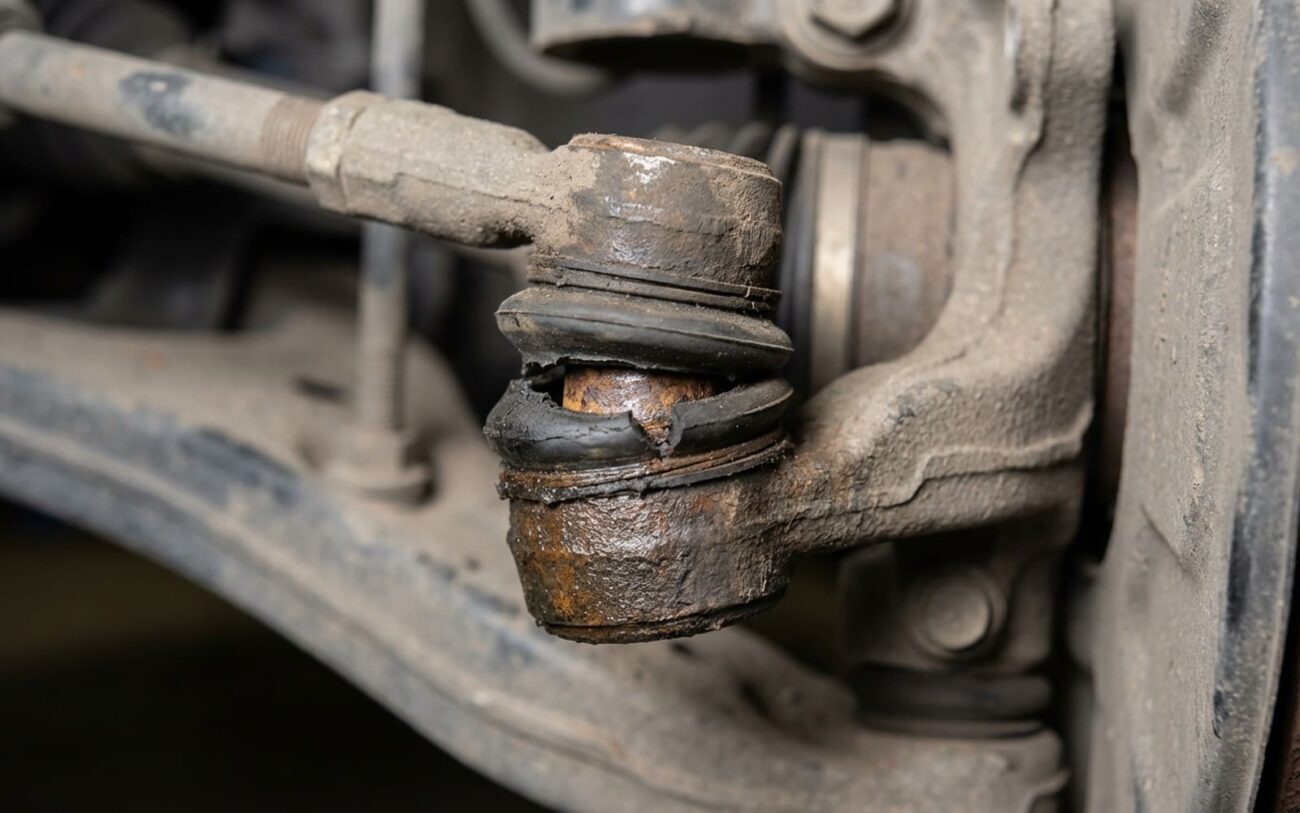
Alright, let’s talk about that steering knock. If you’re feeling a distinct clunk or a sharp knock through the steering wheel every time you hit a pothole, a speed bump, or even just a crack in the road, your vehicle isn’t just making noise—it’s trying to tell you something important. And after 25 years turning wrenches, I can tell you this: that knock is almost always a sign of excessive play in your steering linkage.
You’ll notice this most at lower speeds. Why? Because at 5 MPH, the body movement is minimal, so that sharp impact from a road imperfection really highlights any slack in the system. When you’re going faster, there’s more suspension movement and road noise, which can mask the subtle clunking.
The most common culprit I see in my shop? Worn tie rod ends. These little ball-and-socket joints are what connect your steering rack to your wheels, and they’re supposed to transfer every bit of steering input with zero slack. When they wear, even a tiny bit, you get that unmistakable “clack” as the joint shifts inside its worn-out socket under load. It’s like a door hinge with a loose pin; every time you move it, it clicks before it actually swings.
Usually, the outer tie rod end goes first. It’s more exposed to the elements and takes more direct abuse from steering and suspension movement. But don’t ever rule out the inner tie rod end, especially if the noise sounds like it’s coming from deeper in the engine bay. I’ve seen plenty of those fail too.
Tolerance: EXCEEDED
Figuring Out Exactly What’s Loose: My Diagnostic Approach
Look, a knocking noise over bumps isn’t always tie rods. It can come from worn steering rack bushings, a loose intermediate shaft coupling, or even suspension components like lower control arm ball joints or strut mounts. That’s why jumping to conclusions and just throwing parts at it is a waste of time and money. You gotta diagnose it right.
My approach is always systematic. You need to get the vehicle safely in the air, preferably on a lift, but sturdy jack stands will do. The goal is to isolate movement by applying force and observing where the slop occurs. You’re looking for any movement that shouldn’t be there.
The “Load & Listen” Test for Tie Rods
This is my go-to for tie rod ends. With the vehicle safely lifted and the wheels off the ground:
- Grab the wheel at the 3 and 9 o’clock positions. Have a helper firmly rock the wheel side-to-side, mimicking steering input.
- While they’re doing that, you get under the vehicle and grasp the tie rod, both inner and outer, with your hand. You’re feeling for any clunking or play. You’ll feel it before you see it most times.
- For the outer tie rod end, you can also use a pry bar under the wheel (or tire if still on) to lift the wheel vertically. Watch and feel the outer tie rod end for any up-and-down play. There should be none.
If you feel a distinct clunk or movement in either the inner or outer tie rod end, you’ve found your culprit. This usually presents as a knock over small bumps and sometimes a clunk when turning the wheel slightly while parked.
Checking the Steering Rack Bushings
Rack bushings are often overlooked, but they can definitely cause a knock. These are the rubber mounts where the steering rack attaches to the subframe. Get under the car and give them a good visual inspection. Look for any cracks, splits, or signs of collapse. Then, have your helper turn the steering wheel slowly, lock-to-lock, while you watch the rack housing. Any visible lateral shifting of the rack itself means those bushings are shot and need replacement.
The Input Shaft Test for Internal Rack Play
If you’ve got free play in the steering wheel, meaning you can turn the wheel a bit without the road wheels moving at all, that’s a different beast. This often points to internal wear within the steering rack itself—specifically, excessive clearance between the pinion and the rack gear. Here’s how I check it:
- With the vehicle on the ground, or at least with the wheels straight, have your helper turn the steering wheel just enough to take up the slack, but not enough to move the road wheels.
- You’ll be under the hood, watching the input shaft (the shaft coming from the steering column into the rack). If that input shaft rotates a noticeable amount before the tie rods start to move, then you’ve got internal rack play.
This kind of play can also be mimicked by loose U-joints in the intermediate steering shaft, so always check those too. Give the intermediate shaft a good shake and look for any play in its joints.
Why These Parts Give Up the Ghost
Knowing why something fails helps you prevent it from happening again. For tie rod ends, it almost always comes down to contamination. There’s a rubber boot (sometimes called a bellows) that’s supposed to keep the grease in and the dirt and moisture out. Once that boot cracks or tears, it’s a ticking time bomb. Water gets in, road grit gets in, and that internal grease turns into an abrasive slurry. That grit grinds away at the ball and socket, creating play faster than you can say “alignment.”
My Experience:
I’ve seen tie rods fail in under 30,000 miles when the boot was compromised. Keep that boot intact, and they can easily last 100,000 miles or more. On some vehicles, like the Renault Duster, I’ve noticed a pattern of premature inner tie rod wear. If you have a Duster, it’s worth asking a qualified shop if there are any known issues for your specific VIN. Sometimes, manufacturers have updated parts or specific service bulletins.
Internal rack wear, like that pinion-to-rack gear lash, is usually a result of long-term lack of lubrication, contamination in the power steering fluid, or just plain old age and fatigue. Sometimes a leaking seal or an improperly adjusted pinion bearing can mimic internal wear, but those are separate issues. A leak means fluid loss and potential pump damage, while a loose adjuster might cause noise but not necessarily excessive play.
Your Repair Options: From a Quick Swap to a Major Overhaul
SAFETY FIRST, ALWAYS.
Steering components are absolutely safety-critical. If you’re not 100% confident in your ability to torque bolts to factory specifications, use proper tools, or perform hydraulic bleeding, please, for your own safety and everyone else’s, seek professional assistance. This isn’t the place to guess.
Outer Tie Rod Replacement DIY FEASIBLE
- Loosen the jam nut on the tie rod.
- Count the threads or measure the exposed length of the old tie rod end before removing it. This helps get your toe alignment close for the drive to the alignment shop.
- Remove the castellated nut (or self-locking nut) and use the separator to pop the old end out.
- Install the new one, matching your thread count/length. Torque the castle nut to factory spec—for a Duster, that’s usually around 35–40 Nm.
A professional wheel alignment is absolutely mandatory afterward. Don’t skip it, or you’ll chew through tires in no time.
Inner Tie Rod Ends & Boots PROFESSIONAL ONLY
- The rack boot needs to be carefully removed without damaging it (or replaced if damaged).
- The inner tie rod is threaded directly into the steering rack. A special tool is required to remove and install it, as there’s no room for a regular wrench.
- Proper torque (often 50–70 Nm) and thread sealant are critical to prevent it from backing out.
- If it’s a hydraulic power steering system, you’ll likely have to disconnect a hydraulic line to get the boot off. This means you’ll need to bleed the power steering system properly afterward to avoid pump cavitation and noise. For Renault Dusters, I typically see ATF Dexron III fluid used.
Again, a full wheel alignment is essential after this repair.
Full Steering Rack Assembly NON-REPAIRABLE
Making Sure the Fix Actually Worked
Don’t just assume the repair is complete because the new part is bolted on. Validation is critical. For an outer tie rod replacement, I always re-perform the “Load & Listen” test. There should be absolutely no clunking or play. Use a pry bar on the tie rod end to check for vertical or lateral play—again, zero play is the only acceptable result.
After an inner tie rod repair or a full rack replacement, the verification is a bit more involved. The steering should feel smooth and tight through its entire range of motion. If it’s a hydraulic power steering system, it must operate quietly—any whining, groaning, or inconsistent assist suggests there’s still air in the system. I usually have the customer drive the car, turning lock-to-lock several times, then I recheck the fluid level after the system has cooled down. Sometimes it takes a few drive cycles for all the air to work its way out.
And here’s a pro tip: if you’re still chasing a persistent noise after a steering component repair, consider whether it could be related to other suspension components. Sometimes a worn strut mount or ball joint can mimic a steering knock, especially if the original problem was severe enough to mask other issues.
Costs, Risks, and the Big Decision
Outer Tie Rods
This usually includes parts, labor, and that mandatory wheel alignment. It’s the cheapest fix.
Inner Tie Rods
This covers parts, labor, new boots, and the hydraulic system bleeding if applicable. More complex, so more expensive.
Full Steering Rack
This is a major repair. You’re looking at significant labor and part costs. This is where you really need to consider the car’s market value before investing.
Here’s my reality check for customers: if the repair cost starts exceeding half the current market value of your vehicle—say, a $1,500 rack replacement on a $2,500 Duster—you really need to weigh that investment carefully. Look at the overall condition of the car: are there other issues looming, like rust, transmission problems, or accelerated suspension wear? Sometimes, it’s smarter to put that money towards a newer, more reliable vehicle.
Keeping It From Happening Again
Preventative Habits I Recommend
-
Inspect those rubber boots every six months. A torn boot is a ticking clock on joint failure. It takes two minutes to look, and it can save you hundreds.
-
Perform the “3 and 9 o’clock” rock test (as described above) during every oil change. Catching play early means a cheaper, simpler fix.
-
Keep your wheel alignment in check. Improper toe settings don’t just wear tires; they put undue stress on tie rod ends and accelerate their wear.
-
Avoid potholes and rough roads where possible. I know, easier said than done, but every hard impact stresses these components.
My Final Advice
Early detection lets you address small issues before they become major safety hazards or expensive headaches. If you hear or feel a knock in your steering, don’t wait. Diagnose it now, fix it right the first time, and you’ll drive with confidence, knowing your steering is solid.
