What’s Wrong With My Engine? It’s Always Spark, Fuel, or Air.
Look, when a car rolls into my bay running rough, it almost always comes down to one of three things: spark, fuel, or air. That’s the foundation of engine diagnostics. In modern vehicles, the usual suspects are ignition coils, fuel injectors, and the fuel pump. I’ve been doing this for over 25 years, and I can tell you, these components are critical for combustion. When one acts up, the symptoms can get tricky, even for a seasoned tech.
Misdiagnosing means you’re throwing parts at a problem that isn’t there, and that’s just wasting time and money. The real skill is learning to read the symptoms, not just the codes, like someone who’s seen these issues a thousand times. Because I have.
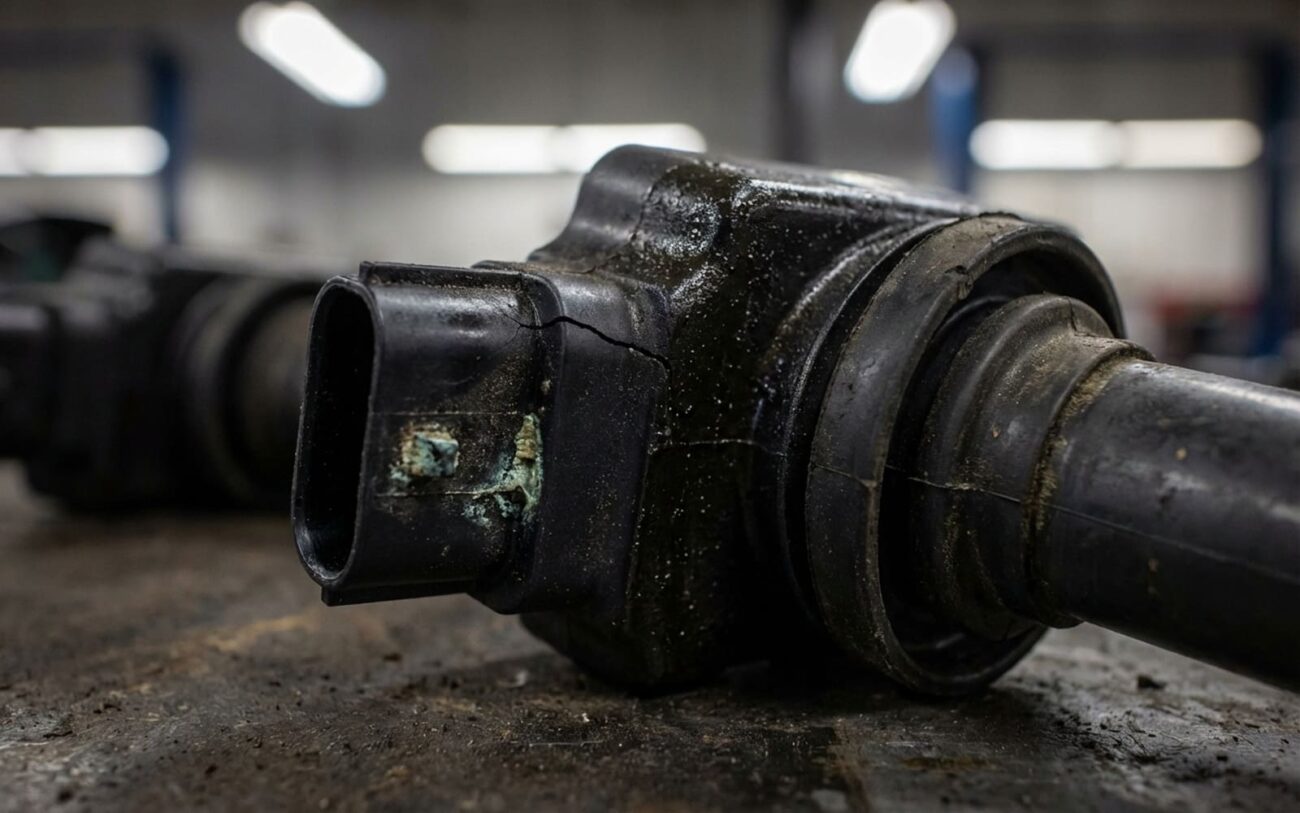
Ignition Coils: When Spark Goes Missing
A failing ignition coil usually gives you a misfire you can definitely feel. It’s that stumble, that hesitation, especially when you’re trying to accelerate or climb a hill. The engine shudders, and you might even hear it. And here’s the kicker: the check engine light often starts flashing. When it flashes, that’s the car screaming for help, telling you there’s a severe misfire that could be dumping raw fuel into your catalytic converter and melting it down. Common diagnostic trouble codes (DTCs) you’ll see are P0300 for a random misfire, or a specific one like P0303 if it’s cylinder #3 acting up.
My Quick Check
“If I suspect a coil, I’ll pull the car into a dark corner of the shop, start it up, and look for visible arcing. Blue sparks jumping from the coil or the spark plug boot? That’s a dead giveaway right there. Saves a lot of time.”
Don’t ignore that flashing light. Sustained misfires mean unburned fuel is washing down the cylinder walls, diluting your engine oil. That leads to increased wear, bore scoring, and eventually, a permanent loss of compression. I’ve seen more than a few engines completely ruined because someone kept driving with that flashing CEL, thinking it was “just a misfire.”
Fuel Injectors: Too Much, Too Little, or Nothing At All
Fuel injector problems can mimic ignition issues, but they have their own distinct clues. If an injector is clogged or failing, you’ll often see lean or rich fuel trim codes alongside a misfire. Think P0171 (system too lean) or P0172 (system too rich). The engine’s computer (PCM) tries to compensate for the imbalance by adjusting fuel delivery across all cylinders, which can actually make it harder to pinpoint the exact cylinder at fault. What I often do is grab my mechanic’s stethoscope and listen to each injector. A healthy injector makes a crisp, rapid clicking sound. A failing one might be silent, or have an irregular, dull click – different from normal valvetrain noise.
Fuel Pump: The Heart of the System
The fuel pump is the backbone of the whole fuel system. When it starts to go, it usually affects all cylinders at once. You’ll often notice long cranking times before the engine finally catches, especially after the car’s been hot and sitting for a bit. Sometimes it’ll die after parking for a few minutes, then magically start again once it cools down. Another classic sign is power loss under acceleration—the engine just “bogs down” when you try to pass someone. I always tell people to listen at the fuel filler cap or under the rear seats. A healthy pump makes a consistent, moderate hum when you turn the key to “on.” If you hear a whine, a screech, or it runs intermittently, that pump is on its way out.
Safety First:
If your fuel pump quits completely while you’re driving, you don’t just lose engine power. You lose power steering assist and brake booster vacuum. Suddenly, that car becomes incredibly hard to steer and nearly impossible to stop. That’s not just inconvenient; it’s downright dangerous. Don’t mess around with a dying fuel pump.
Differential Diagnosis: Don’t Guess, Test.
Just because you’ve got a misfire code doesn’t automatically mean the coil is bad. And same goes for fuel trim codes and injectors. These symptoms have a lot of look-alikes, and jumping to conclusions is how people end up wasting hundreds on parts they didn’t need. The real skill in this business is in testing, not guessing.
My diagnostic process always starts by eliminating the obvious: I check spark plug condition, do a quick compression test, look for vacuum leaks, and scan sensor inputs. Only then do I move on to specific tests that either confirm or rule out each component. It’s methodical, and it saves headaches.
| What You See | Likely Culprit (If Confirmed) | Common Imposters | My Go-To Test |
|---|---|---|---|
| Cylinder #3 Misfire (P0303) | Ignition coil: primary winding short or secondary insulation breakdown. | Fouled spark plug, cracked plug insulator, worn plug wire, low compression in that cylinder. |
Swap coil #3 with a known good coil (like #1). If the misfire moves to cylinder #1, you’ve found your bad coil. I’ll often confirm with an oscilloscope to see the ignition waveform. |
| Cylinder #2 Lean / High Fuel Trim | Fuel injector: clogged, restricted flow, or an open electrical circuit. | Intake manifold gasket leak, faulty O2 sensor, low fuel pressure to the rail, exhaust leak before O2 sensor. |
Perform an injector flow and leak-down test. Check injector resistance with a multimeter (should be 10–16 ohms). A noid light will confirm the PCM is sending a pulse. |
| No-Start, Extended Crank | Fuel pump: motor failure, worn brushes, or failed commutator. | Blown fuse, tripped inertia switch, faulty fuel pump relay, corroded wiring, empty tank (yes, I’ve seen it). |
Connect a fuel pressure gauge to the rail. Verify pressure hits the manufacturer’s spec (e.g., 55–62 psi) and holds. I also use an amp clamp to measure current draw at the pump to check its health. |
That coil swap test? It costs you nothing but a few minutes, and it confirms about 90% of coil issues right there. Fuel pressure testing is non-negotiable—if pressure is low, then the pump, the filter, or the regulator is suspect. For injectors, a quick resistance check with a multimeter is fast and reliable. Infinite resistance means an open circuit, zero ohms means a short. But even if the resistance is okay, the injector might not be getting a pulse signal. I’ve seen more than my share of damaged or frayed wires in the engine harness—especially along the valve cover or near the firewall—causing intermittent signal loss. That’s a common root cause for false injector codes, and it’s why you always check the wiring. For more on that, see: can a frayed wire in the conduit cause false sensor codes.
Fixing It Right: Access, Safety, and Common Pitfalls
Crucial Safety Reminders
Some jobs are pretty DIY-friendly; others demand specialty tools and deep access. But no matter what, always relieve fuel pressure and disconnect the battery before you start messing with any fuel system components. Seriously, don’t skip this.
Ignition Coil Replacement DIY-FEASIBLE
Fuel Injector Replacement PROFESSIONAL-ONLY (Direct Injection)
Fuel Pump Replacement VARIES BY ACCESS
Post-Repair Validation: Did You Actually Fix It?
Replacing the part is never the end of the job. You absolutely have to verify that your repair fixed the root issue and didn’t accidentally introduce any new problems. Trust me on this one.
For an ignition coil, clear those codes, then drive the car through at least two full drive cycles. While you’re driving, monitor your live data. Misfire counters should be sitting at zero, and your short-term fuel trims should be fluctuating normally, usually within ±5%. If they’re way off, you might have another issue or a problem with the new part.
For fuel injectors, recheck your fuel pressure with the key on, engine off (KOEO). The pressure should hit the manufacturer’s spec and hold steady for at least five minutes. If you had to remove the intake manifold to get to the injectors, always use a smoke machine to check for vacuum leaks before buttoning everything up. A tiny leak can throw everything off.
When it comes to the fuel pump, validation is all about pressure and performance. Again, use that fuel pressure gauge. But also, I use an amp clamp to measure the current draw of the pump. If it’s too high (say, 8+ amps), that suggests the pump motor is binding. If it’s too low (under 2–3 amps), you’ve got weak output, even if it’s making some pressure. That tells you if the new pump is actually healthy.
The Bottom Line: Cost, Risk, and Common Sense
Ignition Coil
That’s a typical shop cost. DIY parts usually run $50–$150. If diagnosed correctly, the success rate is almost 100%.
Fuel Injector
This is per injector, installed by a shop. There’s a high risk of fuel leaks if those O-rings aren’t seated perfectly. Don’t skimp on quality here.
Fuel Pump
This is for a full assembly replacement. And a word of caution: cheap aftermarket pumps often fail within a year or two. You get what you pay for.
Here’s the reality I tell my customers: if a repair is going to cost more than 50–60% of what your car is actually worth, especially on an older, high-mileage vehicle, you really need to ask yourself if it’s the first of many big-ticket items. A $1,200 fuel pump job on a $2,500 car might get it running again, but it doesn’t make financial sense if the transmission is slipping, the timing chain is rattling, or the suspension is shot. Sometimes, it’s just delaying the inevitable.
Keeping Your Engine Healthy: My Advice
-
Don’t Skimp on Spark Plugs: Replace them at the OEM recommended intervals. Worn-out plugs with wide gaps put enormous stress on your ignition coils, making them fail prematurely. If you notice a rough idle on cold, damp mornings, that’s an early sign.
-
Use Quality Gasoline: Always go for Top Tier gasoline. Their superior detergent packages actually help reduce carbon buildup on your injectors. I also tell folks to monitor their long-term fuel trims; if they consistently exceed ±8%, it’s time to investigate.
-
Keep Your Tank Above Empty: Your fuel pump relies on the fuel in the tank for cooling and lubrication. Consistently running your tank below 1/4 full can lead to the pump overheating and sucking up sediment from the bottom of the tank. Both are bad news.
