You turn the key, hit play, and nothing. Or worse—your sub starts sounding like a bag of popcorn. First thought? “Amp’s dead.” I’ve heard it a thousand times. And yeah, sometimes it is. But more often than not, the amp’s just doing its job—shutting down because something upstream or downstream is wrong. I’ve replaced plenty, but I’ve saved more by not replacing them. Let me walk you through how I diagnose this in the bay, step by step.
Real symptoms vs. mimics — what actually means the amp is dead
If your amplifier is truly blown, it won’t whisper. It’ll scream—or more often, go completely silent while the rest of the system works fine. But don’t pull it yet. I’ve seen guys yank a $600 amp because one RCA shield was touching ground. That’s not failure. That’s a $2 cable issue.
True internal failure looks like one of these:
-
No output, no protect light, no power draw — and you’ve confirmed 12V at the power terminal with the ignition on. If the amp isn’t pulling current and isn’t lighting up, it’s likely dead. But first, check the fuses — both the main power fuse near the battery and any internal ones on the amp itself.
-
Constant distortion at any volume — not just when you crank it. If you disconnect the speakers and run a clean signal into a test load, and you still hear that raspy, frying-bacon noise, that’s shorted output transistors. And that’s bad news. That’s DC getting through, and it’ll fry your speakers fast.
-
Protection mode that won’t clear — even with all inputs and outputs disconnected. If you power it with just +12V, ground, and remote, and it still trips, the fault is inside. But if it powers up clean, the problem is in your wiring or load.
-
Excessive heat with no signal — I mean, too hot to touch in under five minutes. That’s not normal. A healthy amp should run warm, not scalding. If it’s drawing over 3 amps at idle (measure it in series with a multimeter), something’s shorted internally.
Step-by-step isolation: how I rule out the easy stuff
I don’t touch the amp until I’ve eliminated the obvious. Most “blown amp” calls I get? Blown fuse, bad ground, or a pinched RCA. Here’s my flow:
First: Check the fuses. Not just the big one by the battery—check any internal fuses on the amp. Some amps have them under a cover. If it’s blown, don’t just replace it. That fuse blew for a reason. Could be a short in the power wire, a failing amp, or even a bad ground causing backfeed.
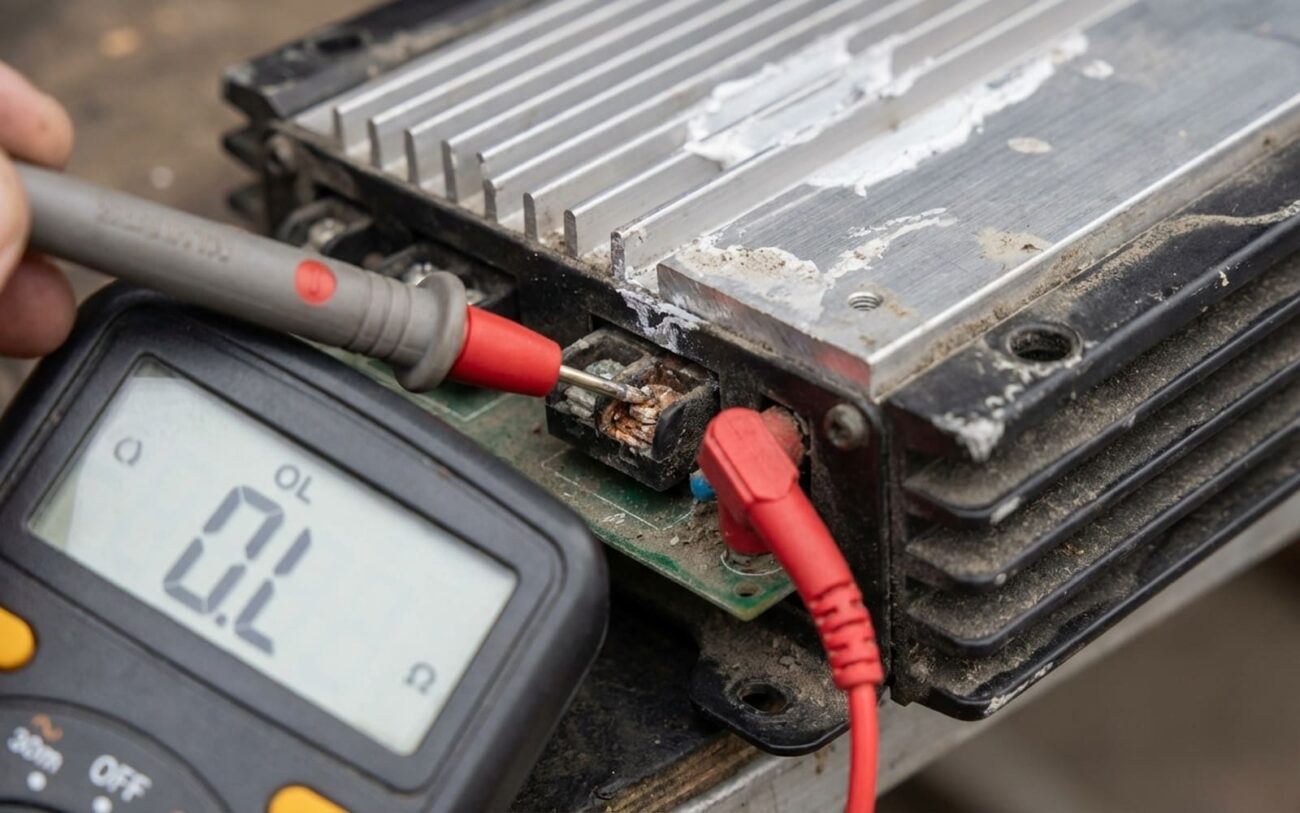
Second: Verify power and ground. Use a multimeter. With ignition on, you should see 12–14.4V at the amp’s power terminal. Ground? Test it by measuring resistance from the amp’s ground lug to the battery negative. Should be less than 0.1 ohms. If it’s higher, clean the mounting point—paint, rust, or loose bolts kill grounds.
Third: Test signal input. Swap the RCA cables. Try a different source. If you’ve got a known-good head unit, hook it up. I keep a test deck in the shop for this. If the amp works with a different source, the problem isn’t the amp.
Fourth: Disconnect everything. Unplug all RCAs and speaker wires. Power the amp with just +12V, ground, and remote. If it powers up and stays out of protect, the issue is in your wiring or speakers. If it still trips, now you’ve got a real internal problem.
What actually fails — and why
If the amp is truly dead, here’s what’s likely toast:
Output transistors — especially in Class D amps. They fail when the amp is overdriven (clipping), under-impedance (like running a 2-ohm load on a 4-ohm-stable amp), or overheated. When they short, they dump DC into your speakers. That’s why you hear distortion—and why your subs might be blown too.
Power supply MOSFETs — these boost 12V to higher rails. If your alternator spikes (say, 16V+ during a jump-start), they can blow instantly. I see this after battery replacements when the charging system wasn’t checked. One guy fried three amps in six months because his regulator was bad.
Solder joints — heat cycles crack them over time. I’ve pulled amps apart and found hairline fractures on the transformer or output transistors. The amp works when cold, drops channels when hot. Classic thermal failure. Common on factory amps mounted under seats—no airflow, constant heating and cooling.
Capacitors — especially in older amps or units in hot trunks. They dry out, bulge, or leak. When they fail, the power supply collapses. Amp won’t turn on, or it cycles on/off. Not always visible—sometimes you need to test ESR with a meter.
Your options — and which ones actually work
Replace the external fuse DIY Feasible
Internal repair Professional Only
Replace the amp Non-Repairable
Avoid “fixes” that cause fires Avoid At All Costs
How to test before you reinstall
Never put an amp back in blind. Bench test it first.
For a fuse replacement: power it with just +12V, ground, and remote. It should light up, stay out of protect, and draw under 2A at idle. Then feed a 50Hz test tone into the input and measure AC voltage at the speaker terminals. If you get voltage, it’s working.
For a repaired amp: use a dummy load (e.g., 4-ohm power resistor). Feed a 1kHz sine wave. Measure output with a multimeter—should be clean AC. If you’ve got an oscilloscope, check for clipping or distortion. Also recheck idle current. Should be 0.8–1.5A. Too high? Bias is off. Too low? It won’t deliver full power.
Final advice: when to walk away
If the repair quote is over half the cost of a new amp, just replace it. You get a warranty, known condition, and no risk of hidden failures. I’ve had customers bring in amps they tried to fix—now with lifted pads and melted traces. That’s repairable, but now it’s twice as expensive.
And if you’re serious about keeping the next one alive:
-
Set the gain right. Use a multimeter and 0dB test tone. Too high, and you’re clipping—killing the amp over time.
-
Use proper wire gauge. 4-gauge for high-power amps. Undersized wire = voltage drop = heat = failure.
-
Mount it where it can breathe. Leave clearance around the heatsink. No carpet, no tight spaces.
-
Check your charging system. Voltage should be 13.8–14.8V running. Over 15V? That’s a death sentence for electronics.
-
Listen. If the amp sounds off at low volume or runs hot, investigate. Catch it early, save the system.
