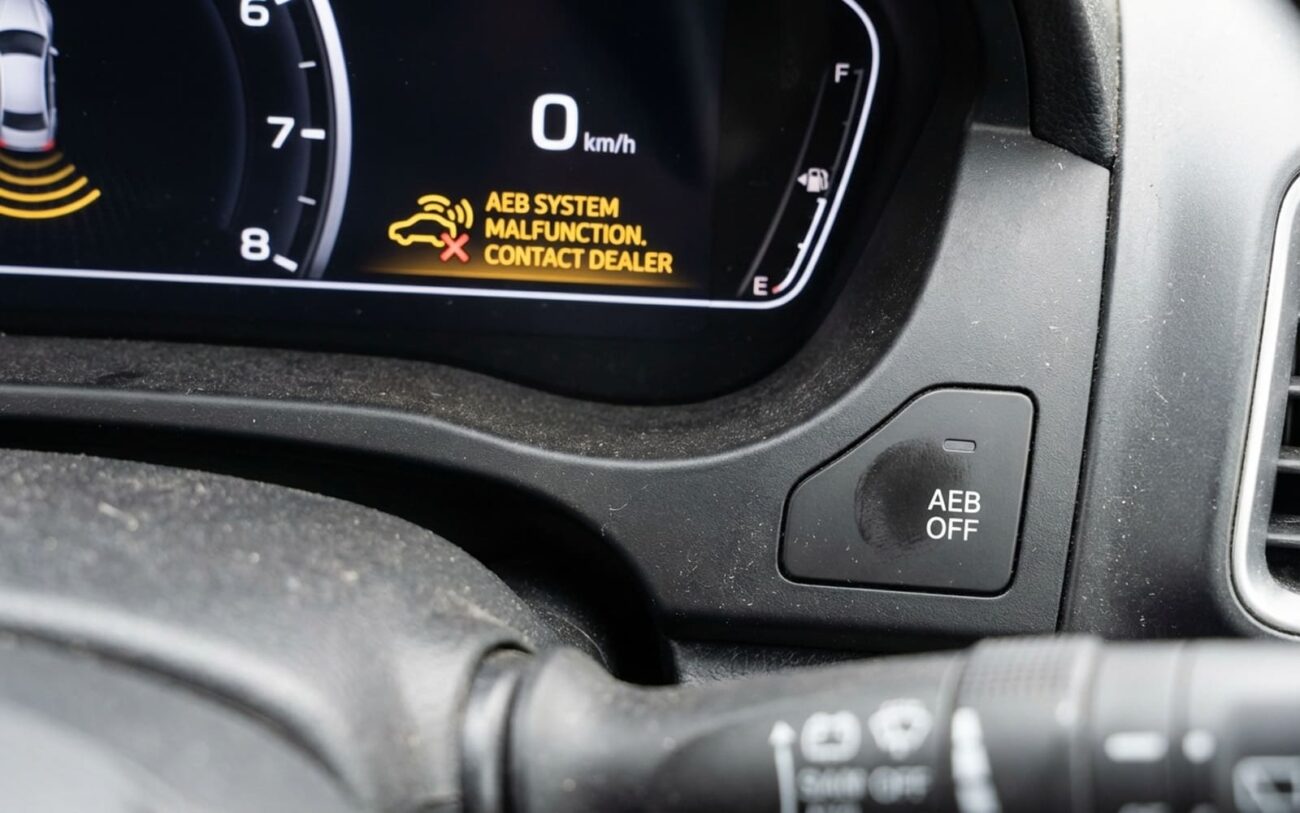
Let me tell you, there are few things more unnerving than when your car decides to slam on the brakes for no reason. No traffic, no obstacle, just a sudden, full-force stop out of nowhere. I’ve seen it firsthand, and it’s not just alarming; it’s downright dangerous. That’s usually the tell-tale sign of a false Automatic Emergency Braking (AEB) activation.
The system thinks you’re about to hit something, so it reacts exactly like a human would in a panic: hard on the brakes. And often, it happens at speeds where even a light tap is enough to throw everyone forward. But before we jump to conclusions, we’ve got to confirm it’s actually the AEB system doing this and not some other part of the car mimicking the behavior.
What’s Really Going On? Symptoms & Initial Thoughts
The key identifier for false AEB is that uncommanded, aggressive braking on a clear road. You’re driving along, minding your business, and BAM. Nothing there. If it happens repeatedly under similar conditions—say, when you’re passing under an overpass, near certain reflective signs, or even sometimes just in heavy rain or fog—it’s almost certainly the AEB system acting up. The root cause in those cases often leans more toward a sensor calibration issue or environmental interference than a hard parts failure.
You’ll often see a dashboard warning pop up right after one of these incidents: “AEB Disabled,” “Front Sensor Blocked,” or “Pre-Collision System Malfunction.” Now, these messages are clues, not the final diagnosis. They just tell you the system detected something it didn’t like, either internally or from its inputs. It’s like a check engine light for your safety system.
My Diagnostic Process: Hunting Down the Culprit
False AEB activation can really mimic other problems, so you can’t just rely on the symptom alone. My job is to isolate whether the fault is truly within the AEB system or if something else is sending it bad information. This is where the real work begins.
Is It Really AEB? Or Something Else?
When you get that uncommanded braking, my first thought is always: is the AEB system commanding the brakes, or is something else forcing them on?
-
Likely AEB System: This points to a faulty forward radar or camera sensor, corrupted software in the AEB control module, or a sensor fusion error where the system misinterprets data.
-
Common Mimics: I’ve seen a short-to-ground in the brake pedal position switch circuit cause phantom braking. The ABS hydraulic control unit itself can also fail and interpret false signals, applying the brakes without a command from the driver or AEB.
How do I tell the difference? I hook up an OEM-level scan tool. A basic OBD2 scanner won’t cut it here; AEB systems run on high-speed networks like CAN FD or DoIP and need advanced diagnostic tools, often OEM-specific or J2534-compliant hardware with ADAS support. Without it, you’re just guessing, and that’s how you end up replacing expensive parts you don’t need.
I’ll take the car for a low-speed test drive while monitoring the AEB module’s target tracking data. If the system starts registering a false object—say, a “stationary vehicle” at 50 feet when there’s nothing there—then the fault is in the radar or camera. At the same time, I’m watching the brake pedal switch status and the ABS module commands. If the brakes engage without any signal from the pedal switch, then we know the AEB or ABS module is initiating it.
Persistent ‘Front Sensor Blocked’ Warnings
Another common one is the “Front Sensor Blocked” warning that just won’t go away, even after you’ve cleaned the car.
-
Likely AEB System: This could be an internal sensor failure, damaged housing, or condensation inside the sensor unit itself.
-
Common Mimics: More often than not, it’s something simple like dirt, ice, snow, or a big bug splatter on the lens. Sometimes, a minor front-end bump can misalign the mounting bracket.
My first step is always a thorough visual inspection of the sensor lens—behind the grille for radar, near the rearview mirror for the camera. I clean it with an approved lens cleaner and a microfiber cloth. Then, with the scan tool, I’ll try to initiate the OEM sensor calibration procedure. If that calibration fails, or if fault codes like “Radar Out of Alignment” or “Internal Camera Fault” immediately return, then we know the sensor or its mounting is compromised. I’ve seen shops replace radar units only to find out later the real issue was a corroded ground in the brake switch wiring. Save time and money: get the right tool or go to a shop that has it.
One important distinction: if multiple ADAS features fail at once—like your Adaptive Cruise Control dropping out along with AEB—that usually points to a shared root cause. We’re talking a power supply issue, a network communication fault, or damaged wiring affecting the entire ADAS module group. It’s rarely just one sensor acting up in isolation when that happens.
Digging Deeper: The Actual Breakdowns
Once we’ve confirmed the AEB system itself is at fault, the root cause typically falls into one of three categories: sensor hardware failure, software corruption, or sensor fusion errors.
Sensor Hardware Failure
Radar units can suffer internal dielectric breakdown in the transmitter, especially in older units that have seen years of thermal cycling. Camera modules, particularly the CMOS sensors, can degrade over time, or develop micro-condensation if the housing seal fails. Even a tiny bit of moisture inside will scatter light and create “ghost” images that the system interprets as real obstacles. Physical damage from road debris or even improper cleaning—like using a pressure washer too close—can distort readings.
Software Corruption or Bugs
The algorithms that process all that radar and camera data are incredibly complex. A corrupted flash memory chip in the AEB control module or a bug in the vision processing logic can cause misclassification. It might see a shadow as a pedestrian or a manhole cover as a curb. These issues are often addressed via software updates, and manufacturers sometimes issue Technical Service Bulletins (TSBs) for known problems. For example, I’ve seen certain model years of specific brands with documented patterns of false AEB activation due to software timing errors, especially in low-light conditions.
Sensor Fusion Errors
Modern AEB systems don’t just use one sensor; they rely on both radar and camera data. The system cross-checks both to confirm obstacles. If one sensor is out of alignment or malfunctioning, the other can’t compensate, leading to false positives or negatives. For instance, if the camera sees a “vehicle” but the radar detects no object, the system should ignore it. But if the logic is flawed or the data stream is corrupted, it might still decide to brake.
And let me be clear:
this isn’t a hydraulic brake failure. The AEB system doesn’t have its own brake lines or fluid. What it does is send a command to the ABS module, which then applies the brakes using the existing hydraulic system. So if your master cylinder is failing or you have air in the lines, that’s a separate issue entirely—one that usually causes a spongy pedal feel or inconsistent braking, not sudden, targeted stops.
The Fix: What It Takes
Professional Territory Only
How you resolve false AEB activation depends entirely on what the diagnosis reveals—and your comfort level with ADAS systems. These aren’t typical repairs. They require precision, the right tools, and often OEM-specific procedures. This isn’t something you want to guess at.
Software & Firmware Update Professional Only
Sensor Cleaning/Re-alignment
Radar Sensor/Module Replacement Professional Only
Disabling AEB Temporary / Last-Resort
Proof It’s Fixed: Post-Repair Validation
Never, ever assume the repair worked just because the warning light is off. Validation is critical. For a software update, your scan tool must confirm the new software version is installed and that no fault codes return after clearing. Then, I always take it for a 10–15 mile test drive, covering city streets, highways, and those common trigger zones like underpasses or near guardrails. I’m monitoring for any false activations.
If I’ve replaced or recalibrated a sensor, the scan tool has to show “Calibration Complete” and zero active or pending codes in all the ADAS modules. I use the live data function to watch how the radar and camera interpret the environment. The target list should be stable—no flickering “ghost” vehicles or erratic lane detection. If the system shows a car 40 feet ahead when the road is clear, something’s still wrong, and it’s not leaving my shop.
All of this requires the same advanced diagnostic tool used in diagnosis. Without it, you’re flying blind. I’ve seen shops replace parts, clear codes, and call it done—only for the customer to come back a week later with the same problem. Proper validation prevents comebacks and, more importantly, keeps drivers safe.
Making the Call: Costs & Choices
Repair costs vary widely depending on the root cause. Here’s a realistic breakdown based on what I see in the shop:
| Repair Type | DIY Cost | Shop Cost | Success Rate | Secondary Risk if Failed |
|---|---|---|---|---|
| Software Update | $0 (if under warranty or recall) | $150–$300 (1 hour labor + tool time) | Near 100% for documented software bugs | None if procedure followed correctly |
| Sensor Cleaning/Re-alignment | $50 (microfiber cloths, lens cleaner, torque wrench) | $200–$500 (labor + calibration) | High if only misaligned or dirty | Persistent fault if internal sensor damage exists |
| Radar Sensor Replacement | N/A (requires programming and calibration) | $1,000–$2,000 (part + labor + calibration) | High if calibrated correctly | Improper calibration renders system inoperative or unsafe |
When the diagnosis points to a failed AEB control module, the cost can jump to $2,500 or more. At that point, you have to make a hard decision. A common rule in the industry is that if the repair cost exceeds 40% of the vehicle’s current market value, you should seriously consider whether repair is economically viable. For older cars with high mileage, a documented, professional deactivation might be the only sensible choice—though it means losing a key safety feature. It’s not ideal, but it’s a real-world trade-off many owners face.
Keeping Your System Healthy: Prevention & Monitoring
Prevention is always the best way to avoid false AEB activation. Treat these front sensors like the precision instruments they are—because that’s exactly what they are. Keep the radar area (usually behind the grille emblem) and the camera lens (near the rearview mirror) clean. Use gentle, non-abrasive cleaners. And never, ever apply tint, vinyl wraps, or aftermarket coatings over these areas—they will interfere with signal transmission.
After any front-end contact—even a minor parking lot bump—get the sensor alignment checked. A fraction of a degree off can cause false readings. It’s like the difference between using the correct coolant and risking aluminum cylinder head corrosion: small oversights lead to big failures down the road.
For Early Detection
-
Become observant. If you experience a false activation, write down the conditions: time of day, weather, road type, nearby structures. That data is gold for a technician trying to identify patterns or match your case to a known issue.
-
Make it a habit to check your vehicle’s safety settings menu every few months. Just ensure AEB is still enabled and that no hidden warnings have popped up. Catching a “Sensor Blocked” alert early could prevent a panic stop down the road.
