Alright, let’s talk about regenerative braking. If you’ve got a hybrid or an EV, you know that feeling when you lift off the accelerator and the car just slows down – that’s regen working its magic, putting energy back into the battery. But what happens when that feeling starts to fade? When your car doesn’t quite slow down like it used to, or you find yourself having to hit the friction brakes more often? That’s a red flag, and in my 25+ years under the hood, I can tell you, it often points right back to the high-voltage battery.
Recognizing the Symptoms: Is Your Battery Getting Tired?
When your car’s regenerative braking feels weaker, like it’s not slowing down as much when you lift off the throttle, that’s the primary symptom. Now, I’ve seen hundreds of these vehicles come through the shop, and while it could be a brake sensor acting up, a software glitch, or even a dragging caliper, more often than not, the real issue starts with the high-voltage battery itself. Regenerative braking relies on that battery being able to accept a rapid charge, and as its ability to do that declines, so does your “engine braking” feel.
Think of it this way: when you decelerate, the electric motor flips into generator mode, converting the car’s kinetic energy back into electricity. That electricity needs a home, and ideally, it’s the high-voltage battery pack. But if the pack can’t absorb that incoming current efficiently, the Battery Management System (BMS) steps in. It’ll reduce or even shut down regen to protect the cells. You’ll feel this immediately as a noticeable drop in braking force, especially if you’re trying to slow down moderately or aggressively.
Key Indicators I Look For:
-
Cold Morning Blues: If you start the car on a cold morning and get almost no regen for the first few miles, even after the cabin warms up, that’s a big red flag. A healthy, cold battery might limit regen a bit, but a degraded one will almost completely disable it because its internal resistance shoots up in the cold.
-
High State-of-Charge (SOC) Fade: Another common one is regen fading away once the battery’s charge level climbs above 75–80%. This usually means the pack’s actual capacity has dropped. The BMS sees the voltage rising too fast, thinks the battery is “full,” and stops accepting charge—even though it’s not holding nearly as much energy as it used to.
-
Permanent Max Regen Reduction: Did your car used to grab 60–70 kW during hard braking and now it tops out at 40–50 kW, no matter the temperature or how you’re driving? That tells me the pack’s charge acceptance capability (its C-rate) has degraded. This forces the car to lean harder on the friction brakes, meaning more wear on your pads and rotors. In hybrids, I’ve seen this lead to overheated traditional brakes on long downhill stretches – exactly what regen is supposed to prevent.
Differential Diagnosis: Don’t Just Guess (and Don’t Waste Money)
Before you or your shop starts talking about a new high-voltage battery – which, let’s be honest, is a major expense – you have to rule out other components. I’ve seen more than a few shops replace entire battery packs only to find out the problem was a cheap sensor or a weak 12V auxiliary battery. The symptoms can be identical, so you can’t just rely on a dashboard warning light. Diagnostics need to go much deeper.
Pro Tip: Always Check the 12V System First
Seriously, don’t overlook the 12V auxiliary battery. In almost every hybrid and EV, a weak 12V battery can cause all sorts of system instability, leading to power limitations and regen faults. It’s cheap to test and can save you a fortune. Confirm that 12V system is healthy before you even think about the big battery. You can check that here: How to Tell If Your Battery Is Dead or If You Have a Charging System Problem.
Here are some common culprits that can fool you into thinking the HV battery is toast:
-
Faulty Battery Temperature Sensor: This is a classic. A bad sensor can feed the BMS incorrect temperature data, making it think the pack is -20°C when it’s actually 20°C. The BMS then triggers cold-weather regen limits, and suddenly, you have no regen.
-
Weak DC-DC Converter: This little guy maintains your 12V system. If it’s failing, it can’t keep stable 12V voltage during high regen events. Control modules see this instability and derate power as a safety measure.
-
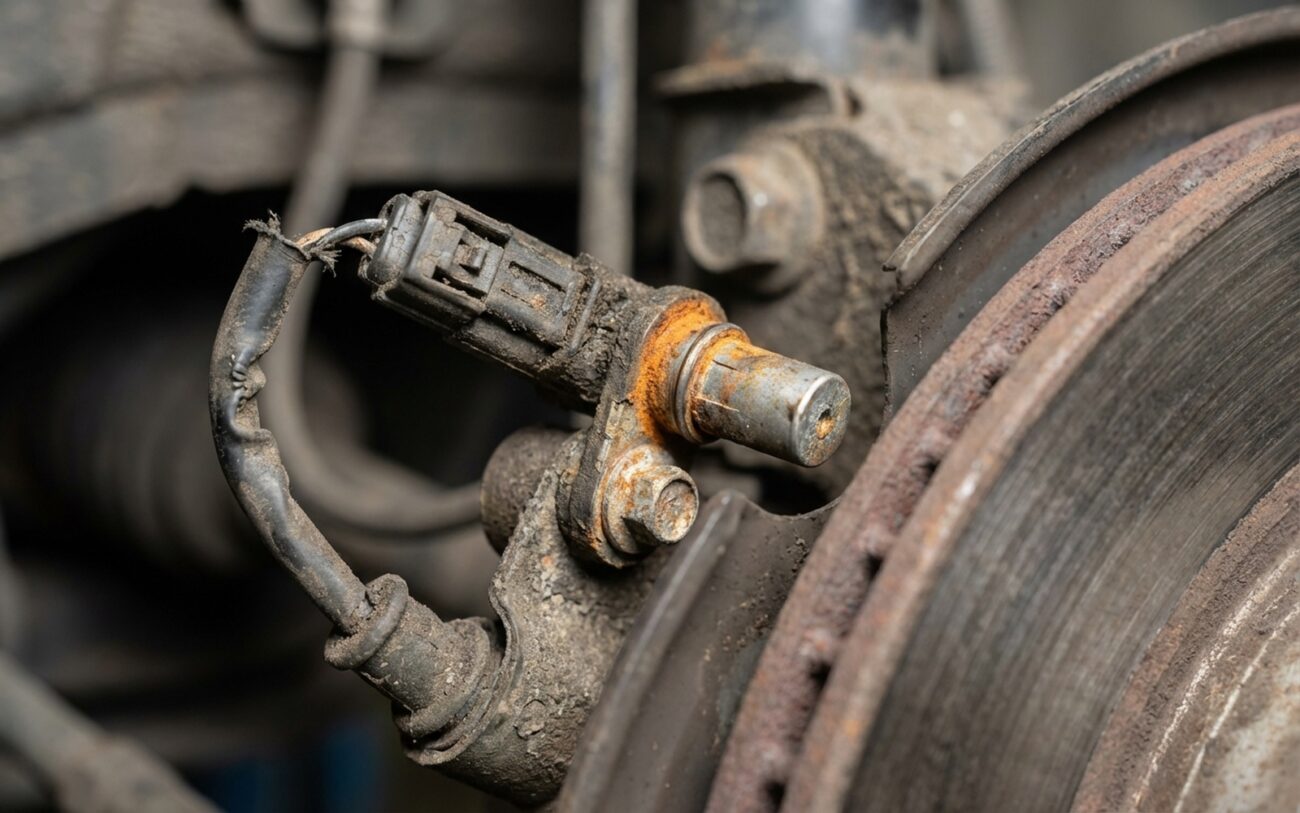
Brake Blending Issues: Modern vehicles blend friction braking with regen. If the system isn’t calibrated right, or a sensor (like a brake pedal position sensor or wheel speed sensor) is off, the friction brakes might engage prematurely. It feels like weak regen, but regen is actually being overridden.
This is why a factory-level scan tool is absolutely essential. Your generic OBD2 reader won’t cut it; it won’t talk to the BMS or the hybrid control modules. You need a tool that can pull live data from the high-voltage system: internal resistance, SOC accuracy, individual cell/module temperatures, and real-time power limits. That’s the only way to truly see what’s going on.
To help you sort through it, here’s a breakdown of how I distinguish true battery degradation from these system-level mimics:
| Symptom | Likely from HV Battery Degradation | Common External Mimics | Definitive Test to Confirm Source |
|---|---|---|---|
| Reduced regen on cold start | High internal resistance (IR) due to degraded cell chemistry, especially in cold conditions | Faulty battery temperature sensor, BMS software calibration error | Use a factory scan tool to monitor “Battery Pack Internal Resistance” and actual temperature readings. High IR with accurate temp readings confirms degradation. |
| Regen reduction at high SOC | Reduced charge acceptance due to capacity loss—battery hits voltage ceiling faster | BMS state of charge calibration drift, inaccurate SOC reporting | Perform a controlled discharge and recharge cycle while logging actual voltage and current. Compare final capacity to OEM specs. |
| Permanently reduced max regen power | Overall increase in pack internal resistance and reduced maximum charge rate | DC-DC converter fault, inverter derating, communication error in hybrid control module | Log a full regen event at mid-SOC and warm temperature. Check “Battery Max Charge Power” in BMS data. |
| Poor real-world regen efficiency | Low energy recapture due to high internal resistance causing heat loss during charging | Dragging brake calipers, aggressive brake blending settings, wheel speed sensor faults | Data-log a city/highway drive. Compare energy returned to battery vs. kinetic energy lost. |
What’s Really Happening Inside That Battery?
If your diagnostics confirm the high-voltage battery is indeed the problem, you’re not looking at a simple electrical fault. There’s no loose connection to tighten or fuse to replace here. We’re talking about internal electrochemical degradation – a breakdown at the cell chemistry level. And that directly impacts the battery’s ability to accept charge during regenerative braking.
The main villain here is increased internal resistance (IR). When you brake, that motor generates a lot of current, and it needs to flow into the battery. But as IR goes up, more of that energy gets wasted as heat instead of being stored. To prevent overheating or damaging the cells, the BMS steps in and reduces the allowable charge current. Less current in means less regen braking force out.
This resistance doesn’t just appear overnight; it builds up over time through several mechanisms:
-
Solid Electrolyte Interphase (SEI) growth: This layer forms on the anode as a normal part of lithium-ion chemistry. Over years, it thickens, blocking the movement of lithium ions and increasing resistance.
-
Lithium plating: This happens when you charge at low temperatures or very high rates. Metallic lithium deposits on the anode surface, reducing the active material and, you guessed it, increasing IR.
-
Cell swelling and connection fatigue: Every charge and discharge cycle causes slight mechanical expansion and contraction within the cells. Over years, this can degrade internal busbar connections or welds, leading to higher resistance.
-
Cell imbalance and capacity fade: Not all cells age at the same rate. As individual cells degrade, the BMS has to limit the overall pack performance to protect the weakest link.
I’ve also seen specific component failures within the pack. For example, in some older Tesla models, contactor wear from repeated high-current cycling has been linked to reduced regen and power output. That’s a failure of a critical internal component, not just cell chemistry. But again, it’s inside the pack and requires specialized repair.
Just to be clear: a bad wheel speed sensor, a faulty brake pedal position sensor, or a software glitch in the brake blending system is not battery degradation. Those are separate faults with their own diagnostic paths. True battery-related regen loss comes down to the pack’s fundamental inability to accept charge efficiently.
Fixing It: What Are Your Options?
HIGH-VOLTAGE SAFETY WARNING: THIS IS NOT A DIY JOB.
Let’s be absolutely clear: there is no quick fix for internal battery degradation. This isn’t a job for your garage. It requires insulated gloves, Class-0 HV-rated tools, a service plug for safe disconnection, and precise torque control. Even a slightly loose bolt can lead to thermal runaway, and trust me, you don’t want to be anywhere near that. Leave this to the professionals.
Once you’ve got a definitive diagnosis, here’s what we typically look at for repair:
Module Replacement (If Possible)
If diagnostics show only one or two modules are weak – which is common in modular pack designs like some Toyota, Honda, or older Tesla models – module-level replacement is possible. But this isn’t just swapping parts. It requires a module-level cell balancer, and you need the correct OEM sealants to prevent moisture ingress. Torque specs are critical here, often something like 8 Nm ± 0.5 Nm; over-torquing is just as dangerous as under-torquing, potentially damaging the module or its connections.
Full Pack Replacement (The More Common Scenario)
For most modern vehicles, especially those with sealed, glued, or non-serviceable packs, module replacement isn’t an option. In these cases, a full pack replacement is the only real solution. This means factory programming for the new BMS, proper high-voltage system commissioning, and if it’s a liquid-cooled system, using the exact correct coolant type (e.g., Toyota’s specific HV inverter coolant). Using the wrong fluid can compromise cooling and lead to premature failure, so don’t cut corners here.
BMS Calibration Reset (A Temporary Band-Aid, Not a Fix)
One thing I sometimes try before committing to a major repair is a BMS calibration reset. Some systems can become overly conservative in their power limits over time. A full, slow discharge down to 10–15% SOC, followed by a complete, uninterrupted AC charge (and I mean AC, not DC fast charge), can sometimes prompt the BMS to “re-learn” the pack’s true capabilities. This might restore some regen power – but it won’t fix the underlying degradation. Think of it like recalibrating your fuel gauge, not repairing the fuel tank.
I’ve seen this work temporarily on a few older Prius and Leaf models, but the improvement usually fades as real-world conditions (like cold weather or high SOC) return. It’s a low-cost diagnostic step, but don’t expect miracles.
Post-Repair Validation: Trust, But Verify
After any battery repair – whether it’s a module swap or a full pack replacement – you absolutely must verify the fix. You can’t just drive it off the lift and hope for the best. The BMS needs to confirm proper balance, capacity, and communication across the system.
-
For Module Replacement: The key is voltage balance. With a factory scan tool, monitor the voltage difference between modules during a simulated regen event (on a dyno or a controlled road test). A healthy pack should show less than 50 millivolts difference between modules at 50% SOC. Also, confirm that “Battery Max Charge Power” meets OEM specifications across the entire SOC range.
-
For Full Pack Replacement: Validation is more involved. The BMS should report “Battery Internal Resistance” and “Estimated Capacity” values within the range expected for a brand-new pack. Then, you need to conduct a thorough road test that includes:
-
A cold start to verify regen is available immediately.
-
A high-SOC run (80%+) to confirm full regen power is maintained without premature derating.
-
A long downhill section to test sustained regen and the thermal management system.
I also like to use a thermal imaging camera to scan the pack during heavy regen. Look for any single module running significantly hotter than the rest – that’s a warning sign of imbalance or a poor connection.
-
Cost, Risk, and Making the Call
Let’s get real about the cost and value here. Replacing a high-voltage battery is one of the most expensive repairs you can face in a modern vehicle. Whether it makes financial sense depends on the car’s overall condition, how you use it, and how much longer you plan to keep it.
| Repair Type | DIY Cost | Shop Cost | Success Rate | Secondary Risk if Failed |
|---|---|---|---|---|
| Module Replacement | Not Advised | $1,500 – $5,000 | Medium-High | Incorrect diagnosis leads to repeated work; improper sealing risks coolant leak. |
| Full Pack Replacement | Not Advised | $5,000 – $20,000+ | Very High | Incorrect BMS programming; improper HV handling risks severe injury or fire. |
Here’s a general rule I use with customers: if the cost of a full HV battery replacement exceeds 40% of the vehicle’s current market value, and the only symptom is reduced regen (meaning no loss of range or drive power), it often makes more financial sense to adapt your driving. Drive more smoothly, anticipate stops earlier, and budget for more frequent friction brake jobs. It’s not ideal, but it’s a practical compromise for many.
Prevention and Monitoring: Keep That Battery Healthy
If your battery is still healthy, or you’ve just invested in a costly repair, you want to extend its life as much as possible. Lithium-ion batteries degrade fastest under extreme conditions – consistently high SOC, deep discharges, high temperatures, and frequent fast charging. So, here’s what I recommend to my customers:
-
Avoid 100% and 0% Charges: For daily driving, try to keep your charge between 20% and 80%. Most EVs have a charge limit setting; use it.
-
Limit DC Fast Charging: It’s convenient when you’re on a road trip, but frequent use accelerates degradation. Stick to Level 2 (AC) charging for your everyday needs.
-
Precondition in Cold Weather: If your car has a scheduled departure or preconditioning feature, use it while still plugged in. This warms the battery pack to an optimal operating temperature before you even leave.
-
Park in Shade or a Garage: Heat is one of the biggest enemies of battery longevity. Keep your car out of direct sun whenever possible.
For early detection, keep an eye on your car’s energy flow display. Many hybrids and EVs show real-time regen capture. A steady decline in those numbers over time is a soft warning. For deeper insights, invest in an OBD2 scanner with EV-specific capabilities. These can track “State of Health” (SOH), internal resistance trends, or BMS-reported capacity over time. Catching degradation early gives you more options – and more time to plan your next move.
