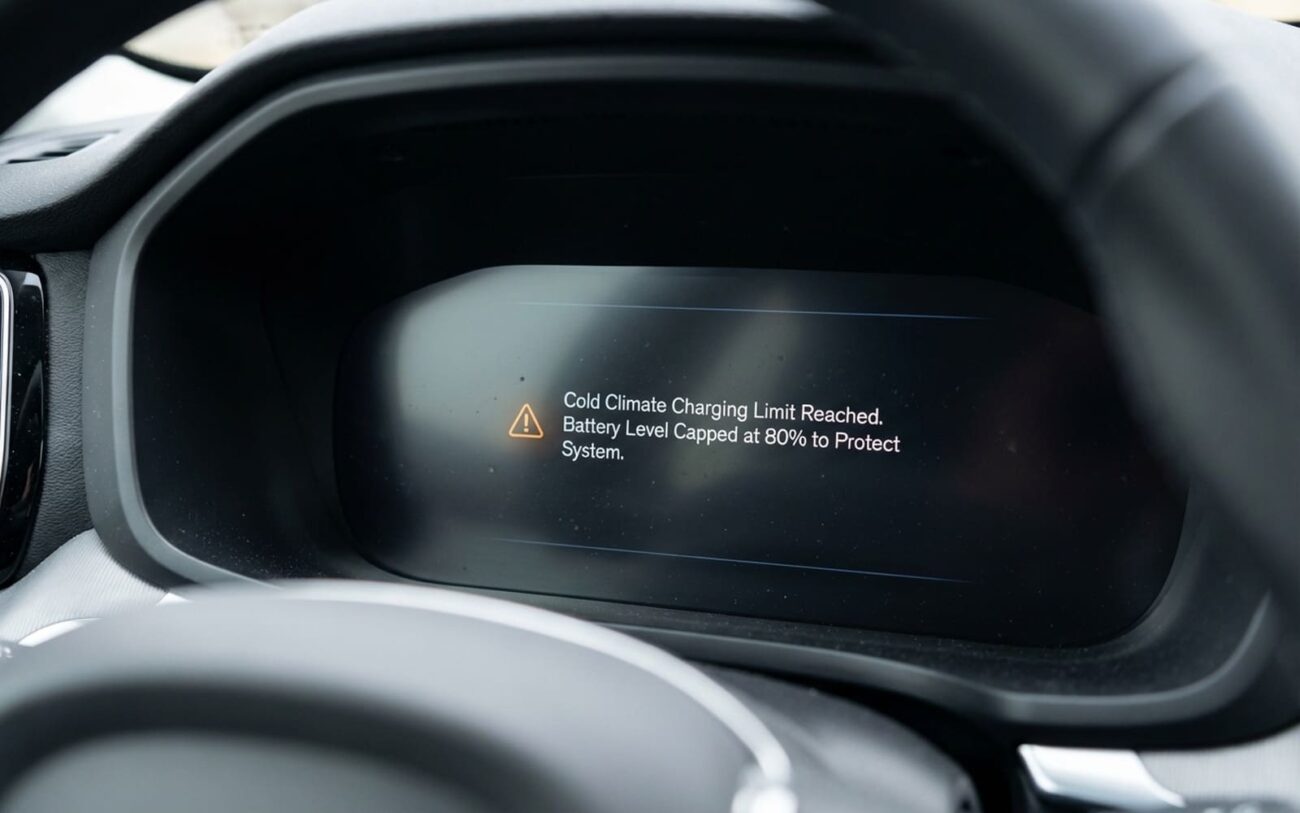
Alright, let’s talk about your Volvo XC60 Recharge acting up in the cold. You plug it in, expect a full charge, and it just… stops at 80%. Sound familiar? I get calls about this every winter, and in most cases, the first thing I ask is, “What’s the temperature outside?”
See, if it’s below freezing – say, 20 to 30°F (that’s -6 to -1°C for my Canadian friends) – and your charge halts around 80%, chances are your Volvo isn’t broken. It’s actually doing exactly what it’s supposed to. This isn’t a glitch; it’s a built-in safety feature of the Battery Management System (BMS) designed to protect that expensive high-voltage battery pack from damage when it’s cold.
Why Cold Weather Triggers the Charge Limit
The real “why” behind your Volvo XC60 Recharge not charging past 80% in winter comes down to basic electrochemistry and long-term battery health. Lithium-ion batteries store energy by moving lithium ions between the anode and cathode. When it’s cold, that electrolyte they move through thickens up, slowing everything down.
If you try to force a full charge at high voltage when the battery is cold, those lithium ions don’t embed properly into the anode. Instead, they plate on the surface. This “lithium plating” isn’t just inefficient; it’s destructive. Over time, it permanently reduces the battery’s usable capacity and can create rough spots that lead to internal shorts or even thermal runaway. That’s why automakers like Volvo program the BMS to limit charging in cold conditions.
Your Volvo’s battery conditioning system includes a dedicated electric heater in the battery coolant loop. When you plug in, the car doesn’t just start charging; it often starts warming the battery to an optimal range (usually 40–80°F or 4-27°C). But this takes time and energy. If the battery doesn’t reach a safe temperature, the BMS won’t allow a full charge, even if the grid power is available. It’s a smart system, protecting your investment.
Is It Normal, Or Is Something Actually Broken?
This is the million-dollar question. The BMS’s protective behavior looks a lot like a real charging fault, and that’s where my experience comes in. Before you call the dealership or start looking for high-voltage parts, you need to figure out if this is normal operation or an actual failure. The key is context: temperature, consistency, and any other symptoms.
I had a customer once convinced his XC60 T8 had a charging fault because it only hit 78% on a 25°F morning. We checked the logs: battery was cold, preconditioning was active, no diagnostic trouble codes (DTCs). Normal. But then another customer came in with the same car, same charge level, but it was 60°F outside, and his battery had been stuck at 80% for days. That’s not protection; that’s a failure.
So, how do you tell the difference? Here’s what I look for:
| Symptom | Likely Normal (BMS Protection) | When to Worry (Possible Fault) | My First Diagnostic Steps |
|---|---|---|---|
| Charge stops at ~80% only in cold weather (below 32°F) | The BMS is doing its job, applying cold protection logic. | If it’s happening when it’s mild out, or if the battery never warms up even after hours of charging. Could be a faulty battery temperature sensor, a failed battery coolant heater, or a wiring issue. |
Scan for DTCs, especially in the hybrid system or BMS. Monitor battery core temperature with a scan tool (like Volvo VIDA). |
| Slower charging speed in cold ambient temps | The car is using some of the incoming power to warm the battery. It prioritizes temperature over speed. | If it’s always slow, even in warm weather, or if the battery never seems to get warm. Could be low grid voltage, an undersized extension cord, or a failing EVSE (your charger). |
Check actual charging amperage and voltage at the car’s inlet. Try a known-good Level 2 charger if possible. |
| Reduced electric range in winter | Direct result of the 80% charge cap. Less charge means less range. | If your range drops significantly even when the battery charges to 100% in warm weather, or if you see sudden, erratic drops in range. This points to a bad battery module, cell imbalance, or overall degraded capacity. |
Perform a battery health check using Volvo VIDA. Look closely at cell voltage spread and internal resistance. |
| Charging stops early regardless of temperature | This is highly unlikely to be normal BMS strategy. | This almost always points to a fault. Could be a failed battery coolant pump, an open heater circuit, a software bug, or even an internal battery fault. |
Check battery heater activation and coolant flow with a scan tool. Look for any charging-related DTCs. |
| Vehicle doesn’t initiate preconditioning when plugged in | Could be user error (settings disabled, timer not set correctly). | If settings are correct, this points to a failed battery coolant heater, a blown fuse, or a BMS communication fault preventing the command from reaching the heater. |
Double-check all preconditioning settings in the vehicle’s infotainment. Then, check for active heater commands and heater circuit status in live data with a scan tool. |
Repair Options and Real-World Solutions
If your diagnostic checks confirm a fault, here are the most common fixes I’ve performed in my shop:
BMS Software Update or Reset Professional Only
Replace Battery Coolant Heater Professional Only
Fix Wiring or Sensor Issues
Check Fuse and Relay for Heater Circuit
Validation: Confirming the Fix (or Normal Operation)
After any repair – or if you’re just trying to verify that this 80% cap is normal behavior – validation is key. Here’s how I confirm the system is working correctly:
-
1
Perform a cold soak test: Leave the vehicle unplugged overnight in sub-32°F (0°C) weather. Plug it in the next morning and monitor it, ideally using the Volvo app. You should see the battery begin preconditioning. -
2
Monitor battery core temperature: With a good scan tool, watch the battery’s internal temperature. Once it hits around 40°F (4°C), that charge limit should lift, and it’ll start pushing past 80%. -
3
Check for DTCs: After the test, scan the BMS and other related modules again. No active or pending codes means the system is healthy. -
4
Verify full charge in warmer conditions: On a mild day (above 50°F or 10°C), plug it in and confirm the car charges all the way to 100%.
Cost, Time, and Economic Considerations
Let’s talk brass tacks. If this is just normal cold-weather behavior, there’s no cost – just a temporary reduction in your electric range. But if a component has failed, here’s what you’re likely to face:
Diagnostic Fee
Standard at most dealers or independent shops that are properly equipped for PHEV work.
Battery Coolant Heater
This includes parts and labor. Remember, labor involves careful coolant handling and high-voltage safety procedures, so it’s not cheap.
Sensor/Wiring Repair
This varies a lot depending on where the fault is and how accessible it is.
Compare those costs to ignoring the system: accelerated battery degradation could lead to a high-voltage battery replacement down the line—and that’s a $5,000–$10,000 bill. The 80% cap isn’t the problem. It’s the solution.
Prevention and Best Practices for Cold Weather Charging
You can’t change the weather, but you can definitely work with your Volvo’s system. Here are the steps I recommend to maximize charging efficiency and electric range in winter:
-
Use scheduled charging: This is my number one tip. Set your charge to finish about an hour before you plan to drive. That gives the thermal management system time to warm the battery fully, improving both charge acceptance and range.
-
Enable cabin pre-heat: While plugged in, use the app or car settings to pre-heat the cabin. This uses grid power to warm the interior, taking a big load off the battery when you start driving.
-
Keep the car plugged in: Even if charging stops at 80%, the system may continue warming the battery in the background, drawing power from the grid to maintain optimal temperature.
-
Upgrade your charging setup: If you’re still on Level 1 (120V), consider upgrading to a dedicated 240V line with at least 30 amps. Faster charging means more power available for heating the battery, which can help it reach optimal temperature quicker.
-
Monitor battery health: Keep an eye on your long-term performance using the Volvo app. A steady decline in range, even in mild weather, could indicate deeper issues that warrant a professional check.
