What You’re Feeling: The “Heat at RPM, Cold at Idle” Mystery
Alright, let’s talk about that frustrating feeling when your heater only blows hot air when you’re on the gas, but then it goes lukewarm or downright cold the moment you hit a stoplight or get stuck in traffic. If that sounds familiar, you’ve stumbled onto one of the most common heater complaints I hear in the shop. And trust me, it’s not your imagination.
This isn’t usually a problem with your HVAC controls or the blower fan itself. What’s happening is a classic coolant flow issue through the heater core. Think of the heater core as a mini-radiator tucked away behind your dashboard. Hot engine coolant gets pumped through it, and your cabin fan pushes air across those hot fins to give you heat. At idle, your water pump is spinning slowly, so it’s not generating much pressure. If there’s any kind of restriction—and we’ll get into what those are—that low pressure just can’t push enough coolant through. But when you rev the engine, the pump speeds up, pressure increases, and suddenly, you get a blast of heat. That RPM-dependent behavior? That’s the dead giveaway right there. It tells me we’re looking at a flow problem, not a blend door or thermostat issue.
Beyond the lack of heat, listen for other clues. A gurgling or sloshing sound from behind the dash, especially when you first start the car or shut it off, is a huge indicator of trapped air. It’s the sound of coolant trying to move past a big air bubble in the heater core. Now, sometimes this is just from a recent coolant top-off that wasn’t properly bled. But sometimes, it points to something much more serious, like a blown head gasket pushing combustion gases right into your cooling system. I’ve seen that one too many times.
How I Diagnose It: No Guesswork, Just Facts
Before you even think about pulling the dashboard apart—and trust me, you don’t want to do that unless you absolutely have to—we need to confirm exactly where the restriction is. A lot of things can mimic this symptom: a weak water pump, a failing thermostat, a collapsed heater hose, low coolant, or even a stuck heater control valve. Jumping straight to a heater core replacement without proper testing is a surefire way to waste time and money. I’ve seen it happen.
My go-to diagnostic for this issue is a temperature differential test using an infrared (IR) thermometer. It’s a simple, non-invasive test that tells you a lot. Here’s how I do it:
- Get the engine fully warmed up to operating temperature.
- Locate the two heater hoses that go through the firewall to the heater core.
- With the engine idling, use your IR thermometer to measure the surface temperature of both the inlet and outlet hoses. Note these temperatures.
- Now, rev the engine up to about 2500 RPM and hold it there for a minute or two. Measure both hose temperatures again.
The results of this test are pretty definitive:
- If the heater core is clogged: At idle, the inlet hose will be hot (close to engine temperature), but the outlet hose will be significantly cooler—I’m talking a difference of 30°F or more. When you rev the engine, the outlet temperature will increase, but it still won’t be as hot as the inlet. This tells you coolant is getting to the core, but it’s struggling to get through it.
- If you have a large air pocket: Both hoses will likely remain cool at idle, or at least not get very hot. When you rev the engine, both hoses will heat up as the increased pump pressure forces coolant past the trapped air. This indicates the air is blocking flow to and through the core.
- To rule out a weak water pump: If both hoses are cool at idle and don’t get significantly hotter at 2500 RPM, you might have a weak water pump. You can do a quick visual check at the radiator neck (ONLY when the engine is cool and the cap is off, then warm it up carefully). Once the thermostat opens, you should see good coolant flow. Weak or erratic flow suggests the pump impeller is worn.
While you’re checking, always verify your coolant level in the reservoir when the engine is cold. And with the engine running, look for persistent air bubbles in the overflow tank—that’s another strong sign of combustion gases from a potential head gasket issue. I’ve seen this pattern on everything from older GM trucks (where silicate drop-out from old antifreeze was a common culprit) to modern compacts. The principle is the same: flow restriction.
What Actually Fails Inside That Heater Core
When my diagnosis points squarely at the heater core, it’s rarely a leak. That would give you a sweet smell in the cabin and wet floorboards, not just weak heat. And it’s not a blend door actuator, which would usually give you either full hot or full cold, or maybe just one side of the car being affected. This specific symptom—heat only at high RPM—is almost always about an internal flow restriction within the core’s tiny tubes.
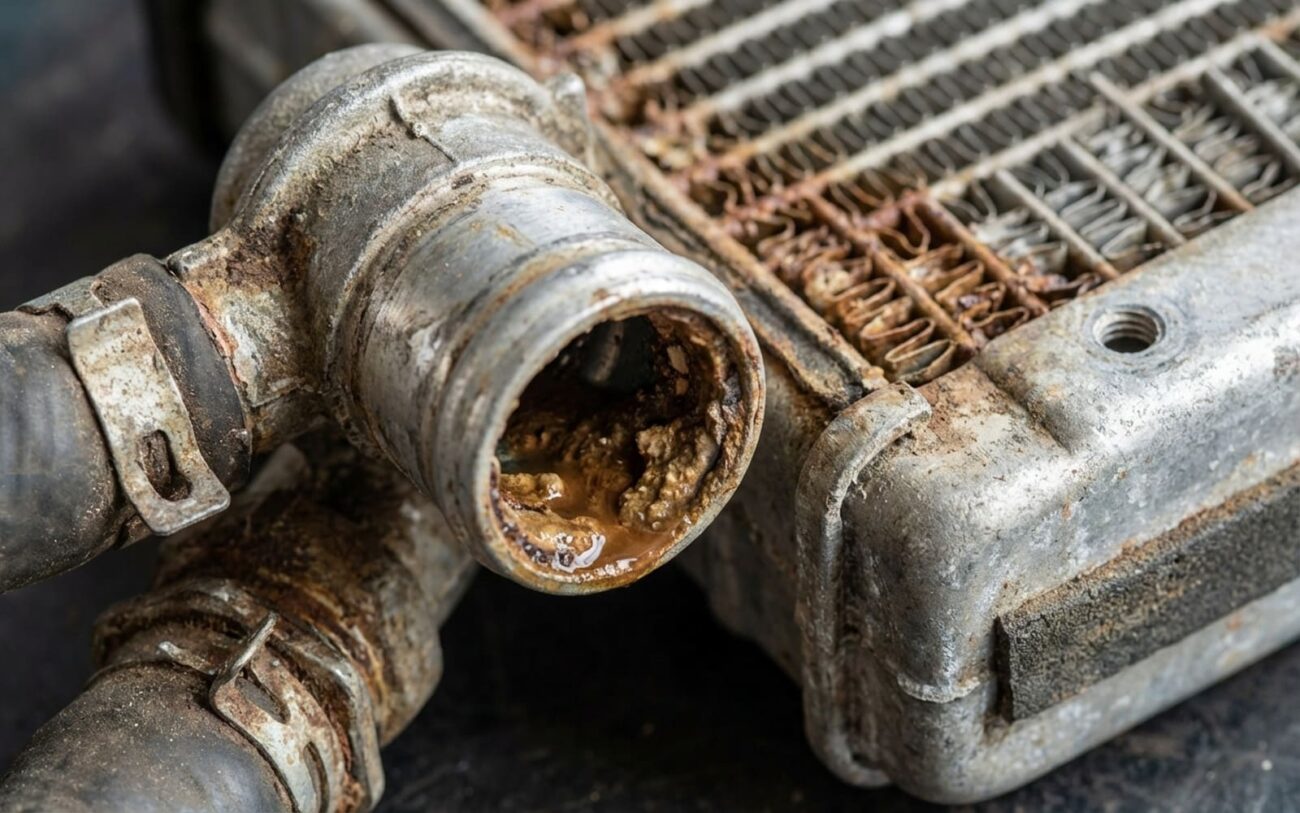
I’ve seen two main culprits for these clogs: corrosion and contamination. In aluminum cores, if your coolant’s pH drops or if you have stray electrical currents (electrolysis), you get pitting and scale buildup. That crud slowly narrows the passages. In areas with hard water, mineral deposits from using tap water instead of distilled water for coolant mixing do the same thing. Over time, flow just diminishes until only high pump pressure can force coolant through.
Then there’s contamination. And here’s where I get on my soapbox: “stop-leak” products. While they promise a quick fix, I’ve seen them cause more problems than they solve. The sealants or fibers they contain are designed to find tiny leaks, which means they’re also perfectly designed to lodge in the narrowest parts of your cooling system—the heater core, the radiator tubes, even the thermostat. Similarly, casting sand from engine manufacturing (rare, but it happens) or debris from a failing radiator or water pump can find its way into the core. Because the heater core has the smallest internal channels in the entire cooling system, it acts like a filter. Eventually, it just clogs up.
It’s important to understand what this isn’t. A stuck thermostat usually causes overheating across the board, not just selective heat loss, unless it’s one of those rare cases where the internal bypass is blocked. And while a failing water pump can reduce flow, it typically impacts overall engine cooling more noticeably. Air pockets, while a common cause of this symptom, aren’t a failure of the heater core itself; they’re a symptom of improper bleeding, a coolant leak, or those combustion gases I mentioned earlier.
My Approach to Fixing It: From Simple to Serious
The repair path I recommend always depends on the root cause. We start simple. Many of these issues can be resolved without ever touching the dashboard.
Air in the System? DIY-FEASIBLE
Clogged Heater Core? DIY-FEASIBLE LOW SUCCESS RATE
Heater Core Replacement Professional Only NON-REPAIRABLE → REPLACE
Confirming the Fix: How I Know It’s Done Right
After any repair, validation is absolutely crucial. Never assume the problem is fixed just because the engine runs normally. You need to verify the heater is actually working as it should.
If you performed an air purge, success means you’re getting strong, consistent heat at idle within about five minutes of a cold start. There should be no more gurgling sounds from the dash. The coolant level in your overflow tank should stabilize after a few heat/cool cycles. And for a definitive check, use that IR thermometer again: at idle, the outlet hose should be within 10°F of the inlet hose temperature.
After a flush, the same temperature test applies. At idle, the outlet hose temperature should rise significantly—ideally within 15°F of the inlet. The vent airflow should feel hot and steady, not pulsing or cooling off. Always, always follow up with a cooling system pressure test to ensure you didn’t introduce any new leaks when reconnecting hoses. I typically do a 30-minute pressure test at the radiator cap’s rated pressure (e.g., 15 psi).
After a full heater core replacement, the standard is clear: full heat at all RPMs, no coolant smell in the cabin, and no leaks under pressure. Since the dashboard was removed, you also need to verify all HVAC functions: blower speeds, mode doors (defrost, floor, face), and A/C operation. Misaligned mode doors are a common oversight after reassembly, and it’s a pain to go back in for that.
Cost and the Real-World Decision
Repair costs can vary wildly, and it’s almost always about labor. The decision to fix often comes down to your car’s value and your long-term plans for it. Here’s what I typically see:
System Burp/Air Purge
I’d say a 95% success rate if air is the only issue. Very low secondary risk.
Chemical Flush/Descaler
Maybe 30–60% success for moderate scale. There’s a real risk of downstream blockage or seal damage.
Heater Core Replacement
If installed correctly, it’s a 99% success. But there’s a risk of dashboard rattles, airbag wiring damage, or HVAC mode issues if not done meticulously.
That labor cost for heater core replacement is the biggest factor. On an older minivan or a simpler sedan, it might be on the lower end. But on modern EVs or compact crossovers with densely packed dashboards, it can easily exceed $2,000. My practical rule of thumb is this: if the repair cost is over 40% of your car’s private-party value (check Kelley Blue Book or similar), it’s really time to consider if that investment makes sense. Putting $2,000 into a $3,000 car is a tough pill to swallow, especially if other big-ticket items—like timing belts or suspension components—are coming due soon.
Preventing This From Happening Again
Prevention is always cheaper and easier than repair, especially with cooling systems. The key is maintaining clean, properly mixed coolant. It sounds basic, but it’s where most problems start.
My Key Prevention Strategies
-
Always use the coolant type specified in your owner’s manual. I can’t stress this enough. Mixing incompatible coolants (like OAT with IAT) can cause gelling and accelerate silicate drop-out, which is a direct path to a clogged heater core.
-
Never use tap water. The minerals in hard water are a major contributor to scale buildup. Always mix your concentrate with distilled water at the correct ratio, usually 50/50.
-
Stay ahead of the problem. If you start noticing weak heat at idle, don’t wait for it to get worse. Grab an affordable IR thermometer and do that inlet/outlet hose temperature test. A growing temperature gap means a restriction is developing, and you can catch it early.
-
Check your coolant level and condition regularly when the engine is cold. If it looks brown, cloudy, or has particles floating in it, it’s past time for a flush. That contaminated fluid is silently damaging your entire system, one mile at a time.
Crucial Advice From My Bench: Avoid Stop-Leak Products
I cannot stress this enough: avoid stop-leak products like the plague. I’ve seen more heater cores and radiators utterly ruined by these “fixes” than by actual neglect. Use them only as an absolute emergency measure to limp home, never as a permanent solution. They cause more problems than they solve, every single time.
