You pull the wiper stalk, and nothing happens. No spray, no noise—just silence. I’ve seen this a thousand times in the shop. Nine out of ten times, it’s the washer pump. But before you yank it out, let’s talk about what actually kills these little motors—and how to tell if it’s really dead or if you’re chasing a fuse, a wire, or a switch.
What a Dead Pump Sounds Like (And What It Doesn’t)
If you hear nothing—no click, no hum, no whir—the pump might be open-circuited, or the circuit isn’t even getting power. That’s the first fork in the road. But if you hear a faint buzz or a strained groan from the fender well, the motor’s getting juice but can’t turn. That’s mechanical binding. Impeller seized. Or jammed with gunk.
And here’s what I tell every customer: if it’s struggling, stop hitting the switch. You’re not helping. You’re cooking the windings. I’ve pulled reservoirs where the pump housing was half-melted from someone spamming the stalk for weeks. Now you’ve got a new pump and a warped grommet letting fluid leak into the fender liner. That’s how a $30 part turns into a two-hour labor job.
Is It the Pump or Something Else? (Spoiler: It Might Not Be)
I’ve replaced plenty of pumps that weren’t the problem. More than I’d like to admit early in my career. The truth is, a blown fuse, a corroded connector, or a failing switch can mimic a dead pump. So let’s test properly—before you drain the reservoir and start prying.
| Symptom | Likely Pump Issue | Common External Causes | Definitive Test |
|---|---|---|---|
| No spray, no sound | Motor failed, open circuit, or seized impeller | Blown fuse, damaged wiring, faulty switch, or BCM issue |
Test: Check for 12V at the pump connector with the switch activated. No voltage? Trace back—fuse first, then relay, then switch. I’ve found more bad connectors in the kick panel than I care to count, especially on older Hondas. |
| Pump hums, no flow | Seized impeller, blocked inlet | Empty reservoir, clogged filter, kinked hose |
Test: Disconnect the outlet hose at the pump. Activate the switch. If nothing sprays out, it’s the pump. If it does, the blockage’s downstream—probably a clogged nozzle or a pinched line. |
| Weak or sputtering spray | Worn impeller, failing motor | Clogged nozzles, air in lines, frozen fluid, hose leak |
Test: Flow test. Disconnect a hose, run the pump for 10 seconds into a graduated container. You should see 100–150 ml. Less than that? The impeller’s worn or the motor’s dying. On the 2015–2017 F-150s, I see this weekly—weak flow from a pump that’s been running on tap water for two winters. |
Why Tap Water Is Killing Your Pump (And You’re Paying for It)
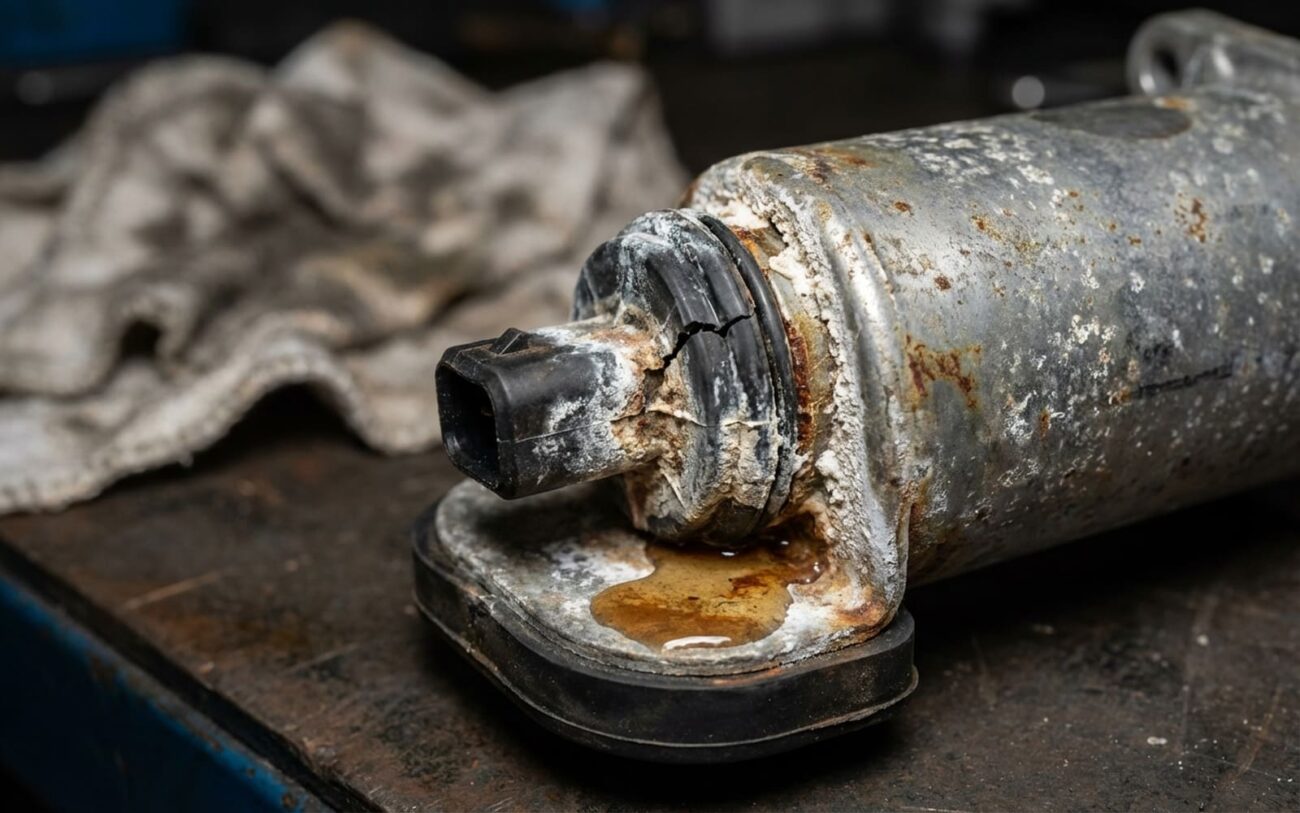
I get it—washer fluid costs money. But tap water? That’s a false economy. I’ve torn down dozens of pumps that failed at 30,000 miles, and the impeller was coated in white crust. That’s calcium. That’s scale. And it’s not just hard water areas—any tap water leaves deposits over time.
Here’s what happens inside:
-
Mineral buildup: The impeller spins in a tiny chamber. Scale builds up, increases friction, makes the motor work harder. Eventually, it overheats. Same principle as a coffee maker—but this motor’s rated for 3 seconds of runtime, not continuous use.
-
No lubrication: Washer fluid has mild lubricants. Water doesn’t. The sintered bronze bushings in most pumps rely on that. Run them dry (or with water), and they wear fast. I’ve seen shafts with visible play after a year of water use.
-
Corrosion: Even stainless steel shafts corrode in oxygen-rich water. Contacts degrade. I’ve pulled pumps where the motor terminals were green with oxidation—no wonder it wasn’t getting power.
-
Freezing: This is the big one. Water expands. Ice cracks plastic. I’ve seen impellers shattered, housings split, seals blown out. And yes—some manufacturers (looking at you, BMW) have service bulletins warning against water use due to freeze-related failures. Don’t believe me? Try explaining to a customer why their $500 front bumper needs to come off because they topped off with tap water in December.
And algae? In warm climates, stagnant water in a dark reservoir is a petri dish. It clogs filters, but worse—it turns into sludge that grinds down the impeller. I’ve found black goo inside pumps that looked like motor oil. That’s biological growth. And it’s preventable.
Repair Paths: What You Can Do vs. When to Call a Pro
Once you’ve confirmed the pump is dead, your options depend on the car. These pumps are sealed—no rebuilds, no service kits. If it’s gone, it’s gone.
[DIY-FEASIBLE] Accessible Pump (Most GM, Ford, Toyota)
Buried Pump (Luxury, EVs, Some SUVs) Shop Job
[NON-REPAIRABLE] Internal Failure
[LAST-RESORT] Vinegar Flush (Use With Caution)
Did It Work? Here’s How to Know
-
Functional Test: Activate both front and rear (if equipped). Spray should be strong, immediate, and even. No sputtering. Check each nozzle—adjust if needed. On some Volvos, the nozzles clog constantly. A pin usually clears them. -
Electrical Test: Set your multimeter to amps. Break the circuit at the pump connector and measure draw. Healthy pump: 2–5 amps. Zero? Open circuit—maybe a bad new pump. Over 6 amps? Binding or voltage drop. Check ground resistance at the chassis. -
Leak Test: Run the system, then inspect the pump seal and hose connections. Look under the fender liner—drips show up there first. A flexible mechanic’s mirror helps. I keep one in my top drawer.
What’s It Gonna Cost? (And Is It Worth It?)
| Repair Type | DIY Cost | Shop Cost | Success Rate | Risk if Wrong |
|---|---|---|---|---|
| Accessible Pump | $25 – $75 | $150 – $300 | >95% | Damaging the grommet during removal—causes slow leak into fender. |
| Buried Pump | $25 – $75 | $300 – $600+ | >95% | Paying big labor only to find it was a $1 fuse or corroded connector—same as winter taillight failures. |
| Vinegar Flush | <$5 | $50 | <50% | Degrades hoses; no fix for mechanical failure. |
If the shop quote is over 10% of your car’s value and the pump’s accessible, just do it yourself. For older cars with buried pumps? Be honest. If you’re not constantly in snow or bugs, you can live without it. Keep a microfiber cloth in the console. That’s what I do on my old Jeep.
How to Never Do This Again
Use washer fluid. Not water. Not “just until I get to the store.” Actual fluid. Winter blend if it gets cold. Summer blend for bugs. Concentrate if you want to save money—just mix it right.
And listen to the pump. A healthy one is quick—whir, done. If it’s slow, labored, or loud, investigate. Could be low fluid, could be early wear. Either way, catch it early.
If you suspect it’s frozen? Don’t mash the switch. You’re burning the motor. Park in a garage. Wait it out. Or use a space heater in the bay for an hour. Patience saves parts.
And once a year—especially in hard water areas—drain the reservoir, flush it with fresh washer fluid, and check the inlet filter. Takes 10 minutes. Prevents half the failures I see.
