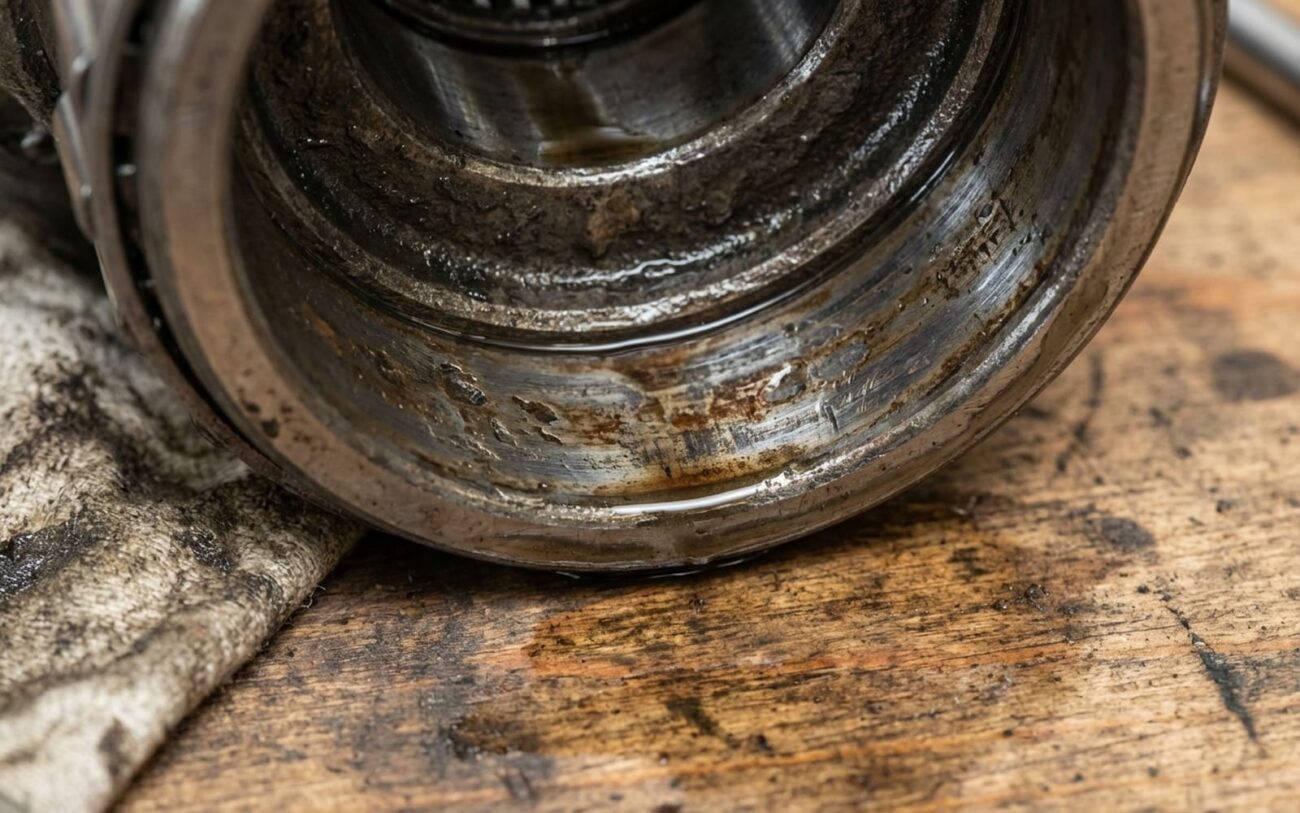
Alright, let’s talk about that hum you’re hearing when you turn the wheel. In my 25+ years under the hood, a humming noise that shows up when you’re cornering – especially under power, like when you’re accelerating through a curve – is one of the clearest signs your differential bearings are waving the white flag. This isn’t just some random road noise; it’s your vehicle telling you, loud and clear, that something in the rear end is wearing out fast.
What That Hum Means (and Why It’s Dangerous)
The key here is that the noise is tied to your road speed and how much load is on the corner, not your engine RPM. You’ll hear it in every gear, and it’ll usually get louder as you pick up speed. But here’s the kicker: it often fades or disappears when you’re driving straight. That’s because when you turn, the weight of the vehicle shifts to the outside wheels, putting a huge amount of stress on the corresponding differential side bearings. A worn bearing will start to hum, growl, or whine under that exact loaded condition.
You might even notice the sound changes between left and right turns – louder in one direction than the other. That’s a dead giveaway. A left turn, for example, really loads up the right-side bearing. So if that right bearing is shot, the noise will spike when you’re making a left-hand turn. It’s like a roller skate with a flat spot on one wheel: it rolls fine until you lean into a turn, then the vibration becomes impossible to ignore.
Status: Degrading
Don’t ignore this early warning. A humming noise means the bearing race and rollers are starting to degrade. We call it spalling or brinelling. If you let it go, that bearing will develop excessive play, the cage can collapse, rollers can break loose, or the whole thing could seize up. A seized pinion or side bearing can lock up your differential or even weld itself to the shaft. Imagine that happening at highway speeds – sudden driveline lockup. That’s not just dangerous for you, it’s going to be an extremely costly repair.
My Approach to Pinpointing the Noise
Before we even think about tearing into a differential, you’ve got to be sure that’s where the noise is actually coming from. A hum on turns can be a real chameleon, mimicking a bad wheel bearing, worn tires, or even a CV joint, especially in an AWD system. Misdiagnosis here is a waste of your money and my time, so let’s rule out the usual suspects first.
Pro Tip: I always start by asking the customer to describe the noise. Does it change with speed? Does it go away when you let off the gas? Does it get louder turning left or right? These details are gold.
Here’s how I typically narrow it down:
-
Road Test & Figure-8: If you’re hearing a speed-dependent hum primarily in turns, that’s a classic differential or wheel bearing symptom. I’ll take it for a drive and do a “figure-8” pattern in a safe parking lot. If the pitch or volume changes significantly between left and right turns, that points strongly to a differential side bearing. The noise will usually be most pronounced when the damaged bearing is on the outside of the turn, under maximum load.
-
Coast Test: If the humming is present in all gears, regardless of engine RPM, I’ll try coasting in neutral (safely, of course, and only where permitted). If the hum remains, we’ve confirmed the source is downstream of the transmission – meaning it’s in the driveshaft, differential, or wheel bearings. If it goes away, it could be something in the transmission or transfer case.
-
Stethoscope on the Hoist: This is the definitive test. Once we’ve got the vehicle safely on a hoist, I’ll run it up to speed (again, safely!) and use a chassis ear or a mechanic’s stethoscope. I’ll listen carefully at the differential housing, the axle tubes, and each wheel hub. True differential noise will peak right at the differential housing, while a wheel bearing noise will be loudest at the hub. It’s a subtle difference sometimes, but crucial.
-
Tire Check: Don’t forget the simple stuff. Cupped or unevenly worn tires can make a surprisingly similar humming or droning noise. A quick visual inspection and running your hand over the tread can rule this out fast.
Why Bearings Give Up the Ghost
Differential bearing failure isn’t just bad luck; it’s almost always the result of mechanical stress, poor maintenance, or sometimes, a design limitation. Understanding the root cause helps prevent repeat failures and tells you whether you’re just replacing a bearing or if there are deeper issues at play.
Common Ways Bearings Fail:
Spalling: These are microscopic cracks that develop from repeated stress, eventually flaking off metal.
False Brinelling: This happens when a vehicle sits for a long time, and vibrations cause indentations in the bearing races.
Loss of Preload: If the crush sleeve (on pinion bearings) relaxes, it allows excessive movement, leading to rapid wear.
Contamination: Metal shavings from other worn parts or dirty gear oil can act like grinding paste, destroying the bearings.
And let’s be clear about what this noise usually isn’t: a worn ring and pinion gear set typically causes a distinct howling noise, often under acceleration or deceleration, not a constant hum. While a bad bearing can certainly lead to gear damage if ignored, the reverse isn’t always true. Also, seeing leaking axle or pinion seals isn’t a bearing failure in itself – but excessive bearing play and shaft runout are common reasons those seals start to leak. So, if you see a leak, check the bearings first.
Your Repair Options: From a Pinion Job to a Full Swap
This Isn’t a Beginner’s Job
Let me be straight with you: there’s no shortcut or magic additive for a failed differential bearing. Fixing this means complete disassembly, precise measurements down to the thousandth of an inch, and specialized tools like dial indicators, bearing pullers, and press sets. This is specialist territory, not a weekend DIY for most folks.
Once we’ve confirmed it’s a differential bearing, here are the paths we can take:
Targeted Pinion Bearing Repair Professional Only
Full Carrier Overhaul
Assembly Swap
Making Sure the Repair Actually Worked
Just because the noise is gone after reassembly doesn’t mean the job is done. A proper validation process is absolutely critical to ensure the repair lasts and you don’t end up back in my bay next month.
Finally, inspect for leaks. After about 100 miles and a few heat cycles, I’ll get the vehicle back up and check the pinion seal and axle seals. To make this easier and catch even the tiniest weep, I’ll often add a UV dye to the gear oil during the initial fill-up. Then, a black light makes any leaks glow like a Christmas tree. It’s a small step that prevents big headaches – and comebacks – later on.
Cost, Risk, and Making the Hard Decision
So, what’s this going to cost you? It varies a lot by vehicle, parts availability, and whether you’re doing it yourself (which, again, I don’t recommend for most people) or taking it to a specialist. Here’s a rough idea based on what I see:
| Repair Type | DIY Parts Cost (Approx.) | Shop Cost (Approx.) | My Success Rate Expectation |
|---|---|---|---|
| Pinion Bearing & Seal | $300 – $600 | $800 – $1,500 | 95% (Only if done by a specialist with proper tools) |
| Complete Overhaul | $1,000 – $2,000 | $2,000 – $3,500 | 90% (Requires extreme precision; gear setup is key) |
| Assembly Swap | $500 – $1,500 | $1,500 – $2,500 | 98% (Often the most straightforward and reliable option) |
The “DIY Cost” columns are for parts only. Don’t forget the cost of specialized tools you’d need, which can easily add hundreds more. For most folks, an assembly swap is often the best balance of cost, reliability, and peace of mind.
How to Keep Your Differential Healthy
My Maintenance Checklist
-
Change the gear oil regularly. I tell my customers every 30,000 to 50,000 miles. Don’t believe the “lifetime fluid” myth – it’s just not true for differentials that work hard.
-
Use the right stuff. Always use the correct GL-5 rated fluid. And if you’ve got a limited-slip differential, make sure you’re adding the specific friction modifiers it needs.
-
Listen for early warnings. Once a month, do a quick “parking lot circle test.” Just drive slowly in tight circles, both left and right, and listen for any new humming or whines. Catching it early can save you a fortune.
-
Keep your driveline balanced. Make sure your driveshafts are balanced correctly. Constant vibrations put unnecessary stress on all your bearings over time.
Pro Tip from the Shop Floor
If you ever spot oil streaks on your axle tubes, don’t just assume it’s a bad seal. More often than not, it’s a symptom of excessive bearing play causing the seal to fail. Always check the bearing for runout and play before you just slap a new seal in there. Otherwise, you’ll be replacing that seal again in short order.
