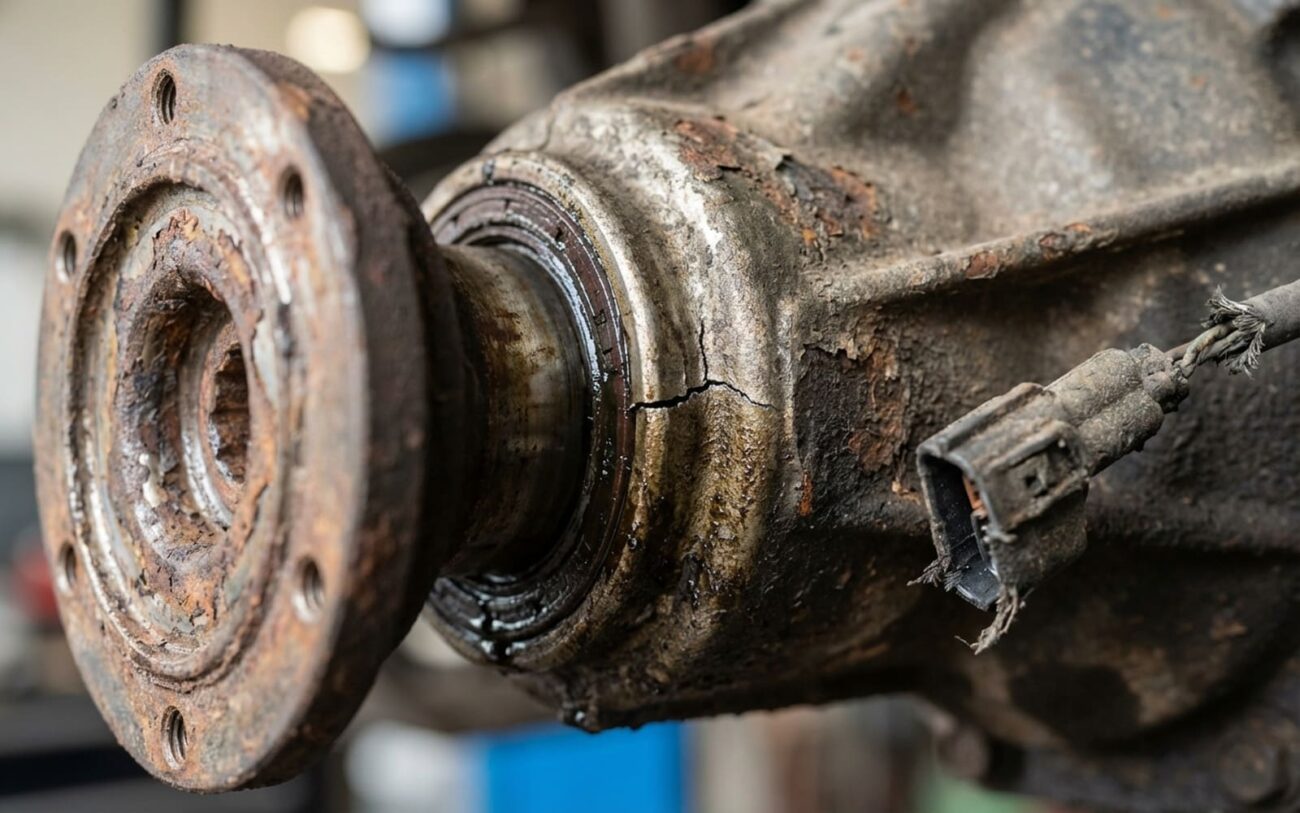
Alright, let’s talk about that “clunk” you’re hearing from the back of your rig when you try to engage four-wheel drive. You hit the button or turn the dial, wait a few seconds, and then BAM! — a loud thud, and then the system finally kicks in. Sound familiar? Especially common on part-time or on-demand 4WD systems, like what you’d find in a Nissan X-Trail or many other modern SUVs and trucks.
Now, I’ve been turning wrenches for over 25 years, and I can tell you straight up: that delay and clunk isn’t normal. Not by a long shot. These systems are designed to engage quickly, usually within a second or two. Anything longer, and you’ve got a developing issue in the driveline’s engagement system. And trust me, you don’t want to ignore it.
The Reality
That clunk? It’s the sound of internal components finally overcoming resistance they shouldn’t have. It’s not happy, and it’s telling you so.
What you’re hearing isn’t usually a driveshaft binding or a wheel bearing screaming. In most modern 4WD systems, especially the on-demand type, that clunk comes from the rear differential’s clutch pack or its actuator struggling to lock up. These systems typically use an electronically controlled multi-plate clutch right there inside the rear differential, engaged by an electric motor and hydraulic pressure. When that system hesitates, it’s because something’s worn, sticky, or just plain failing.
I see this misdiagnosed a lot. People jump to the transfer case, or maybe they check a fuse. But in my experience, when you get that delayed, hard engagement, the fault is almost always at the rear axle itself.
How I Pinpoint the Problem
While that delay and clunk strongly point to the rear differential, I’ve learned that several other components can mimic the same symptoms. You could have a slow actuator motor, old or contaminated fluid, or even a flaky 4WD switch. The tricky part? The 4WD control module doesn’t always set a trouble code unless the fault is pretty severe. So, don’t just wait for a dash light to come on.
The key, in my shop, is always a good bi-directional scan tool. This isn’t just a code reader; it’s a tool that lets me talk to the 4WD control module. I can command the system to engage, then watch the live data: actuator position, current draw, and what the sensors are telling me. Without this, you’re just throwing parts at it, and that gets expensive fast.
| Symptom | Usually Points to Rear Diff | Common Mimics (Check These First) | My Go-To Test |
|---|---|---|---|
| Delayed Engagement & Clunk | Worn clutch pack, sticking clutch piston, or a failed internal seal causing low hydraulic pressure. | Slow or failing 4WD actuator motor (the external one), low/contaminated differential fluid, faulty 4WD switch, or a bad encoder signal. |
Use a bi-directional scan tool. Command 4WD engagement and watch the actuator motor position and current draw. If the command is sent but the actuator response is slow, or current draw is out of spec, you’re on the right track. |
| 4WD Warning Lamp On | Failed internal clutch position sensor or an oil temperature sensor sending bad feedback. | Faulty wheel speed sensor, transfer case encoder motor fault, wiring harness damage, or connector corrosion. |
Read live data. Compare the commanded clutch engagement percentage to the actual sensor feedback. If there’s a mismatch of more than 10%, especially if the transfer case and wheel speed data look good, it’s an internal differential fault. |
So, if your scan tool shows the 4WD module is sending the correct commands to the actuator, but you’re still getting a delayed or failed mechanical response, and the sensor feedback doesn’t match what’s happening (and you’ve ruled out issues with the transfer case or wheel speed sensors), then yeah, the problem is almost certainly inside that rear differential.
What I Typically Find Worn Out Inside
When the fault is internal to the differential, it generally comes down to one of these four issues:
-
Worn clutch pack: These are friction and steel plates, just like in an automatic transmission. They wear down over time. As the clearances increase, the hydraulic pressure can’t build up fast enough to clamp them, causing that delayed engagement and clunk.
-
Failed internal seals: There’s a piston that compresses the clutch pack. If its seal starts to leak, hydraulic pressure bleeds off, weakening the clamping force. This leads to slipping, which generates heat, and eventually, failure.
-
Contamination: Over time, especially if fluid changes are skipped, tiny metal particles from normal gear wear can get into the clutch assembly. This contamination can make the plates stick or bind erratically, causing inconsistent engagement.
-
Failed position sensor: This won’t stop the mechanical engagement, but it will prevent the 4WD module from verifying that the system is actually working. So, you’ll get a warning light, and the system might even disable itself as a failsafe.
Pro Tip for Nissan X-Trail (Rogue) Owners:
I’ve seen a specific issue on some 2014–2015 Nissan X-Trail (Rogue) models where air gets trapped in the hydraulic actuator circuit. This causes those engagement delays. It requires a specific bleeding procedure using a scan tool to cycle the actuator. Many shops skip this, so it’s worth asking about before anyone starts tearing into your differential. It’s a much simpler fix if that’s the root cause.
Just to be clear: the electric actuator that bolts to the outside of the differential is a separate component from the internal clutch assembly. A faulty external actuator can definitely cause similar symptoms, and it’s generally an easier and less expensive fix. Don’t confuse a rear axle engagement delay with a transfer case shift delay, either. They’re different systems, and the symptoms, while sometimes similar, point to different areas.
Your Repair Options, From Simple to Severe
Actuator Motor Replacement DIY Feasible
Internal Clutch Pack/Seal Service Professional Only
Complete Assembly Replacement
Fluid Change Maintenance
Making Sure the Fix Actually Worked
I never consider a job done until I’ve validated it under real-world conditions. Here’s how I check my work:
-
For actuator replacement: After the learn procedure, I verify with the scan tool that the actuator position reaches its target within 2 seconds. Then, I take it for a test drive on gravel or wet pavement. The engagement needs to be quick and quiet—no more clunk.
-
For internal service: The commanded clutch position must match the actual feedback from the sensor within 5%. And critically, the 4WD warning light has to stay off for at least three full drive cycles. That tells me the module is happy.
-
Temperature check: After a good test drive, I use an infrared thermometer on the differential housing. If the temperature is more than 20°C (about 36°F) above the ambient temperature, that’s a red flag. It signals internal binding or clutch slip, meaning something’s still not right.
What This is Going to Cost You
Let’s talk dollars and cents. These are rough estimates, of course, but based on what I see in my shop:
Actuator Motor
This includes parts and labor. If you’re doing it yourself, parts typically run $300-$600. It’s got a high success rate if diagnosed correctly.
Internal Service
This is labor-intensive work. It requires precision shimming and specialized tools. The success here depends heavily on the technician’s skill and attention to detail.
Full Assembly
This is the “nuclear option” for when clutches are welded or there’s severe contamination. It’s the most reliable long-term fix, but also the most expensive.
A quick reality check: if the repair cost starts to creep above 40% of your vehicle’s current value, it’s time to weigh the economics carefully. Sometimes, it’s just not worth it.
How to Keep This From Happening Again
Maintenance is Your Best Friend
-
Change that fluid early: If your owner’s manual says 60,000 miles, I’d recommend doing it every 30,000 miles, especially if you use 4WD often. Always, and I mean always, use the manufacturer-specified fluid. It’s not just a suggestion.
-
Test it monthly: Engage your 4WD on a loose surface (like dirt or gravel) once a month. This helps keep the system lubricated and responsive. It’s like exercising a muscle—use it or lose it.
-
Address related issues: While things like driveshaft vibration or a failing center support bearing won’t directly cause a 4WD engagement delay, they can definitely complicate diagnosis and put extra stress on your driveline. Get them fixed.
