Driveshaft Vibration: My 25 Years of Diagnosing and Fixing Driveline Shakes
Alright, let’s cut to the chase. When your vehicle starts shaking, especially under acceleration or braking, and that vibration picks up with road speed, you’re almost certainly dealing with a driveline issue. After 25 years under the hood, I can tell you the driveshaft is usually one of the first things I check.
Think about it: this shaft is spinning at driveline speed, transferring all that power from your transmission to the differential, whether it’s front or rear. Any imbalance, any damage, any wear in that assembly—it translates directly into a shake you feel right through the floor, your seat, or even the steering wheel. It’s not just annoying; it’s a clear warning sign.
Pinpointing the Problem: Symptoms and My Diagnostic Approach
The first step in my shop is always diagnosis. Many things can mimic a driveshaft vibration—out-of-balance tires, worn CV joints, failing wheel bearings. The trick is isolating the source. Here’s how I break it down:
The key diagnostic clue? Speed-dependent vibration. If the shake gets worse as you go faster, regardless of what the engine RPM is doing, you’re likely looking at something in the rotating assembly: driveshaft, wheels, or axles. But if that vibration is also load-sensitive—meaning it gets noticeably worse when you accelerate hard or decelerate abruptly—it almost always points to the driveshaft or its universal joints (U-joints). I’ve had countless customers swear it’s a tire problem, but once we get it on the lift and isolate the driveline, the real culprit becomes clear.
Here’s the table I use, and teach my junior techs, to differentiate a driveshaft issue from common mimics. This is the process of elimination that saves time and money:
| What You Feel (Symptom) | What It Often Means (Driveshaft) | Other Possibilities (Mimics) | My Go-To Test to Confirm |
|---|---|---|---|
| Vibration that gets worse the faster you go (speed-proportional) | An unbalanced driveshaft. This could be a missing balance weight, a dent in the tube, or a bent yoke. | Unbalanced or damaged tires, warped brake rotors, bent wheels. |
Get the vehicle on a lift, support it safely, and run it in gear at the problem speed. Use a dial indicator on the driveshaft. Anything over 0.005 inches of runout is excessive and tells you the shaft itself is the problem. |
| A clunk or thud when you shift into drive/reverse, or during hard acceleration/deceleration | Worn U-joints or slip yoke splines. This creates too much “lash” or play in the driveline. | Worn CV joints, loose differential backlash, failed engine or transmission mounts. |
With the engine off and the vehicle safely supported, try to rotate the driveshaft by hand at the rear yoke. If you feel excessive rotational play before the differential starts to move, you’ve got U-joint or spline wear. |
| Vibration that gets significantly worse when you accelerate or put the engine under load | Incorrect U-joint operating angles. This can be caused by a bent yoke, a damaged crossmember, or even a misaligned differential. | A worn pinion bearing (this usually comes with a distinct whine), or a soft engine mount. |
Measure the U-joint angles using an inclinometer. The angles at both ends should be within 0.5° of each other and complementary. If they’re off, the U-joints aren’t happy. |
What Actually Breaks on a Driveshaft (and What Doesn’t)
Most folks hear “driveshaft problem” and immediately think “bad U-joints.” And sure, U-joints wear out—they’re a service item, like brake pads. But the shaft itself can fail, and that’s a whole different ballgame. True driveshaft failures involve the main tube, the welded yokes, or internal balance defects. This isn’t just a worn part; it’s a structural issue.
One common defect I see is a loss of balance weights. I’ve seen this on countless trucks where the factory adhesive just gives up after years of heat cycling and road grime. You’re driving along, everything’s fine, then suddenly you get a violent vibration. Some Ford and GM models even had service bulletins about this—weights detaching after a few years, especially on trucks that saw heavy towing. That’s not user error; that’s a manufacturing or design flaw.
Physical damage is another big one. Hit a monster pothole? Run over some road debris? That can dent the driveshaft tube. Even a small dent throws off the balance significantly and creates a stress point that can lead to cracking. I once diagnosed a persistent vibration at 55 mph on a truck that had a quarter-inch dent—barely visible, but it caused a whopping 0.012 inches of runout. That’s enough to shake your teeth out.
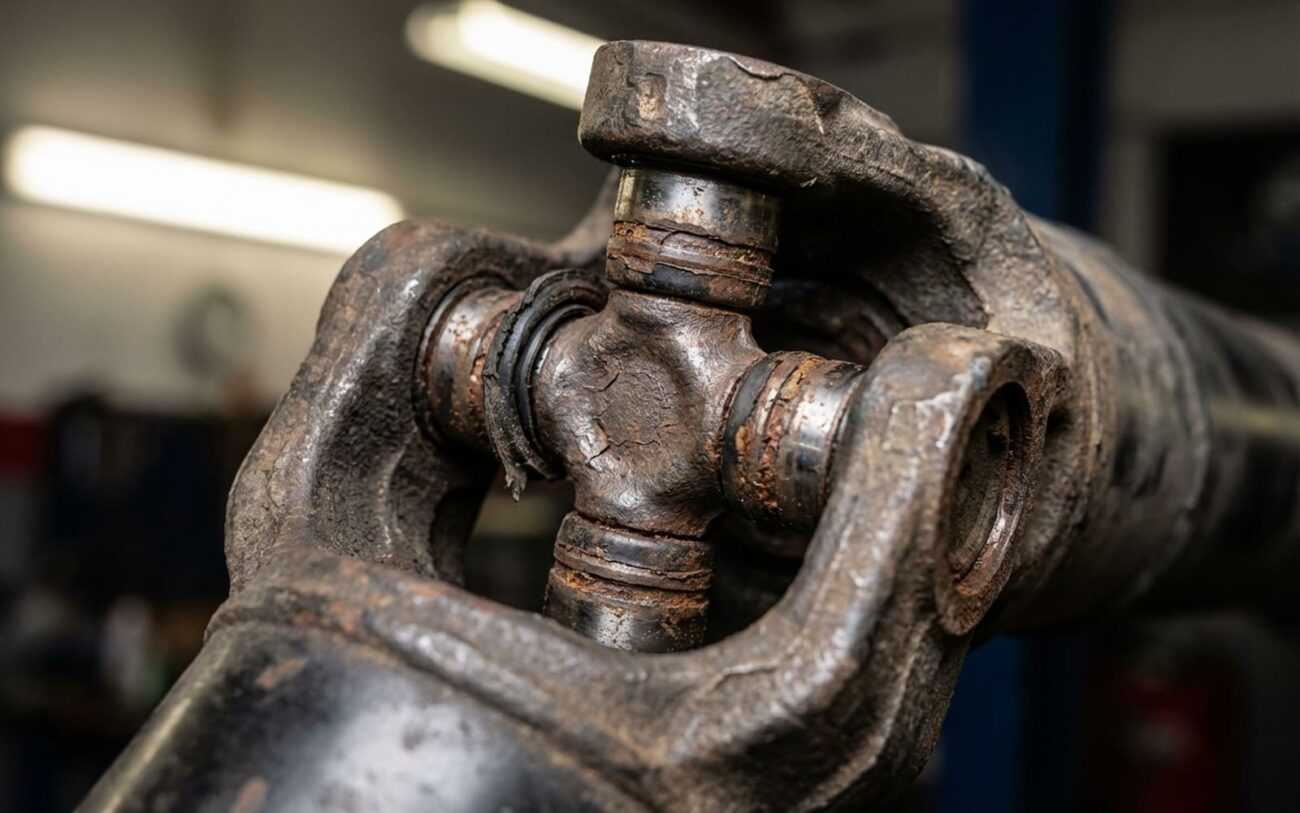
Yoke damage is a silent killer, too. If someone, maybe a previous DIYer or a careless tech, hammered a U-joint into place instead of using a proper press, those yoke ears can spread. That changes the U-joint’s operating angle and you’ll get a vibration under load. Over-torquing the U-bolt straps can do the same thing. And don’t forget the slip yoke: if it’s not lubricated with the correct grease (often a moly-based compound like Molykote G-n), the splines can gall and wear, leading to clunking and binding.
Let me clarify what’s NOT a driveshaft failure:
Worn U-joint bearings. That’s just normal wear and tear, a maintenance item. Also, vibrations that pop up after a suspension lift are usually due to incorrect pinion angles, not a bad shaft itself. In those cases, the driveshaft is just the messenger—it’s telling you the driveline geometry is all out of whack.
The Fix: What Works and What’s a Waste of Time
My Shop Strategy: Don’t Guess, Diagnose
Once we’ve pinpointed the problem, the repair path depends entirely on what’s actually broken. Here’s how I approach it in the shop—and what I tell my customers:
Missing Balance Weight or Minor Imbalance Professional Only
Dented Tube, Bent Yoke, or Cracked Weld Replace Only
Worn U-Joints or Dry Slip Yoke DIY Feasible
Two-Piece Shaft with Center Support Bearing Temporary Fix / Diagnostic Aid
And one critical thing I always stress, especially if you’re replacing the shaft or U-joints: double-check U-joint phasing. The yokes at both ends of the driveshaft must be aligned. If they’re off, even by a little, you’ll introduce a vibration, even with a perfectly balanced shaft. It’s a common rookie mistake that leads to comebacks.
Verifying the Repair: Don’t Just Assume It’s Fixed
Don’t ever assume that just because you’ve put in a new shaft or new U-joints, the job is done. Validation is absolutely critical. First, you need to road test the vehicle under real-world conditions: accelerate, cruise, and coast through all the speeds where that vibration occurred. It should be smooth across the board.
In the shop, we use a vibration analyzer to measure the amplitude. Anything over 0.2 inches per second (IPS) is usually noticeable to the driver; under 0.1 IPS is generally considered acceptable. If you don’t have a fancy meter, drive it with an experienced tech—they’ll feel it if something’s still off. Trust your gut, and trust your butt-dyno.
Pro Validation Tip: The Details Matter
If you replaced U-joints or serviced the slip yoke, always check for smooth operation by hand. Rotate the shaft—it should turn freely, with no binding or notchiness. There should be zero lash at the slip yoke. After your road test, always inspect the transmission tail housing for any leaks. A damaged output seal will show up in a few days if you don’t catch it immediately. And remember, tools matter: use a dial indicator for runout, an inclinometer for pinion angles, and a torque wrench on every critical fastener. That pinion nut, for example? It’s not just “tight is tight”—it’s often 180 ft-lbs plus an additional 90-degree turn with an angle gauge. Guesswork causes comebacks, every single time.
Driveshaft Repair Costs: What to Expect (and When to Walk Away)
Repair costs can swing wildly, but here’s a realistic breakdown based on what I see every day in the shop. This table covers typical labor and parts for common repairs. Keep in mind, these are averages—your specific vehicle and location will affect the final price.
| Repair Type | DIY Cost (Parts Only) | Shop Cost (Parts + Labor) | Success Rate (If Done Right) | Potential Secondary Risks |
|---|---|---|---|---|
| U-joint replacement | $50–$150 | $250–$500 | High (with proper press tools) | Premature U-joint failure, driveshaft dropping, transmission seal damage if slip yoke isn’t handled right. |
| Driveshaft replacement (single-piece) | $300–$800 | $700–$1,500 | Very High | Vibration from incorrect phasing or angle issues, transmission/differential seal leaks, poor balance on cheap aftermarket shafts. |
Here’s the reality check I give my customers: on older vehicles, you really need to weigh the repair cost against the car’s overall value. If the fix is more than, say, 40% of what the vehicle is actually worth—and it’s not some classic, collector’s item, or an absolute daily necessity you can’t live without—you need to ask yourself if it makes financial sense. I’ve seen people spend $1,200 on a driveshaft for a $3,000 truck. That’s not always a bad call if you’re planning to keep it another five years, but you have to be honest about the economics before you dive in.
Preventing Driveshaft Vibration: Simple Steps That Save Big Money
Most driveshaft issues are actually preventable. The biggest oversight I see, year after year? Not lubricating the slip yoke. Many RWD trucks and SUVs have a service interval for this—check your owner’s manual. And I can’t stress this enough: use the OEM-recommended grease. It’s not just about reducing wear; using the wrong lubricant can swell the splines and destroy the transmission output shaft seal, leading to fluid leaks and much bigger problems down the road.
My Early Detection Habits
-
Every time you’re under the car for an oil change or tire rotation, take a minute to slide under and look at the driveshaft. Check for dents, any missing balance weights, or rust forming around the U-joints.
-
Grab the driveshaft firmly and try to move it up and down, and side to side. Any noticeable movement means you’ve got U-joint wear, and it’s time to investigate.
-
Spin it by hand (with the vehicle safely supported and in neutral, of course). Listen for any grinding noises or feel for any binding. It should rotate smoothly.
-
If you hit a deep pothole or run over a large object, pay extra attention on your next drive. A new vibration or clunk could mean a loose balance weight or a slightly damaged joint. Catching it early means a relatively cheap U-joint job instead of a much more expensive full driveshaft replacement.
