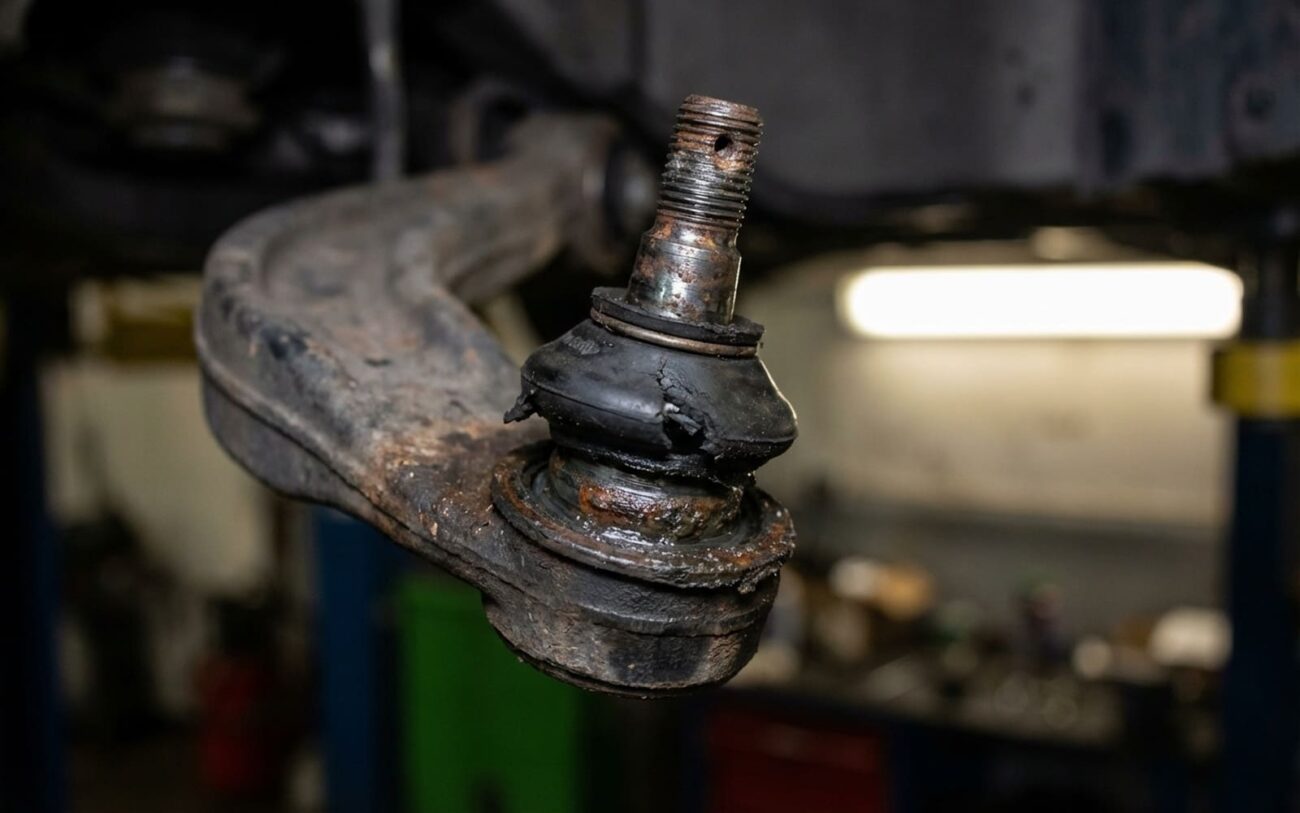
Can a Worn Ball Joint Really Cause Your Wheel to Fall Off?
Absolutely. And let me tell you, this isn’t some hypothetical “what if” scenario. I’ve seen it happen more times than I care to count in my 25+ years in the shop. I’ve pulled vehicles in where the wheel was literally hanging by the brake hose and axle shaft after a ball joint gave up the ghost. It’s a terrifying sight, and it happens fast.
Think of a ball joint as your vehicle’s hip socket. It’s the critical pivot that connects your steering knuckle (which holds the wheel, hub, and brake assembly) to the control arm and, ultimately, to the vehicle’s frame. When that joint fails completely, that mechanical link breaks. The control arm drops, the knuckle collapses, and the wheel can either splay out at an extreme, dangerous angle or, in the worst cases, fully detach from the vehicle.
Warning Signs: What Your Car Tells You Before It Breaks
A ball joint doesn’t just fail silently, not usually anyway. There are almost always clear, escalating symptoms that show up long before you’re in real trouble. Learning to recognize these early can save you from a catastrophic failure – and a much bigger repair bill.
The Clunking and Popping
This is probably the most common early sign. You’ll hear a loud, rhythmic clunking or popping noise, usually from one front corner of the vehicle. It’s most noticeable when you’re turning at low speeds, like in a parking lot, or when you’re driving over uneven surfaces, potholes, or speed bumps. That sound? It’s the ball stud rattling around inside a worn-out socket. Think of it like a loose hip joint – every movement causes a painful, unstable clunk. On older F-150s or Chevy trucks, I hear this weekly.
Steering Wheel Shimmy or Vibration
Another big indicator is a sharp, unpredictable shimmy or vibration in the steering wheel. You’ll often feel this under braking, but it can also show up during acceleration or even just cruising down the highway. What’s happening is that the excessive play in the ball joint allows your front-end geometry to shift around dynamically. Your wheel alignment is changing on the fly, which causes instability that feels a lot like a bent rim or an unbalanced tire. But it’s worse, because it’s inconsistent.
Erratic Steering or Pulling
If your car starts wandering, feeling loose, or pulling to one side, especially over bumps, that’s another red flag. A worn ball joint changes the suspension geometry, specifically camber and toe, as you drive. This makes the steering unpredictable and can be downright dangerous at highway speeds.
Visible Positive Camber
This is the most visual and critical red flag. If you park your car on a flat surface and look at it from the front, check the angle of the tires. If one front tire is noticeably tilted outward at the top while the other stands straight, that’s a sign your lower ball joint has lost significant structural integrity. This is often called “positive camber.” If you see this, you need to understand one thing:
Diagnosing the Problem: Is It Really the Ball Joint?
A lot of front-end components can make similar noises or cause similar handling issues. That’s why a proper diagnosis is key – you don’t want to throw parts at it. This table lays out the symptoms, common culprits, and the definitive tests I use in the shop to pinpoint a bad ball joint.
Before you start, make sure the vehicle is safely lifted on jack stands, or on a hoist if you have access. Never work under a vehicle supported only by a jack. And always remember, safety first.
| Symptom | Ball Joint Likely | Common Mimics | My Go-To Test to Confirm |
|---|---|---|---|
| Clunking or Popping over bumps | Vertical play in the ball joint due to a worn internal bearing or socket. | Worn strut mount, loose sway bar link, bad shock absorber, worn control arm bushing. | With the wheel off the ground, place a long pry bar under the tire (at 6 o’clock). Gently lift upward, watching the ball joint. Any visible vertical movement between the stud and its housing means it’s worn. Don’t mistake tire flex for joint play. |
| Steering wheel shimmy or vibration | Horizontal or multi-directional play, causing wheel instability under load. | Unbalanced tire, bent wheel, failing wheel bearing, warped brake rotor, worn tie rod end. | Grasp the tire firmly at 12 and 6 o’clock and rock it in and out. If you feel play, that’s usually a wheel bearing. Then, grasp it at 3 and 9 o’clock and rock it side to side. Play here could be a tie rod end or a horizontal ball joint issue. You’ll need to watch the specific joints. |
| Erratic steering, wandering, or pulling | Excessive joint wear altering suspension geometry (camber and toe) on the fly. | Bad tie rod end, incorrect alignment, binding steering rack, worn control arm bushings. | Do a “dry-park” inspection. With the vehicle on the ground, engine off, have someone gently turn the steering wheel back and forth (just enough to load the linkage, not full lock). You get under the car and watch all the steering and suspension joints. Look for delayed movement or “slop” in the linkage before the wheel actually turns. |
Why Ball Joints Give Up: The Root Causes of Failure
Ball joint failure isn’t usually a sudden event; it’s almost always a progressive process. Inside that joint, you’ve got a steel ball stud rotating within a lubricated socket, often lined with a polymer or metal-backed bearing. Over time, especially once you’re past 100,000 miles, that bearing material just wears down. That wear creates play, and that’s where the problems start.
The Silent Killer: A Damaged Boot
In my experience, the single biggest threat to a ball joint’s lifespan is a compromised rubber boot. This boot is supposed to seal in the grease and keep out contaminants. But once it cracks, splits, or tears – and they often do, especially on older vehicles or in harsh climates – it’s game over. Water, dirt, road salt, and grime get in, washing out the grease. What’s left turns into an abrasive paste that rapidly grinds away the internal components. I’ve seen ball joints fail in under 20,000 miles after a boot rupture. It’s that critical.
Corrosion and Impact Damage
Corrosion is another major factor, particularly if you live in a northern climate where they salt the roads. Rust can seize the ball stud in place, preventing it from articulating smoothly. When that happens, and you hit a bump, the joint can suddenly fracture under stress. And speaking of stress, severe impacts – like hitting a deep pothole at speed – can cause immediate damage, sometimes even cracking the housing on stamped-steel control arms. Avoid those potholes, seriously.
Repairing Ball Joints: DIY or Professional Job?
A Word on Safety and Complexity
How you tackle this repair really depends on your vehicle’s specific suspension design and your comfort level. Some ball joints are straightforward, but others require specialized tools, specific torque procedures, and a good understanding of suspension dynamics. Don’t underestimate the job.
Replaceable Ball Joint (Press-in or Bolt-on)
Integral Ball Joint (Part of the Control Arm) Professional Recommended
Catastrophic Failure: When the Wheel Has Already Fallen Off
After the Repair: Verifying the Work and Preventing Future Issues
Replacing a ball joint isn’t the finish line; it’s just the start of making sure everything’s right. A poorly installed ball joint can fail just as fast, or even faster, than the worn-out one you just removed. So, before you even think about lowering the vehicle, repeat that pry bar test. There should be absolutely no play – zero. If you see even a tiny bit of movement, the joint isn’t seated properly, or something else is wrong. Don’t skip this step.
My Post-Repair Checklist: Don’t Skip These
-
Get a professional front-end alignment. This isn’t optional. Any time you mess with suspension components, even minor changes to geometry can lead to rapid, uneven tire wear and poor handling.
-
Request an alignment printout. Make sure the toe, camber, and caster values are all within factory specifications. This is your proof the job was done right.
-
Take a test drive. Drive on a variety of surfaces, including some rough roads if possible. Listen for any clunks, feel for vibrations, and pay attention to how the steering feels. A properly repaired front end should feel tight, stable, and predictable.
What a Ball Joint Replacement Will Cost You
Costs can vary quite a bit depending on your vehicle, where you live, and whether you’re doing it yourself or taking it to a shop. Here’s a general idea:
| Repair Type | DIY Parts Cost (Approx.) | Shop Cost (Parts + Labor) | Risk if Done Wrong |
|---|---|---|---|
| Press-in Ball Joint | $40–$80 per side | $200–$400 per side | Improper seating or torque can lead to premature failure or wheel collapse. |
| Control Arm w/ Integral Joint | $100–$250 per side | $350–$600 per side | Separation risk, accelerated tire wear, and premature bushing failure from incorrect ride-height torque. |
| Front-End Alignment | N/A (requires specialized equipment) | $80–$120 | Poor handling, steering wheel off-center, and rapid, expensive tire wear if skipped. |
My Two Cents on Value
Look, if the total cost of this repair starts creeping up to 25% or more of your car’s current market value (check KBB or similar), and you’ve got other major repairs looming, it might be time to consider if it’s economically wise to keep pouring money into it. That said, never, ever compromise on safety if you intend to keep driving the vehicle. Some things just aren’t worth cutting corners on.
Keeping Your Ball Joints Healthy: Prevention is Key
The best way to avoid all this trouble is through regular, proactive inspection. Every time your vehicle is up on a lift – for an oil change, tire rotation, whatever – take literally 30 seconds to visually inspect the ball joint boots. Look for any cracks, splits, or signs of grease leaking out. If that boot is compromised, contamination is already happening, and the clock is ticking.
I also recommend a manual play check every 15,000 miles or so. With the wheel off the ground, use that pry bar under the tire and lift upward. Any movement at the ball joint itself is a sign of wear. Catching a torn boot or minor play early might just save you from a full control arm replacement, which is a much bigger job. And if you’re replacing them, consider premium joints that come with grease fittings – they allow for periodic lubrication, which can significantly extend their life.
