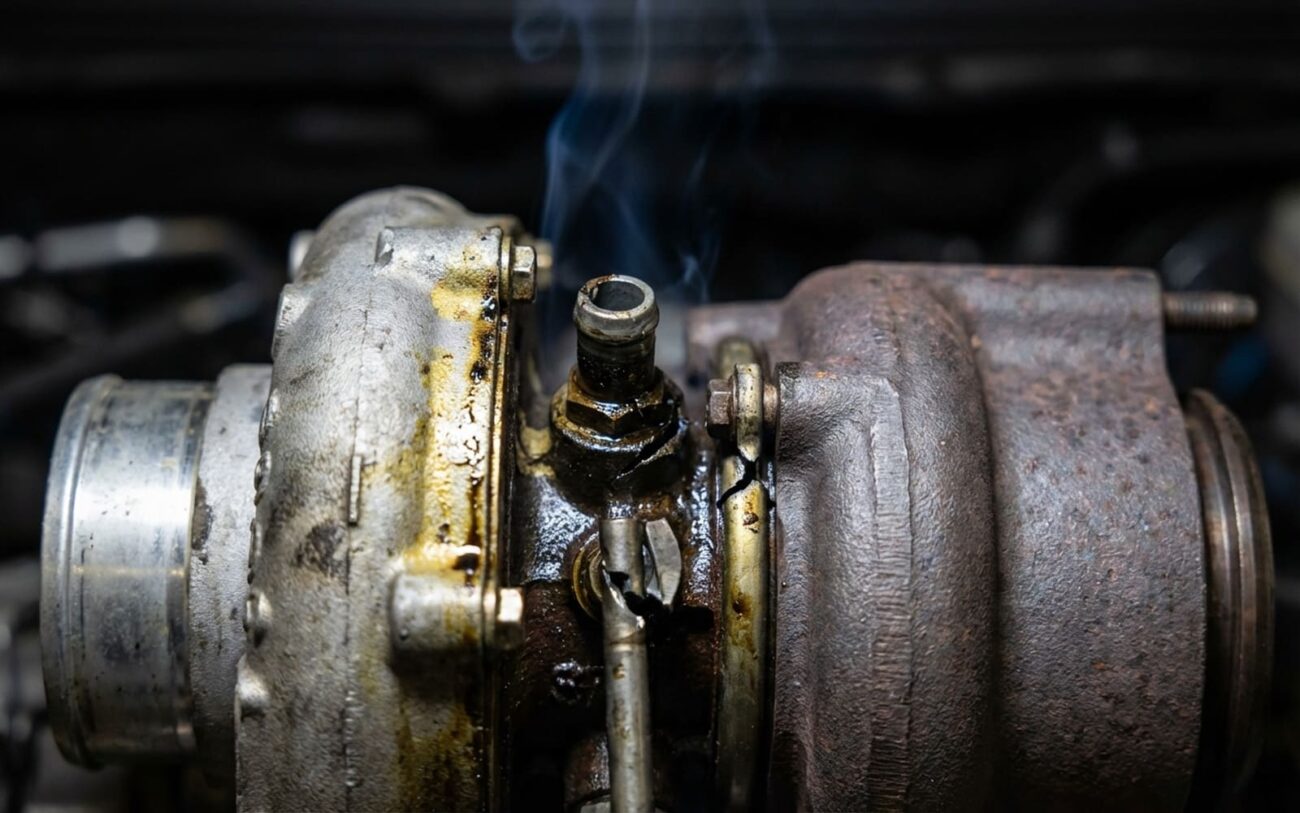
If you’re driving a Ford EcoBoost and you’re seeing smoke out the tailpipe, or maybe the check engine light is on, you’re probably worried about the turbo. And you should be. After 25 years turning wrenches, I can tell you that a failing turbo on these engines is a common problem, but it’s also one that’s often misdiagnosed. We’re going to break down what you’re seeing, what it really means, and how to fix it right – the first time.
What You’re Seeing, Hearing, and What It’s Telling Me
Let’s start with the obvious stuff. If you’re seeing yellow or a grayish-blue smoke from the exhaust, especially when you really get on the gas, that’s almost always a sign that engine oil is getting burned up in the combustion chamber. On EcoBoost engines, the biggest culprit for this kind of smoke is a failure of the internal oil seals inside the turbocharger. These seals, one on the compressor (cold) side and one on the turbine (hot) side, are supposed to keep pressurized oil from leaking into either the intake or exhaust. When they give up, oil gets sucked into the engine and, well, you get that telltale smoke.
Now, it’s true that worn valve stem seals or piston rings can also cause an engine to burn oil and smoke. But the pattern helps us narrow it down. If the smoke is really noticeable when the turbo is spooling up – under boost or during hard acceleration – then the turbo is my prime suspect. If you only see a puff of smoke on a cold start, that might lean more towards valve seals. But even then, a turbo with worn compressor seals can pull oil from the crankcase during those high-vacuum moments, so don’t rule it out completely.
You’ve probably also got a check engine light glaring at you. Common codes like P0299 (underboost) or P0234 (overboost) are red flags, sure, but they only tell you there’s a performance issue with the turbo. They don’t tell you why. It could be those failing oil seals, but it could also be a stuck wastegate, a faulty boost control solenoid, a vacuum leak somewhere, or even a partially clogged catalytic converter. These codes are just your starting point, not the final diagnosis.
Another big clue I always look for is oil in the intercooler or charge pipes. If I disconnect a hose after the turbo and find liquid oil pooling inside, that’s a pretty strong indicator of a failing compressor-side seal. But – and this is a critical “but” – oil in the intake tract can also come from excessive crankcase pressure, usually because of a failing PCV (Positive Crankcase Ventilation) system. So, don’t jump to conclusions and assume the turbo is toast just yet. You’ve got to trace that oil back to its source before you start tearing into anything expensive.
And if you’re hearing a high-pitched whine, a whistle, or even a grinding noise from the turbo area, that’s usually bearing failure. At that point, the turbine wheel itself could fracture, sending metal debris into your exhaust system – or worse, back into the engine. That’s a catastrophic failure waiting to happen.
Pinpointing the Real Problem and Why Turbos Fail
You can’t just throw a new turbo at the problem and hope for the best. That’s a quick way to waste a lot of money and likely repeat the failure. In my shop, we take a systematic approach to isolate the actual cause. Turbos don’t just fail for no reason; they’re pretty robust when they’re properly maintained. But EcoBoost engines, especially the 2.0L and 2.3L variants, are particularly sensitive to deferred maintenance.
The two biggest turbo killers I see are oil coking and oil starvation. Both are usually preventable.
Oil coking happens when you shut down the engine while the turbo is still scorching hot. The residual oil sitting in the turbo’s center housing (CHRA) essentially bakes onto the internal components, turning into hard carbon deposits. These deposits block tiny oil passages and damage the seal surfaces. This is a huge problem if you’re using the wrong type of oil or if you’re stretching your oil change intervals too far. That’s why Ford’s oil specifications are so critical.
Listen Up: Critical Oil Spec!
Ford has put out service guidance (like SSM 50183) for certain 2020–2022 2.0L EcoBoost models, and frankly, it applies to all of them. You must use Motorcraft SAE 5W-30 Full Synthetic Blend or an equivalent that meets specification WSS-M2C946-B1. This isn’t just a suggestion; it’s absolutely vital for your turbo’s long-term survival.
Oil starvation is just as deadly. The turbo’s bearings need a constant, clean, pressurized flow of oil. If the oil feed line gets clogged with sludge or debris, or if the oil return line is kinked, restricted, or even improperly angled, the oil can’t circulate properly. This leads to the bearings overheating, metal-on-metal contact, and eventually, total failure. I’ve seen plenty of turbos die because of a collapsed or poorly routed return line that wasn’t obvious until we really dug in.
Less common, but still possible, is physical damage. Debris from a disintegrating oil filter or a foreign object getting sucked into the compressor inlet can chip the compressor wheel. That causes an imbalance and vibration that quickly destroys the bearings. And don’t confuse external oil leaks – from gaskets or feed/return lines – with an internal seal failure. Those are separate issues. A leaky oil feed banjo bolt is a maintenance oversight, not a blown turbo. Same goes for a split charge pipe; that’s a boost leak, not turbo damage, though it can certainly trigger those misleading P0299 codes.
My Diagnostic Approach: Symptoms to Solutions
| What I’m Seeing/Hearing | Most Likely Turbo Problem | Common External Mimics | How I Confirm It |
|---|---|---|---|
| Yellow/gray-blue smoke under boost | Compressor or turbine oil seal failure | Worn valve stem seals, piston ring wear |
I perform a boost-hold smoke test. I’ll pressurize the crankcase (keeping it under 5 psi) with a smoke machine. If smoke pours out the exhaust, that’s a bad seal. |
| P0299 / P0234 DTCs (under/overboost) | Stuck wastegate, failed actuator, or VGT vane sticking | Boost control solenoid fault, vacuum leak, MAP sensor error, clogged exhaust |
I use a bidirectional scan tool to command the wastegate or VGT position. Then I monitor the feedback to see if it’s actually moving and holding position. |
| Oil in intercooler or charge pipes | Failed compressor-side oil seal | Excessive crankcase pressure (PCV system failure) |
I measure crankcase pressure at the oil fill cap with a manometer. I check it at idle and again at 2500 RPM. If it’s too high, the PCV is bad, not necessarily the turbo. |
| Whining, grinding, or rattling noise | Turbo bearing failure | Failing alternator, serpentine belt tensioner, transmission bearing |
I use a mechanical stethoscope to pinpoint the noise. Then I remove the intake pipe and check for shaft play on the compressor wheel. Any significant movement, and that turbo is done. |
Your Repair Options, From DIY to Deep Shop Work
Once we’ve got the real problem isolated, then we can talk about fixing it. Your options range from things you might tackle yourself to jobs that absolutely require a professional touch.
Wastegate Actuator or Boost Control Solenoid DIY-FEASIBLE
Internal Seal or Bearing Failure Professional Only
The Mechanic’s Reality Check
Let me be absolutely clear: there is no reliable temporary fix for internal turbo seal failure. If the smoke is minor, changing to the correct oil spec might slow down the leakage a little, but it won’t stop it. Driving with a dying turbo risks destroying your catalytic converter, which, as I mentioned, can add another $1,500–$2,500 to your bill. The risk far outweighs any short-term savings you think you’re getting by delaying the repair.
Making Sure the Fix Actually Worked
After any turbo repair, don’t just drive off and assume everything’s golden. You need to validate the repair properly. First, find a safe area and perform a full-throttle acceleration test. There should be zero visible exhaust smoke – no gray, no blue, no yellow. Use your scan tool to monitor actual versus desired boost pressure. On a 2.0L EcoBoost, for example, you should be seeing 16–18 psi under wide-open throttle, with the actual boost closely tracking the target. Also, clear any stored adaptation values in the PCM; this lets the system relearn with the new component.
If oil consumption was part of your original problem, monitor the oil level closely over the first 1,000 miles. It should remain stable, without any noticeable drop. I always recheck the charge pipes or intercooler for any fresh oil residue. If you’re still a little unsure, you can add a UV dye to the oil and inspect it with a black light after some driving. That can reveal even small leaks that aren’t visible to the naked eye yet.
What This Is Going to Cost You (The Real Talk)
Here’s a realistic breakdown of repair costs, based on what I see in the shop for common EcoBoost configurations.
| Repair Type | DIY Cost (Parts) | Shop Cost | Success Rate | Secondary Risk |
|---|---|---|---|---|
| Wastegate Actuator Replacement | $150 – $400 | $400 – $800 | High | Continued under/overboost codes if the problem was actually the turbo or another component. |
| Full Turbo Assembly Replacement (OEM) | $800 – $2000 | $1800 – $3500 | High | Immediate bearing failure if oil lines aren’t properly flushed and primed. |
| Certified CHRA Cartridge Replacement | $400 – $1000 | $1000 – $2000 | Medium-High | Boost leaks if the housing surfaces are damaged or not properly sealed during reassembly. |
Here’s a reality check I give my customers: if the repair cost is going to exceed half the car’s clean trade-in value, especially if the vehicle has over 120,000 miles, you really need to weigh your options carefully. I’ve seen customers spend $3,000 on a turbo repair only to face timing chain issues or major carbon buildup problems just a few weeks or months later. Know your car’s overall long-term reliability and factor in those potential future maintenance items.
How to Keep This From Happening Again
Prevention is always, always cheaper than repair. Follow these steps to protect your turbo and extend your engine’s life. Trust me on this.
-
Use only engine oil that meets Ford’s specific requirements for your model year—that’s WSS-M2C946-B1. And change it every 5,000 miles, no exceptions, to prevent coking and sludge buildup.
-
Don’t ignore your PCV system. A failing PCV valve increases crankcase pressure, which will force oil past even brand-new turbo seals. It’s a cheap part, replace it regularly.
-
While cleaning the intake and charge pipes during turbo service is good, if you’ve got carbon buildup on your intake valves (common on GDI engines), consider a decarbonizing service.
-
If you’ve been driving hard, let the engine idle for a minute or two before shutting it off. This allows the turbo to cool down and prevents oil coking. It’s a small habit that makes a huge difference.
