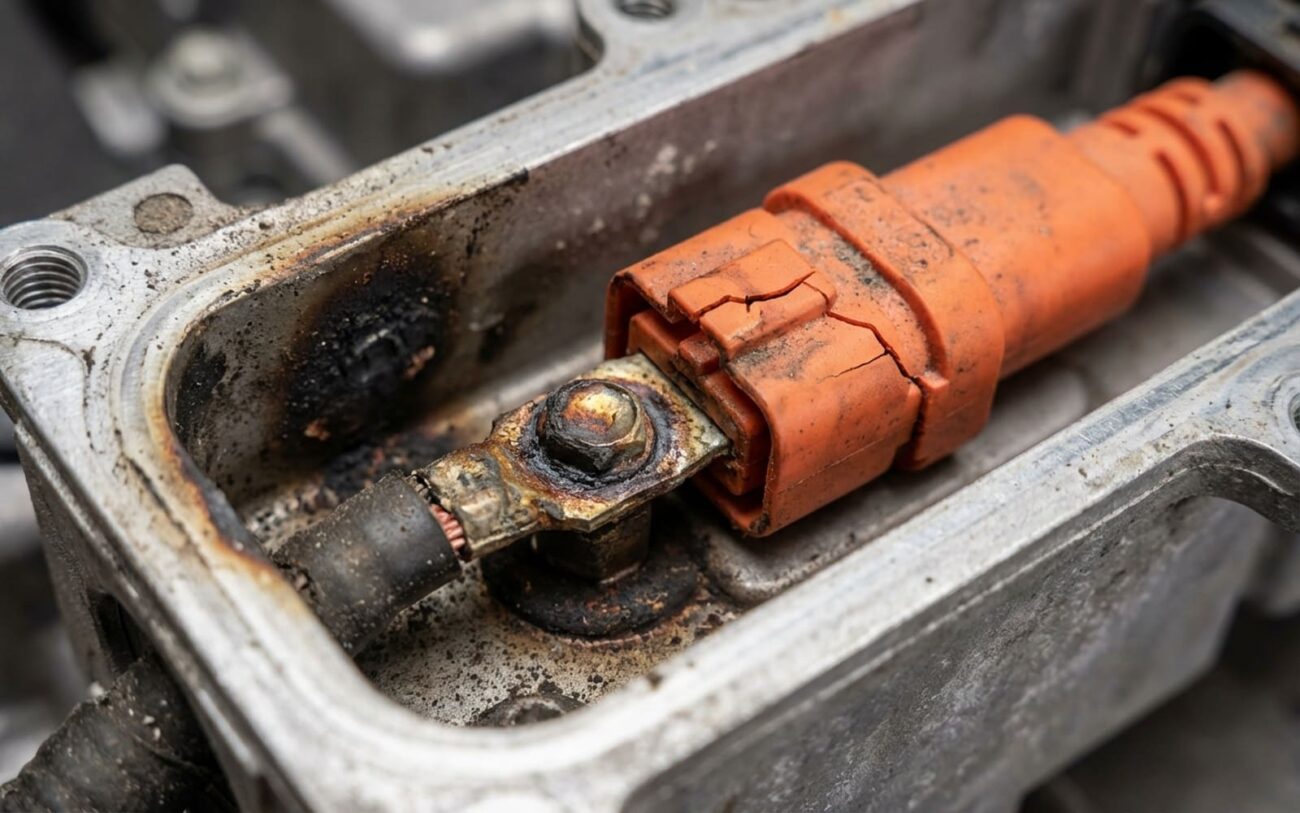
Alright, let’s talk about the Toyota Prius inverter. If you’ve got a Prius with 150,000 miles or more on the clock and it’s acting up, the inverter is almost always one of the first things I look at in my shop. It’s a critical piece of the hybrid system, and when it goes, your car basically stops being a car. This isn’t a light fix, so understanding what you’re up against is key.
What a Failing Prius Inverter Looks (and Sounds) Like
The most common scenario I see is a sudden loss of power or the car just won’t go into READY mode. And believe me, the car will let you know something’s wrong. You’ll get a full light show on the dash: the dreaded red triangle with an exclamation point, the “Check Hybrid System” message, and sometimes that red battery light or the master warning lamp. If your Prius refuses to power up, or it goes into READY but feels like it’s got zero power, that’s a big red flag for the high-voltage system, and the inverter is a prime suspect.
Don’t jump to conclusions, though. These same warnings can pop up for other reasons—a weak hybrid battery, a dying 12-volt battery, or even a loose connection somewhere in the high-voltage circuit. But here’s the critical part: ignoring these symptoms is a really bad idea. A failing inverter can send erratic voltage back through the system, and that can fry your motor-generators (MG1 and MG2) or overload the DC-DC converter, which is what powers your regular 12-volt accessories. If you see these lights, especially if the car won’t move, get it towed. Seriously, do not try to drive it.
Strange Noises from the Back
Sometimes, the inverter will give you a heads-up before the dash lights even come on. I tell my customers to listen closely. If you hear a sharp buzzing, rapid clicking, or a faint arcing noise coming from behind the rear seat—that’s where the inverter is mounted on many models—that’s a major warning sign. That sound usually means electricity is jumping across damaged components inside the inverter, most often the IGBT (Insulated Gate Bipolar Transistor) modules. While similar noises could come from the high-voltage service plug or the DC-DC converter, arcing from the inverter housing itself almost always points to an internal electrical breakdown.
Pink Puddles and Low Coolant
The Prius inverter has its own dedicated cooling loop, separate from the engine, with a small pink reservoir usually located near the firewall. If you notice pink coolant pooling under the center or rear of the car, or if that reservoir is consistently low, you’ve likely got a leak from the inverter’s internal cooling plate. That aluminum plate is bonded to the housing, and over time, it can develop porosity or cracks due to corrosion. Coolant getting inside the inverter is catastrophic. It shorts out circuitry, destroys the IGBTs, and leads to permanent failure. While a leak could be from a hose or the electric water pump, a leak that originates directly from the inverter body means the unit is compromised, no two ways about it.
Diagnosing It Right: Inverter or Something Else?
Look, you can’t just assume it’s the inverter because the hybrid warning light is on. Other components—like the hybrid battery, the 12-volt system, or even damaged wiring—can throw similar symptoms. You need a proper diagnostic approach, and a basic OBD2 scanner won’t cut it here. You need a scan tool that can talk to Toyota’s hybrid system, like Techstream or a good advanced hybrid-capable scanner. These tools pull specific Diagnostic Trouble Codes (DTCs) that are essential for isolating the fault.
The table below breaks down how I differentiate inverter issues from other common failures in the hybrid system. Pay close attention to those codes and definitive tests—that’s what separates guesswork from an accurate diagnosis in my shop.
| Symptom | Likely Inverter-Related Cause | Common Look-Alike Issues | Definitive Test to Confirm |
|---|---|---|---|
| Hybrid system warning light, no READY mode | Failed IGBT modules, gate driver board fault, or DC link capacitor failure | Weak or failed hybrid battery, faulty battery ECU, loose SMR (System Main Relay) connection |
Read DTCs: look for codes like P0A1F, P0A80, or P0A7D. Use a megohmmeter to test insulation resistance on motor cables (>10 MΩ is the spec). |
| Arcing or clicking from rear passenger area | Internal arcing in IGBTs or DC busbar due to insulation breakdown | Faulty high-voltage service plug, failing DC-DC converter |
Inspect connectors for carbon tracking. If they’re clean, you’ll need to remove the inverter and open it up for internal inspection (look for cracked solder, burned traces). |
| Pink coolant leak near inverter | Cracked or porous inverter cooling plate (very common in high-mileage units) | Leaking hoses, O-rings, or a failed inverter coolant pump |
Pressurize the cooling system to 16 psi. Use UV dye. If dye appears at the cooling plate seam, the unit is likely toast and not repairable. |
Why These Inverters Fail: The Real Root Causes
Inverters don’t just fail randomly; they fail due to predictable mechanical and electrical stress. Understanding why helps you diagnose correctly and, hopefully, avoid future issues.
Thermal Cycling
Every time you drive, the inverter heats up and cools down. Over 150,000 to 200,000 miles, this constant expansion and contraction fatigues solder joints on the control board and degrades the thermal paste between the IGBTs and the cooling plate. Once that heat dissipation drops, the IGBTs overheat and fail. Usually, they go one at a time, but I’ve seen them cascade and take out the whole unit.
Electrolytic Corrosion of the Cooling Plate
This is a very common one. The aluminum cooling plate inside the inverter corrodes when the wrong coolant is used, coolants are mixed, or the system goes too long without a flush. The resulting galvanic reaction literally eats the metal from the inside, creating pinhole leaks. When coolant seeps into the electronics, it’s usually fatal. Toyota actually put out a service bulletin on this for some model years (2010–2015 especially), advising on coolant maintenance. There’s no official recall for inverter failure across all years, but proper coolant service intervals are absolutely critical here.
Capacitor Degradation
The large electrolytic capacitors in the DC link are there to smooth out voltage fluctuations. Over time, they dry out, lose their capacitance, and can even swell or leak. When they fail, they can’t regulate power properly, causing voltage spikes that stress the IGBTs and trigger error codes. If you ever open one up, swollen or leaking capacitors are a dead giveaway of age-related wear.
Important Note on Misdiagnosis:
While external voltage spikes—say, from a failing motor-generator—can instantly destroy an IGBT, those are less common than internal wear. It’s crucial to remember: a weak hybrid battery or a blown 12-volt battery can cause hybrid system warnings, but they’re not inverter failures. Similarly, engine mechanical issues like a head gasket leak have nothing to do with the inverter. Confusing these can lead to really expensive misdiagnoses, and I’ve seen it happen too many times.
Repair Options: What Can (and Can’t) Be Fixed
Your repair path depends entirely on what’s actually failed inside the inverter. It’s not a one-size-fits-all situation.
External Repairs DIY Feasible
Internal Failures: Professional Territory Only
Internal failures—like a blown IGBT, a leaking cooling plate, or failed capacitors—require professional disassembly and repair. The inverter has to be removed, opened up, and inspected. Replacing IGBT modules isn’t just a swap; it requires specialized tools: an IGBT puller, a precision torque wrench (3.5–4.5 N·m for those tiny screws), and high-performance thermal paste like Shin-Etsu G751. One mistake in this process can lead to rapid, catastrophic failure of the new components. This is not a job for the backyard mechanic.
Non-Repairable Damage
Verifying the Repair: How to Know It’s Really Fixed
You’re not done just because the inverter is bolted back in. You have to prove the fix works, both mechanically and electrically. This is where a lot of DIYers miss steps, and it comes back to bite them.
For Coolant Leaks
First, refill the system with the correct SLLC mix and bleed all the air out. This takes time, and you’ll usually need to run the inverter coolant pump in diagnostic mode for 10–15 minutes to get all the bubbles out. Then, perform a pressure test to 16 psi and monitor for any drops over at least 30 minutes. No leaks? Good. But don’t stop there. Drive the car through several full thermal cycles—cold to hot and back—to check for expansion-related seepage. If you used UV dye (which I always recommend), scan with a black light to confirm no residual leaks.
For Internal Electrical Repairs
Clear all DTCs, then perform a high-voltage insulation test using a megohmmeter. You need to apply 1000V between each high-voltage circuit (motor cables, inverter terminals) and the chassis. The reading must be above 10 MΩ to pass. If it fails, you still have a short somewhere—likely from moisture or damaged insulation. Only after a clean insulation test should you even think about going into READY mode. This step is non-negotiable for safety and reliability.
Finally, the test drive. Accelerate moderately to load the system and monitor for any warning lights, shuddering acceleration, or power loss. Use an OBD2 scanner that can read hybrid data to check inverter temperature, MG1/MG2 performance, and DC-DC converter output. The tools you’ll need for this verification: a capable hybrid scanner, a megohmmeter, a cooling system pressure tester, and a UV light if you used dye.
Cost, Risk, and Whether It Makes Financial Sense
Let’s be realistic: inverter work is expensive. The decision to repair should always weigh the cost against the vehicle’s current value and your long-term plans for the car.
| Repair Type | DIY Cost (Parts) | Shop Cost | Success Rate | Secondary Risks |
|---|---|---|---|---|
| Inverter Assembly Replacement (Reman OEM) | $1,500 – $2,500 | $2,800 – $4,200 | 98% | Improper HV handling can damage new inverter or motor-generators. |
| Inverter Internal Repair (Specialist) | N/A | $1,200 – $2,000 | 85–90% | Undiagnosed issues (e.g., weak capacitors) can cause repeat failure. |
| Used Inverter from Salvage Yard | $800 – $1,500 | $2,000 – $3,000 | 50–70% | Risk of incompatible firmware or imminent failure; may require reprogramming. |
Here’s a rule I use with customers in my shop: if the repair cost exceeds half of the car’s market value in good condition, you need to seriously consider whether it’s worth it. Putting $4,000 into a Prius that’s only worth $5,000 leaves you with a car that’s more of a financial liability than an asset. That doesn’t mean you shouldn’t fix it—especially if you rely on it daily or plan to keep it long-term—but it’s a decision that should be made with your eyes wide open.
Preventing Inverter Failure: Maintenance That Actually Matters
You can’t stop aging, but you can definitely slow it down. The best way to extend inverter life is through proactive maintenance.
The Coolant Rule
Use only Toyota Super Long Life Coolant (SLLC) or an approved equivalent in a 50/50 mix. Never, ever mix coolant types. Flush the inverter cooling system every 100,000 miles or 10 years—whichever comes first. This is crucial for preventing the electrolytic corrosion that eats cooling plates from the inside. I see this overlooked all the time, and it’s the leading cause of inverter coolant leaks in the 2004–2015 Prius models.
Second, check the inverter coolant reservoir regularly. Every oil change is a good habit. Look for low levels, discoloration, or any sludge. Top off only with the correct coolant. Third, listen to your car. A new high-pitched whine or buzzing during acceleration can signal capacitor or IGBT stress. It’s not always a failure, but it’s a definite warning sign that something’s working harder than it should.
If you’re a bit tech-inclined, use an advanced OBD2 scanner that supports hybrid data to monitor inverter temperature. A steady increase in operating temp over time could indicate cooling issues or component degradation. Catching that early can prevent a roadside breakdown. And while carbon buildup and EGR issues affect engine performance, they don’t impact the inverter directly—but keeping the whole hybrid system in good health always reduces stress on all the electrical components.
