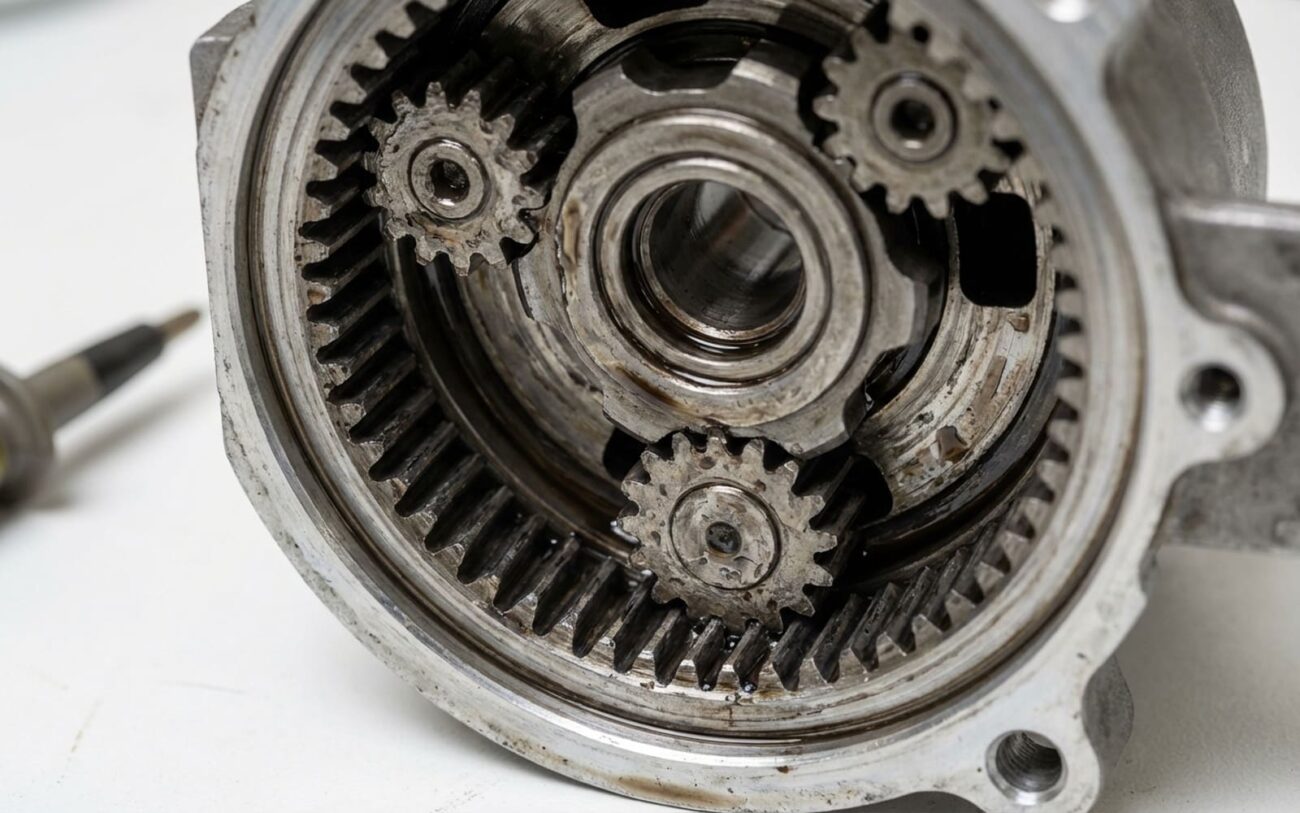
That Gritty Steer? It’s Probably Your Active Steering Gear.
If you’re feeling a strange noise or a gritty sensation through the steering wheel, especially when you’re turning, my money’s on a failing planetary gearset in your active steering system. I’ve seen this issue countless times over the years, mostly on BMWs — think E60, E90, E61, E63, E64 — and a handful of Mercedes models too.
This setup uses an electric actuator, usually mounted right on the steering column, that houses a planetary gearset. Its job is to vary the steering ratio, making the wheel feel lighter at low speeds and firmer on the highway. But when those precision gears wear out, they don’t go quietly. And here’s the kicker: the unit is sealed and factory-calibrated, so you can’t just open it up and replace a few worn parts. It’s a full assembly replacement job. Before we jump to that conclusion though, let’s talk about what you’re seeing and feeling, how I confirm it in the shop, and what your real options are.
Lash: EXCESSIVE
How I Spot a Worn Gear: Symptoms & My First Checks
The first things that usually tip me off are sound and feel. When a customer describes a rhythmic whirring, grinding, or a low growl coming from behind the dashboard, especially when they turn the wheel, my ears perk up. It’s usually near the steering column. The key here is that the noise scales with steering speed – turn faster, it gets louder and quicker. That’s a strong indicator the problem is in the steering column itself, not something in the suspension or driveline.
Alongside the noise, many drivers report a “notchy” or “gritty” steering feel. It’s like the wheel is catching every few degrees, not a constant resistance, but an intermittent binding that comes and goes as you turn. This isn’t just annoying; it’s a clear sign of mechanical wear inside that actuator. Sometimes, the steering effort might even feel inconsistent, particularly at low speeds or when you’re trying to park.
And of course, the car’s electronics usually chime in. You’ll likely see recurring fault codes, often what we call “plausibility” errors. This means the system detects a mismatch between what the steering wheel angle sensor is telling it and what the actuator’s position sensor is reporting. On BMWs, I commonly see codes like 5E20 or 5E21. These codes might clear temporarily with a scan tool, but they’ll always come back because that mechanical play isn’t going away on its own.
My Diagnostic Process: Getting to the Bottom of It
Before you even think about replacing that costly active steering actuator, it’s critical to rule out other, simpler causes. A lot of components can mimic these symptoms. Here’s the diagnostic process I use in my shop to pinpoint the problem:
1. The Mechanic’s Stethoscope Test
If I hear rotational noise from the steering column, my first move is to grab the mechanic’s stethoscope. I’ll place it directly on the active steering actuator housing. Then, I’ll have someone slowly turn the steering wheel lock-to-lock (engine running, in park). If the grinding or whirring is loudest right there, it points strongly to the actuator. For a definitive check, I’ll even disconnect the electrical connector to the actuator and manually turn the input shaft by hand if possible. If that gritty feeling or noise persists, it’s definitely internal mechanical wear.
Common Mimics: Failing electric motor bearings (in the actuator itself, but separate from the gears), a worn intermediate shaft coupler, or even just a worn upper steering column bearing.
2. Isolating the Steering Shaft
For that notchy or gritty steering feel, I want to isolate the actuator from the rest of the steering system. I’ll disconnect the intermediate steering shaft from the actuator’s output. Once it’s disconnected, I can manually rotate the actuator’s input shaft by hand. If I still feel that grit or binding when I turn it, the issue is almost certainly internal to the actuator’s planetary gears or carrier bearings. If it feels smooth now, the problem is further down the line – maybe a binding U-joint, a tight spot in the rack, or even a failing clock spring.
Common Mimics: Binding U-joint in the steering shaft, a tight spot or internal issue in the steering rack, failing clock spring, or worn steering column bushings.
3. Advanced Scan Tool Diagnostics
When I see those steering angle/actuator position plausibility DTCs, it’s time for the OEM-level scan tool – ISTA for BMWs, XENTRY for Mercedes. These tools aren’t just for reading codes; they’re bi-directional. I can command controlled movements of the active steering actuator and monitor the live data. What I’m looking for is a lag or inconsistency between the steering wheel input angle and the actuator’s output position. Excessive gear lash or slippage inside the unit will cause these readings to be out of sync, triggering those fault codes. If the sensors themselves were bad, I’d typically see different, more specific sensor fault codes.
Common Mimics: A faulty steering angle sensor (SAS) or actuator position sensor, or even just wiring faults or corroded connectors. But with the mechanical symptoms present, it’s usually the gears causing the plausibility error.
Why These Gears Give Up: The Mechanics of Failure
Once I’ve confirmed the issue is inside the active steering actuator, the root cause is almost always mechanical degradation of that internal gear train. These planetary gears — the sun, planet, and ring gears — are under constant reversing loads every time you turn the wheel. Over time, that cyclic stress leads to fatigue: you’ll see pitting, spalling, or micro-cracking on the gear teeth surfaces. I see this most often in high-mileage vehicles or those that spend a lot of time in stop-and-go traffic, where steering corrections are constant.
The Concept
“It’s like a clock with a chipped tooth: it might still tick, but it will eventually skip, grind, and lose time.”
Another major factor is lubrication breakdown. These actuators are filled with a specific high-torque grease during manufacturing. Over years, with constant heating and cooling cycles, that grease can dry out, separate, or migrate away from the critical contact zones. Once that lubricating film fails, you get metal-to-metal contact, which accelerates wear dramatically. Unlike a traditional power steering system, there’s no way to top up or flush this grease – it’s a sealed unit.
A Note on Early Models:
I’ve seen a lot of BMW E60, E61, E63, and E64 models built before March 2007 come through my shop with premature planetary gear wear. While BMW never issued a formal TSB (Technical Service Bulletin) for it, dealers often replaced these actuators under goodwill in the early days. If you’re driving a pre-2007 model, this is a very, very common failure point.
The Only Real Fix: Replacement and Calibration
[NON-REPAIRABLE → REPLACE ASSEMBLY]
Let me be clear: this unit is sealed, pre-lubricated, and factory-calibrated. You won’t find OEM individual gears or bearings for sale. Reassembling this to factory tolerances is just not feasible outside a specialized remanufacturing facility. Don’t waste your time trying to “fix” the internal gears.
Complete Actuator Replacement Professional Only
OEM Calibration & Initialization Software Required
Friction Modifier Additive Last Resort
Validating the Repair: Don’t Just Bolt It On and Go
After you’ve replaced the actuator, don’t just assume it’s fixed because the part is new. I always start with a stationary test: engine running, turn the wheel slowly lock-to-lock. Listen carefully – there should be absolutely no whirring, grinding, or growling. Then, assess the feel: the steering should be smooth and consistent, with no notchiness or drag whatsoever.
Next, clear all fault codes and run that OEM calibration procedure again. You want to make sure it takes. After that, it’s time for a proper road test. Drive at various speeds, make plenty of turns, lane changes, and parking maneuvers. Push it a little, but safely. Afterward, reconnect the scan tool and check for any stored or pending DTCs. If codes return – especially plausibility or angle sensor faults – either the calibration didn’t take, or there’s an undiagnosed issue like a damaged wiring harness. Don’t skip these steps; it’s how you ensure the job is done right and safely.
The Hard Truth: Cost and What to Consider
Let’s be honest, this is a high-cost repair. The decision to proceed often depends heavily on the vehicle’s overall value and your attachment to it. The actuator alone typically costs between $1,500 and $3,000, sometimes more depending on the specific model and where you source it.
DIY Replacement
This includes the part ($1500-$3000) plus the non-negotiable cost of OEM scan tool access ($500+ for a subscription or dedicated tool). If you don’t have the software, you can’t do this right.
Professional Shop
This is your total for parts and labor. In my experience, the success rate is 95%+ if the shop performs the calibration procedure correctly with the right tools.
Secondary Risk
An incorrect calibration can cause erratic steering response or, worse, unsafe behavior. This isn’t a “wing it” kind of job.
Can You Keep It From Happening? Prevention & Vigilance
Prevention & Early Detection
-
Go easy on the steering stops. Avoid yanking the wheel against the stops and holding it there, especially when parking or maneuvering. That puts immense stress on the gears.
-
Watch out for impacts. Curbs, deep potholes, or off-road impacts transmit shock directly through the steering system and can accelerate gear fatigue.
-
Listen for new noises. If you’re parked with the engine running, turn the wheel slowly and listen. Catching that faint whirring early gives you time to plan the repair before it becomes a total failure.
-
Check your power steering fluid (if applicable). On systems that still use hydraulic power steering (some older active steering setups are hybrid), low or foamy fluid can mimic steering effort issues. It’s a quick check that can rule out a cheaper fix.
My Go-To Diagnostic Tip
Always use that mechanic’s stethoscope and perform the shaft isolation tests first. It’s how I quickly rule out cheaper, more common issues like a worn intermediate shaft coupler or a failing power steering pump before I even consider telling a customer they need an expensive active steering actuator replacement.
