Your Car’s Alarm is Tripping for No Reason? Let’s Talk BCM.
Alright, so your Skoda Octavia A7 or VW Golf Mk7 has decided to throw a party in the driveway at 3 AM. Lights flashing, horn blaring, locks cycling like it’s possessed. You’re not crazy, and you’re definitely not alone. After more than 25 years turning wrenches, mostly on VW Group vehicles, I can tell you this kind of electrical ghost in the machine almost always points to one thing: the Body Control Module, or BCM.
On these MQB platform cars, the BCM (often called the Central Electrics module, or J533/5Q0 in the parts catalog) is basically the brain for everything that isn’t the engine or transmission. We’re talking lights, locks, windows, the horn, and yes, the entire alarm system. When it starts to go sideways, things get weird fast.
BCM MONITOR (MQB)
Status: FAULTY
What a Failing BCM Looks Like: Common Symptoms
When a BCM starts to fail, it rarely gives you just one problem. Instead, you’ll typically see a whole cluster of seemingly unrelated electrical issues. That random alarm activation, especially when there’s no obvious trigger, is a huge red flag. But it almost never stops there. I’ve seen it all, from cars that lock themselves with the keys inside to lights that just decide to turn on in the middle of the night.
Here’s what I commonly see in the shop:
-
Headlights, taillights, or turn signals activating on their own.
-
Windows or sunroof moving without anyone touching a switch.
-
The horn beeping intermittently, sometimes just a quick “honk” and then nothing.
-
Central locking cycling repeatedly, locking and unlocking itself.
-
Wipers activating with no command, sometimes just a single sweep.
These aren’t just minor glitches. They’re signs the BCM is sending out corrupted or “phantom” commands. And that’s what makes this diagnosis tricky – each symptom could, on its own, point to a bad switch, a faulty door module, or a wiring short. That’s why you can’t just match symptoms; you need to dig deeper.
My Approach: Isolating the True Source (Differential Diagnosis)
Before you even think about replacing a BCM – which is neither cheap nor simple – you absolutely have to rule out everything else. My goal is always to figure out if the BCM is the actual problem, or if it’s just reacting to bad input from somewhere else.
Here’s how I go about it, focusing on what a good scan tool (like VCDS or ODIS) can tell you:
| Symptom | Likely BCM Internal Fault | Common External Mimics | Definitive Test (My Method) |
|---|---|---|---|
| Spontaneous light activation | Internal BCM driver circuit failure | Faulty light switch, short to power in wiring harness, bad door module | Get into the BCM (Central Electrics, address 09) with a scan tool. Go to measuring blocks or live data for the specific light. If the BCM reports the light as “OFF” but it’s physically ON, the fault is external (wiring, switch). If the BCM reports the light as “ON” without command, it’s an internal BCM fault. |
| Random accessory activation (windows, horn, locks) | Internal logic or driver fault in BCM | Faulty switch (e.g., window switch), water-damaged door control module, bad wiring | Disconnect the local switch for the affected component. If the activation continues, and the BCM fails to respond correctly to scan tool commands for that component (e.g., trying to turn it off), the fault is internal to the BCM. Check for water intrusion in door modules too – that’s a common one. |
| No communication with BCM | Internal failure (processor/power) | Blown fuse (SC37 is common), damaged CAN bus wiring, faulty gateway module (J533) | First, check the BCM’s main fuse (SC37 in the engine compartment fuse box is a common one for MQB). If the fuse is good, measure CAN bus voltages at the BCM connector. You should see CAN High around 2.7V and CAN Low around 2.3V. If these are off, or if you have a short, the problem is external to the BCM itself. If voltages are good and the fuse is good, but no comms, then the BCM is likely dead. |
Why They Fail: Root Causes I’ve Seen
So, what actually gives up the ghost inside these sealed units? You’re not supposed to open them, but after years of seeing failures and, frankly, some teardowns, we’ve got a pretty clear picture.
The most common internal fault is solder joint fatigue. Think about it: these modules are constantly heating up and cooling down, especially components that handle a lot of power like voltage regulators or MOSFET driver chips. That constant expansion and contraction stresses the solder joints. Over time, they develop microscopic cracks, leading to intermittent operation. This was particularly common in some of the early MQB BCMs, especially those with part number suffixes like 087.
Watch for Corrosion:
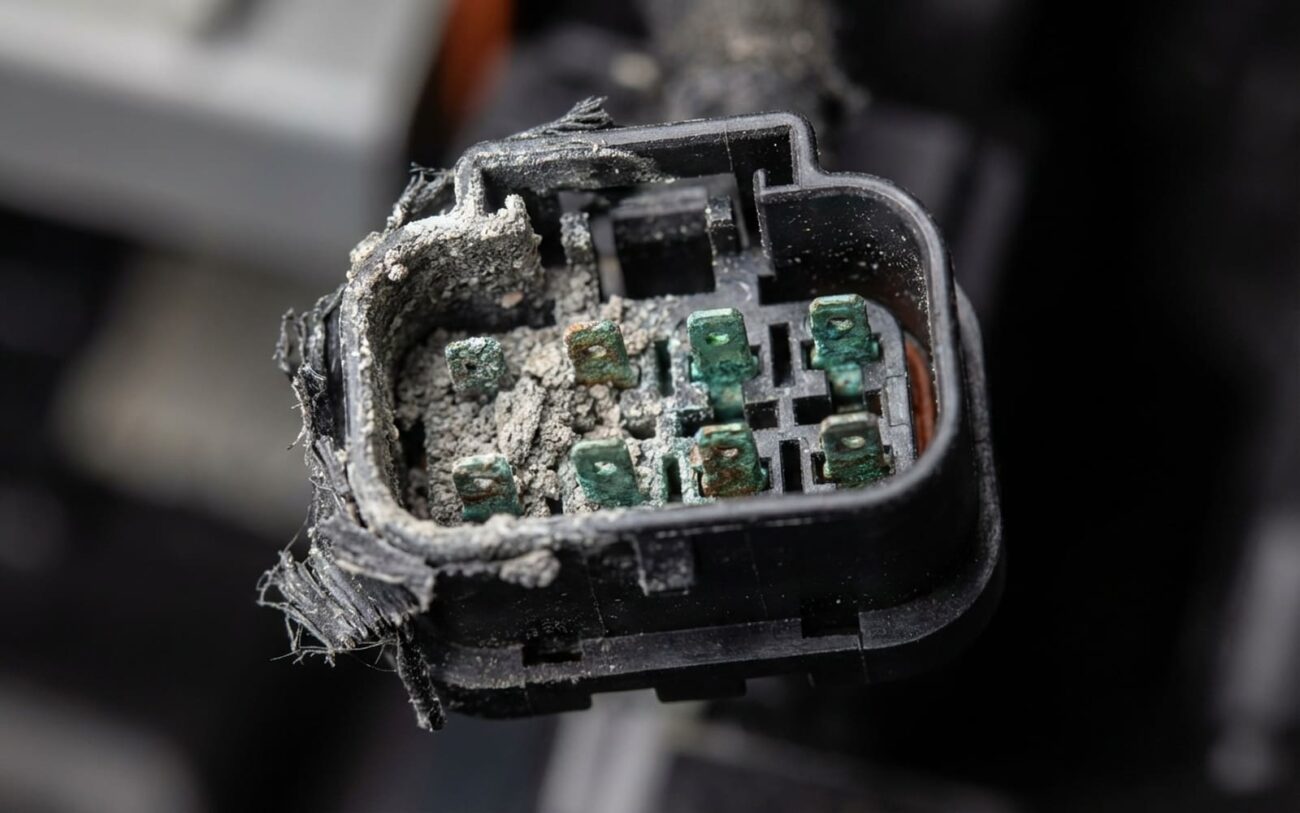
Even if the BCM itself looks bone dry, water from a clogged plenum drain (under the windshield cowl) can migrate along the wiring harness. It acts like a wick, pulling moisture right into the BCM connector. I’ve personally seen several Octavia A7s and Golf Mk7s with classic BCM symptoms that were traced back to green or white corrosion on the connector pins – not the module itself, but the connection to it. Always check those pins!
Fixing It: Your Resolution Options
Professional Programming is a Must
This isn’t like swapping out a headlight bulb. You can’t just plug in a new BCM and expect it to work. VW Group vehicles use “Component Protection.” This means the module is tied to the car’s VIN. You must perform an online component protection removal and coding using VW’s ODIS system (or a very advanced aftermarket tool) to get the new module to talk to the car correctly. Without it, things like your locks, radio, or even the engine might not work.
Connector Repair Professional Only
Full Module Replacement Non-Repairable
“Reflow” Attempt Temporary Only
After the Fix: Post-Repair Validation
Once the BCM is installed and properly coded, your job isn’t done. You’ve got to validate the repair to make sure those electrical ghosts are truly gone. Here’s my checklist:
-
Clear all fault codes across all modules and perform a full vehicle scan again. You want a clean slate.
-
Run all necessary adaptations: window initialization, sunroof calibration, and central locking synchronization. These are often lost with a BCM replacement.
-
Verify the alarm system responds correctly to both the remote and door triggers. Try to trigger it intentionally.
-
Retest for parasitic drain. It should be below 50mA after the car has been asleep for at least 30 minutes. This confirms the module is shutting down properly.
Cost, Risk & Making the Right Call
Let’s be honest, BCM issues aren’t cheap. But knowing your options and the risks involved can help you make an informed decision.
| Repair Type | DIY Cost | Shop Cost | Success Rate | Secondary Risk |
|---|---|---|---|---|
| BCM Connector Repair | ~$50 (for cleaner/grease) | $150–$300 | High | If not thoroughly cleaned, intermittent connection may return. |
| BCM Replacement (New) | $700–$1,100 (part only) | $800–$1,500 | Very High | Incorrect coding can disable critical functions (locks, alarm, radio). Requires ODIS access. |
| BCM Replacement (Used) | $450–$600 (part only) | $600–$1,000 | Moderate | Used unit may have latent failure, or be incompatible. Still requires online unlock and coding. |
My #1 Prevention Tip
Seriously, regularly clear the plenum chamber drains under the windshield cowl. A clogged drain lets water pool up, and that water will find its way into the passenger footwell, and eventually, to your BCM connectors. This is, hands down, the most preventable cause of BCM failure I see on MQB vehicles. Takes five minutes, saves you a grand.
Now, if you’re also troubleshooting something like an ESP light that won’t turn off or an EPB not working after a brake job, remember that while those are different systems, they all communicate on the same CAN bus. A failing BCM can sometimes throw off other modules or even mimic their faults, so always keep the bigger picture in mind.
