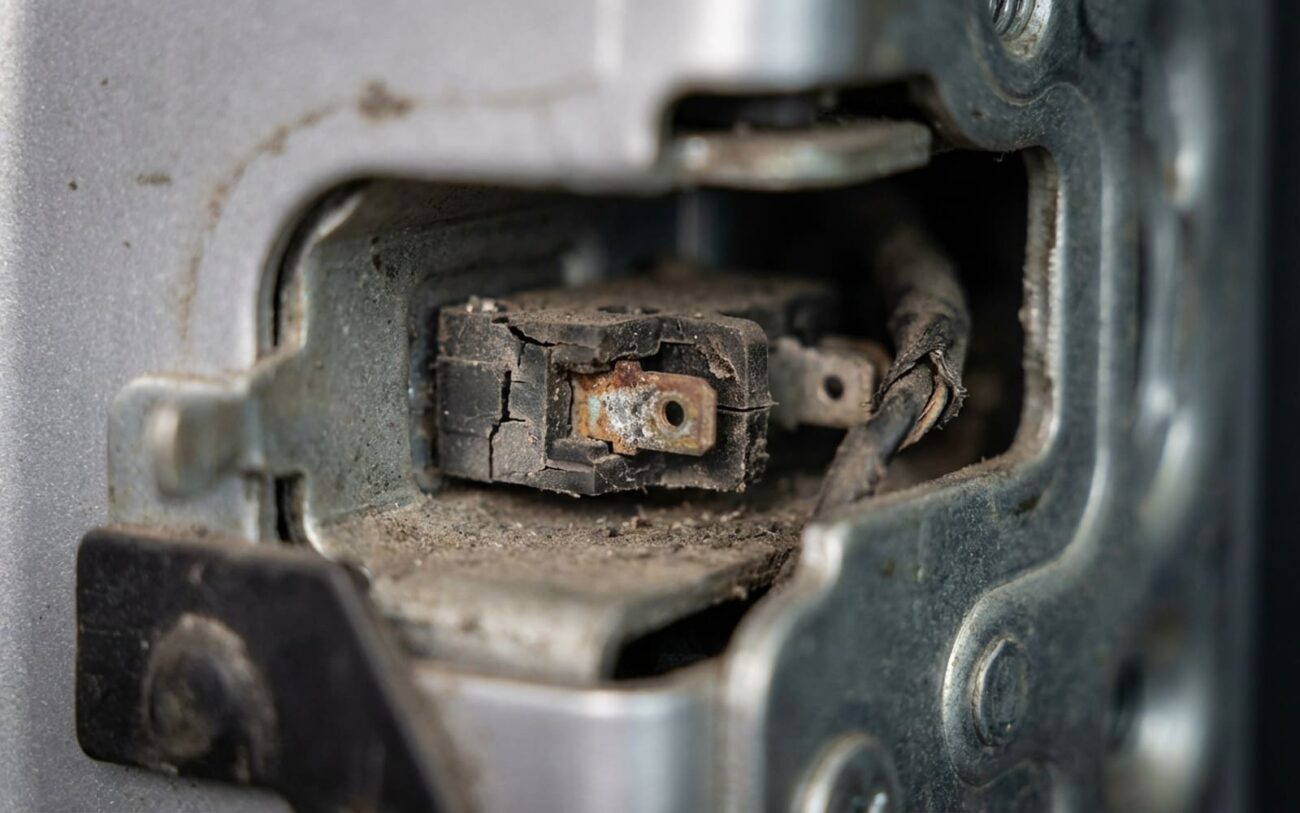
Alright, let’s talk about that annoying ‘door ajar’ light. In my 25+ years turning wrenches, when a car tells me a door’s open when it’s not, or vice versa, it’s almost never the BCM (Body Control Module) itself having a brain fart. It’s usually something right there in the door. The big red flag, of course, is that warning light on your dash – it’s either stuck on, refusing to come on, or flickering like a bad Christmas light. But here’s the first thing I always check, and it’s a critical diagnostic split: Does the dome light come on when you open that door? If the dome light works but your dash still says the door’s closed (or open), that tells me the problem isn’t the whole door being dead. It’s usually a specific signal issue to the BCM, often right at the latch.
Symptom Recognition: What the Car’s Telling Me
See, most newer cars have two different ways of knowing a door is open. The dome light often still uses an old-school mechanical plunger switch in the door jamb—simple, robust. But the BCM? It’s usually getting its signal from a tiny microswitch built right into the door latch assembly itself. That’s why the dome light test is so important.
If the interior dome light turns on when you open the door, but the BCM still shows the door as closed (or open incorrectly), the fault is likely isolated to the BCM’s input circuit. This usually points to the latch’s internal switch or its wiring.
If both the BCM and the dome light fail to respond when the door opens, well, now we’re looking at something bigger. That points to a complete loss of power, ground, or even communication to that whole door’s electrical system.
State: FROZEN
My Diagnostic Approach: Isolating the True Source
Now, let’s get into the actual diagnosis. This isn’t a ‘throw parts at it’ kind of job. I’ve seen too many guys just swap out a latch assembly because it seems like the problem, only to find out it was a broken wire or a bad ground. That’s just throwing money away. You gotta be systematic. Here’s how I break it down, based on what the car’s telling me:
Scenario 1: Dome Light Works, BCM Doesn’t See the Door Open
If your dome light pops on when you open the door, but the dash light stays off (or on, depending on the fault), that tells me the BCM isn’t getting its signal. The problem is usually either the microswitch inside the latch itself, or the signal wire running from that latch to the main door harness connector.
My Test: I’ll pull the door panel, get to the latch connector, and back-probe the signal wire. Then I’ll cycle the latch by hand—you should see a clear voltage change, usually from 0V to 5V or 12V, as the switch opens and closes. If you don’t see that change, the fault is in the latch or the wire right at the latch.
Scenario 2: Nothing Works – No Dome Light, No BCM Signal
When both the dome light and the BCM are ignoring the door, that’s a bigger power delivery issue. We’re looking at a loss of power or ground to the whole door module, or maybe the latch assembly itself. This could stem from a blown fuse, a severed wire in the door’s hinge boot (I see this a lot on older vehicles, especially trucks), or a complete failure of the latch assembly’s control circuit.
My Test: First things first: check the fuses. If they’re good, I’m looking for damaged wiring in the door hinge boot—those wires flex every time the door opens, and they will break eventually. I’ll test for battery voltage on the power pin and check for a good ground at the latch connector. No power or ground? Trace it back.
Scenario 3: The Door Status is ‘Frozen’
Sometimes, the door status on your dash just gets stuck—always showing open, or always showing closed, no matter what you do. This can still be a failed microswitch that’s stuck, or even a mechanical binding issue in the latch. But on modern cars, especially those with more complex door modules, it could be a LIN Bus transceiver failure within the latch itself.
My Test: If I suspect a LIN Bus issue, I’m hooking up the scan tool and watching the door status PID (Parameter ID). If that data is static, I might even grab the oscilloscope to check the LIN Bus waveform directly. A flat line means no communication.
Root Cause Analysis: What Fails Inside the Latch?
So, once you’ve narrowed it down to the latch assembly itself, what’s usually broken inside? I’ve seen three main culprits:
- Worn-Out Microswitch: This is the big one. These little switches have a tiny plastic arm that gets pushed and released as the latch mechanism moves. Over years of use, that plastic arm cracks, or the internal contacts just get corroded and stop making a good connection. It’s pure mechanical fatigue.
- LIN Bus Transceiver Chip Failure: On cars that use a LIN (Local Interconnect Network) bus for the door modules, the latch has a small chip that talks to the BCM. These chips are sensitive. A voltage spike, too much heat, or just plain old age can kill them. When that happens, you’ll often get ‘lost communication’ codes, like a U0101 (Lost Communication).
- Manufacturing Defects: Believe it or not, sometimes it’s just a design flaw. I’ve seen certain GM models from the mid-2010s, for example, where the detent springs inside the latch were undersized. They’d wear out prematurely, causing recurring door ajar issues even after a ‘fix.’ It’s rare, but it happens, and it’s frustrating.
Technician’s Note:
Just a quick reminder: this analysis focuses on failures within the latch assembly. A broken wire in the door hinge harness or a truly faulty BCM is a different diagnostic path. You gotta isolate the problem first, or you’ll be chasing ghosts and replacing parts you don’t need.
My Repair Strategies
Safety First
Before you even think about unbolting a latch, make sure that door is properly supported. You don’t want it swinging free or binding up. And remember, getting the latch back in correctly is critical for door alignment, window operation, and even how the lock works. Don’t rush it.
Replacing Just the Microswitch DIY-FEASIBLE
Replacing the Entire Latch Assembly PROFESSIONAL ONLY
Repairing Wiring (Door Boot) TECHNICAL REPAIR
Post-Repair Validation: Don’t Skip This!
You’ve done the work, the door panel’s back on. Now, don’t just call it good. This is where you confirm the fix. Open and close that door a dozen times. Watch the instrument cluster—does the ‘door ajar’ light respond instantly and correctly? If you’ve got a scan tool, monitor the BCM’s door status PID (Parameter ID) to make sure it’s seeing the signal perfectly. If you replaced a whole latch module, clear any old trouble codes. Then, test everything: lock and unlock with the key fob, use the interior lock switch, check the child locks. You want to be absolutely sure that LIN network is happy and stable.
Cost, Risk & Economic Decision Framework
Let’s talk money and risk. Nobody wants to spend a fortune on a door light, but sometimes you have to. Here’s a quick rundown of what you’re looking at:
| Repair Type | DIY Cost | Shop Cost | Success Rate | Secondary Risk |
|---|---|---|---|---|
| External Microswitch | $15 – $50 | $150 – $300 | High (>95%) | Minimal; original symptom persists. |
| Latch Assembly | $100 – $400 | $400 – $800 | Very High (>98%) | Alignment issues; programming errors. |
| LIN Bus/Wiring Repair | Under $20 | $100 – $250 | High | Intermittent faults if joints are poor. |
Prevention & Monitoring
Maintenance Tip
Every year or two, hit that latch mechanism with a good dry Teflon-based lubricant. It reduces friction on those delicate internal parts, especially that microswitch actuator arm. A little preventative maintenance here can add years to the latch’s life. Trust me on this one.
Early Detection Checklist
-
Watch for that door ajar light flickering or coming on over bumps. That’s usually an early sign of a loose connection or a dying switch.
-
Periodically check the wiring in the door hinge boot. Look for any signs of cracking or fraying insulation.
-
If your car has an infotainment system with a vehicle status screen, use it! It’ll often show you the real-time status of each door, which can be a great early warning.
