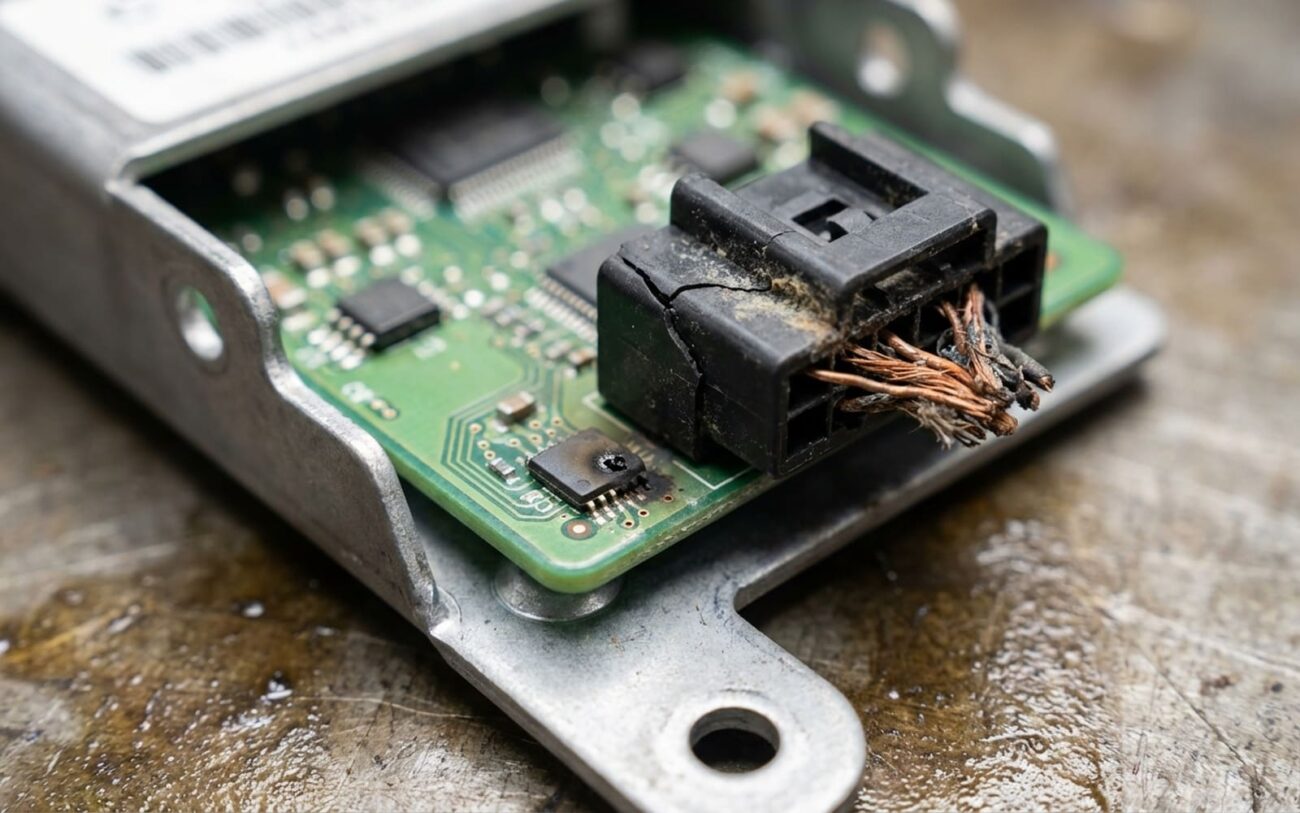
Alright, let’s talk about that SRS light. You’ve had a bump, maybe a fender bender, nothing too serious. Airbags didn’t pop, which feels like a win at first, right? No blown bags, no shattered dash. But then you turn the key, and there it is: that stubborn SRS (Supplemental Restraint System) warning light, glowing steady on your dash. It’s not blinking, it’s not going away. And trust me, after 25 years under the hood, I can tell you this isn’t something to ignore.
Too many folks think, “No airbags fired, so everything’s fine.” That’s a dangerous assumption. The SRS control module — that’s the brain of your airbag system — it does a lot more than just decide when to deploy airbags. It’s constantly monitoring crash sensors, evaluating impact forces, and making split-second decisions about the entire system’s health. Even if the bags stayed tucked away, that module likely saw forces that fundamentally changed its internal state. It’s not a simple switch you can just flip back on. It’s a safety-critical computer, and after a crash, it often can’t do its job anymore unless it’s replaced.
When I Know It’s the Module: Key Indicators
Now, that SRS light can come on for a lot of reasons after an impact. Could be a damaged sensor, a frayed wire, or even a seatbelt pretensioner that got jostled. But when the problem is truly the control module itself, I see some very specific, tell-tale signs. The biggest one is that SRS warning lamp staying on permanently. It won’t flicker, it won’t clear itself after you cycle the ignition. It’s just there, staring at you.
When I hook up a professional-grade scan tool – and I’m talking about something that can really dig into the SRS system, not just a generic OBD2 reader – I’ll typically find persistent Diagnostic Trouble Codes (DTCs) that pretty much scream “module failure.” We’re talking codes like “Crash Data Stored,” “Internal Fault,” “Module Locked,” or “Calibration Error.” These aren’t vague warnings about a bad sensor; these are the module telling you, in no uncertain terms, that it’s been compromised. A faulty impact sensor might set a circuit fault, sure, but only the module itself can store crash event data. If you’re seeing B0000-series codes that specifically mention crash event thresholds or memory locks, the problem is almost certainly locked up inside that unit.
Another big red flag is a complete loss of communication with the SRS module. If my scan tool can’t even talk to it – even after I’ve confirmed it’s getting proper power and ground – that’s a strong indicator of an internal failure. I’ve seen this often on older Hondas after even a minor front-end hit, where the module just goes completely dark.
And here’s one I’ve seen misdiagnosed countless times: a code for “Driver Airbag Igniter Circuit Open” or something similar, but when I test the actual circuit with a multimeter, it checks out perfectly fine. What that means is the module’s internal safing circuit is reporting a fault that doesn’t actually exist in the wiring or the airbag itself. It’s not the clockspring or the airbag; it’s the module’s brain misreading its own data, essentially telling lies. That’s an internal failure, plain and simple.
My Diagnostic Approach: Proving It’s the Module
Before I condemn an expensive module, I always rule out the simpler stuff. You can’t just throw parts at it because the light’s on. You have to prove, definitively, that the module is the problem. That means getting hands-on, testing circuits, verifying communication, and really interpreting the data, not just reading codes off a screen.
Here’s how I typically confirm a module failure:
What Actually Fails Inside That Black Box?
It’s not some kind of black magic; it’s just really complex engineering. The SRS control module, sometimes called the SDM (Sensing and Diagnostic Module), is a sealed unit, often “potted” with epoxy to protect its guts from vibration and moisture. It’s built tough, but a collision can still mess it up in a few key ways:
The Hard Truth: Replacement is the Only Real Fix
No Reset Button for Safety
Let me be absolutely clear here: there is no magic reset button or software trick that will fix an SRS module that has stored crash data or suffered an internal electronic failure. You can’t just reflash it or clear the codes like you might with a check engine light. The only safe, manufacturer-approved solution is to replace it with a new or properly reconditioned OEM unit. Anything else is a gamble with your life.
And when I say “replacement,” it’s not just a simple swap. There are critical steps involved:
Sourcing the Right Module & VIN Matching
Careful Physical Installation
Critical Programming & Initialization Professional Only
Confirming the Fix: Don’t Just Trust the Light
Just because the light is off doesn’t mean the job’s done. That’s a common mistake. You need to validate that the entire SRS system is fully operational and ready to protect you. Here’s what I always check:
The Bulb Check: Turn the ignition to the “ON” position (without starting the engine). The SRS lamp should illuminate for a few seconds (typically 3 to 7 seconds, depending on the manufacturer), then turn off completely. If it stays on, blinks, or doesn’t come on at all, something is still wrong.
Diagnostic Confirmation: Hook up the scan tool again. Verify that you can communicate with the new module without any issues. All previous DTCs should be clearable, and none should return, especially not any “internal fault” or “crash data” codes.
Calibration Verification: Access the live data or special functions on your scan tool. Confirm that the “Zero Point Calibration” or equivalent sensor calibration has been successfully completed. This step is vital for the module to establish its baseline sensor values, ensuring it accurately detects future impacts.
The Bottom Line: Cost and Why You Can’t Skimp
Let’s talk money, because that’s usually the next question. Replacing an SRS control module isn’t cheap, and it’s definitely not a place to cut corners. You’re paying for a critical safety component and specialized labor. Here’s a general breakdown of what you can expect:
| Repair Type | DIY Feasibility | Shop Cost (Typical) | Success Rate (Pro) | Risk if Failed or Incorrect |
|---|---|---|---|---|
| SRS Control Unit Replacement | Extremely Low; Not Recommended | $800 – $2,500 (Parts: $400–$1,500; Labor/Prog: $400–$1,000) |
99%+ | If the module isn’t replaced or programmed correctly, the entire SRS system remains inactive. In a subsequent crash, airbags will not deploy, and seatbelt pre-tensioners will not activate. The consequences are potentially fatal. There is no “almost working” when it comes to airbags. |
Look, I get it. Nobody wants to spend this kind of money after a minor accident. But this isn’t about comfort or convenience; it’s about life and death. Driving with a faulty SRS module is like driving without airbags at all, or with seatbelts that might not hold. It’s just not worth the gamble.
My Final Advice: Prevention & Used Car Checks
There’s no real “maintenance” to prevent a crash-related module failure – a crash is a crash. But you can definitely avoid accidental damage. Any time you’re working near airbags, whether it’s replacing a steering wheel, digging into the dash, or even just swapping out a radio, always, always disconnect the battery and wait at least three minutes. This gives the system’s backup capacitors time to drain, preventing any accidental deployments or static discharge that could fry the electronics. I’ve seen it happen, and it’s not pretty.
More importantly, after any collision, no matter how minor it seems, get that SRS system scanned by a professional. Don’t wait for the light to come on. Sometimes the crash data is stored, but the light hasn’t tripped yet, or it’s an intermittent fault that will become permanent later.
