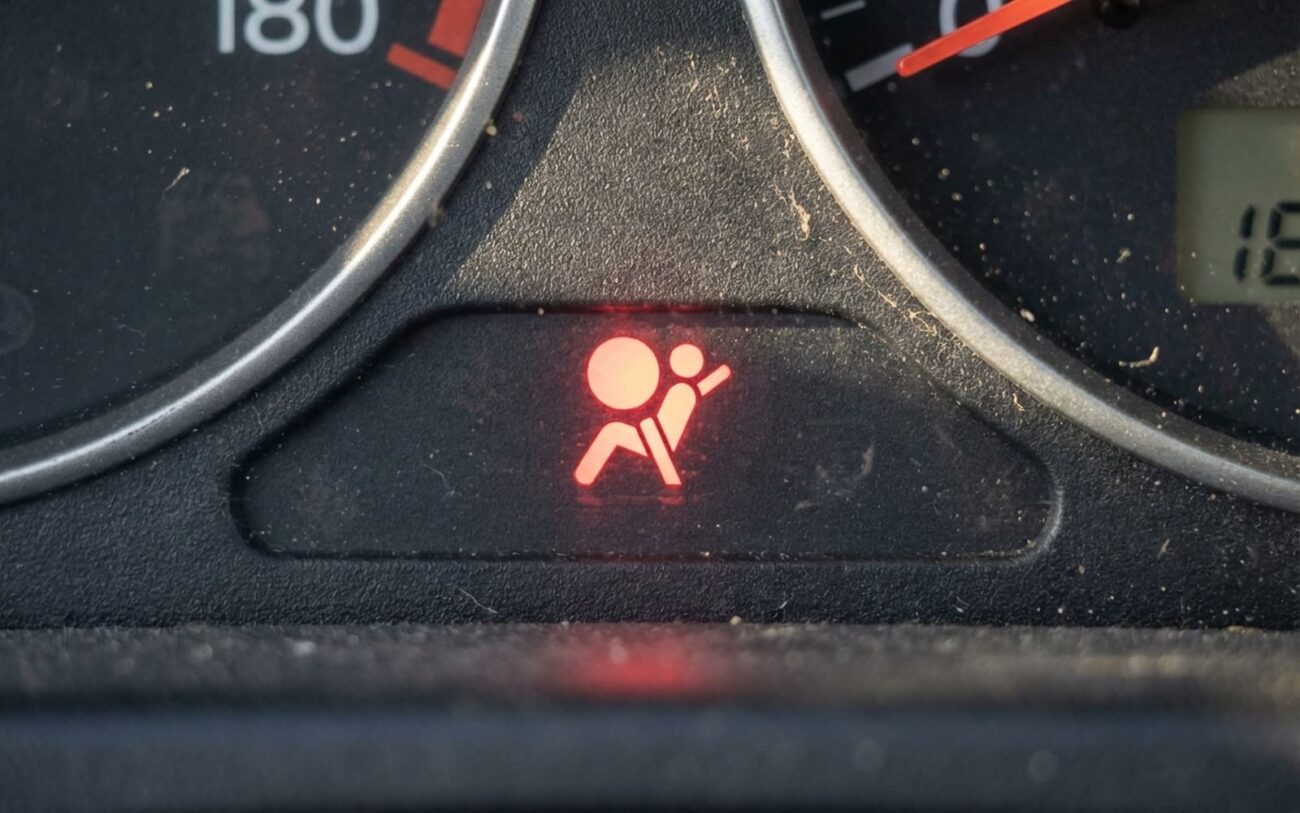
Alright, let’s talk about that airbag light—the one that looks like a little person with a beach ball in front of them. For over 25 years, I’ve seen these lights come on for every reason under the sun. But here’s the deal: when that light stays on, it’s not just a suggestion. It means your Supplemental Restraint System (SRS) is telling you it’s got a problem, and in most cases, the whole system is shut down. That means your airbags, your seatbelt pretensioners—they’re probably not going to work if you get into an accident. That’s a serious safety compromise, plain and simple.
Normally, when you first turn the key, you’ll see that red SRS light come on for a few seconds, then it goes out. That’s just the system doing its self-check, making sure the bulb works and everything’s communicating. But if it stays lit after the engine starts, or worse, if it pops on while you’re driving, well, then you’ve got a fault. And if it came on right after even a minor fender-bender, an impact sensor is often the first place my mind goes.
SRS MONITOR
Status: FAULT
Don’t Just Throw Parts At It: Diagnosing an Impact Sensor Fault
Now, here’s where a lot of folks, even some younger techs, go wrong. Just because your scan tool spits out a code for an “impact sensor circuit fault” doesn’t automatically mean the sensor itself is bad. That code just tells you there’s an issue somewhere in that circuit. I’ve seen countless cases where a shop replaces a perfectly good $200 sensor when the real problem was a $20 wiring repair. That’s a costly mistake, and it doesn’t fix the car.
In my experience, a true impact sensor failure usually comes down to one of three things:
- Physical Trauma: These sensors are designed to detect rapid deceleration. Even a minor bump that doesn’t deploy airbags can damage the internal Micro-Electro-Mechanical System (MEMS) accelerometer.
- Moisture Ingress: If the sensor’s seal gives up, water gets in. And water, as we all know, is the enemy of electronics. Corrosion will eat away at the internal circuitry.
- Electrical Aging: Over years of heat cycles, vibrations, and occasional voltage spikes, the internal components can just degrade.
But here’s the kicker: most of the time, when I see an impact sensor code, it’s not the sensor itself. I’ve found frayed wires near the radiator support, connectors soaked from a leaking cowl drain, or even just a loose ground. These external factors can perfectly mimic a sensor fault. You’ve got to dig deeper.
My Approach: Beyond the Code
When I get an impact sensor DTC, here’s the diagnostic path I follow. This isn’t guesswork; it’s about systematically ruling things out.
| DTC Type | When the Sensor Might Be Bad | Common External Culprits | My Definitive Test |
|---|---|---|---|
| Impact Sensor Circuit Fault (Open/Short) | Internal failure of the sensor’s MEMS or its internal circuitry. | Chafed or broken wiring, corroded connector pins, poor grounding, or even a faulty SRS module itself. |
First, a thorough visual inspection of the wiring. Then, I’ll disconnect the sensor and measure resistance at the sensor connector itself. I also check continuity and resistance of the wiring harness back to the SRS control module. You’re looking for an open circuit, a short to ground, or a short to power. |
| Impact Sensor Signal Plausibility Fault | Internal calibration drift or MEMS element degradation. | Incorrect mounting or orientation, loose mounting bolts, or even a problem with the CAN bus communication. |
I always verify the sensor’s mounting torque (it’s usually 8–12 Nm, but check your vehicle’s service manual). A loose sensor can give false readings. Then, I’ll monitor live data from the sensor while gently tapping on the frame rail or bumper near its mounting location. You’re looking for a consistent, logical change in the sensor’s output. |
Safety First: This is Professional Territory
Seriously, Don’t DIY This Unless You Know What You’re Doing.
The SRS system is no joke. It has capacitors that can store enough residual power to deploy an airbag even with the battery disconnected. You must follow manufacturer-specific safety procedures, which typically involve disconnecting the battery and waiting 10-15 minutes for the system to fully discharge. This isn’t a repair to rush or cut corners on. Your safety, and potentially someone else’s, depends on it.
The Fix: Replacing the Sensor (If it’s Actually Bad)
Hardware Replacement Professional Only
Diagnostic Reset Scanner Required
- Simple Fault Clearing: For basic electrical faults, a professional-grade scanner (like an Autel, Snap-on, or factory tool) can often clear the stored diagnostic trouble code and turn the light off.
- Crash Data Reset: If the sensor actually triggered during an impact (even a minor one where airbags didn’t deploy), the SRS module might store “crash data” in its non-volatile memory. This is a harder reset and requires even more advanced tools. Many modules will need to be sent out for a specialized crash data clear, or in some cases, replaced entirely. You can’t just “hack” this away.
How I Confirm the Repair is Solid
My Post-Repair Validation Checklist
-
Bulb Check: Turn the key to “on” (engine off). The SRS light should illuminate for about 5–7 seconds, then turn itself off. This confirms the system is performing its self-test and passing.
-
DTC Verification: Connect your scan tool again. Confirm there are absolutely no current, pending, or history SRS diagnostic trouble codes remaining. An active code means the problem isn’t fixed.
-
Live Data Review: This is a big one. Go into the live data stream for the SRS module. You should see all airbag squibs (the igniters for the airbags) and all sensors reporting “Normal” status or within their specified resistance range (typically 2–4 ohms for squibs). If anything looks off, you’ve still got a problem.
What This is Likely Going to Cost You
Let’s be realistic about the expenses. SRS work isn’t cheap, mainly because of the specialized tools and the liability involved. Here’s a general breakdown:
| Action | DIY Cost (Parts Only) | Shop Cost (Parts & Labor) | Likely Success Rate (If Done Right) | Major Risk if Not Done Right |
|---|---|---|---|---|
| Diagnose & Replace Sensor | $100–$300 (for an OEM sensor) | $350–$600 | 95% | System remains disabled; airbags won’t deploy. |
| Full SRS Reset / Crash Data Clear | Not feasible (requires specialized tools) | $100–$200 | 100% (if the underlying issue is fixed) | Warning light persists; safety system remains offline. |
My Final Word: Don’t Ignore Your Safety Net
Look, the SRS light isn’t like a “check engine” light where you might have some time. This is your last line of defense in an accident. If that light is on, the system is likely off. And no amount of trying to clear SRS codes without a scanner or hoping it goes away is going to change that reality. After any collision, even a minor one where airbags didn’t deploy, get the SRS system scanned. Sensors can be damaged or triggered without a full deployment. Your safety is worth the diagnostic time.
