Misfire Under Load? It’s Often Fuel Starvation, Not Spark
Alright, let’s talk misfires. After 25 years turning wrenches, I can tell you the first thing most folks think when their engine stumbles is “bad spark plug” or “coil pack.” And sure, sometimes it is. But if that misfire hits hardest when you lean into the throttle—going uphill, passing someone, or with a heavy load in the bed—I’m immediately thinking fuel, not spark. That’s the dead giveaway.
See, an engine needs more fuel when it’s working hard. If the fuel system can’t keep up, the pressure in the rail drops, the injectors can’t spray enough, and suddenly you’ve got a lean air-fuel mixture. That’s when you feel that hesitation, the loss of power, or a rough surge. A true ignition misfire, in my experience, tends to be a bit more random, not so directly tied to engine demand.
First Clues: What the Codes (and Your Gut) Tell You
After you feel that symptom, the next stop is usually the diagnostic trouble codes. If you see a P0300, that’s a “random/multiple cylinder misfire.” That code, especially under load, screams system-wide problem to me—and insufficient fuel delivery is a prime suspect. If it’s just a P0303 (misfire on cylinder 3), then yeah, I’m looking at that specific spark plug, coil, or injector. But multiple cylinders? Think fuel system.
Then there’s the smoking gun: P0087, “Fuel Rail/System Pressure Too Low.” Now, that code is exactly what it sounds like: the engine computer (ECM) is seeing pressure below what it expects. But—and this is critical, so listen up—don’t just assume the fuel rail itself is the problem. I’ve seen too many new rails go on cars only for the misfire to come right back. The code only tells you the pressure is low, not why it’s low. It could be a weak high-pressure fuel pump, a clogged fuel filter, a dying pump relay, or even a faulty fuel rail pressure sensor sending bad data. You have to verify with physical testing.
Proving It: How I Pinpoint the Real Problem
Symptoms are just that—symptoms. You need to confirm where the actual fault lies. This is where a lot of DIYers, and even some less experienced techs, go wrong. They see P0087 and swap the rail. Don’t be that guy. Below is how I break down the common scenarios and the definitive tests to separate guesswork from a solid diagnosis.
| Symptom/Code | Could Be the Fuel Rail (or its integrated regulator) | More Common External Causes (Mimics) | The Definitive Test I Use |
|---|---|---|---|
| P0087 DTC stored | Internal leak in the fuel pressure regulator (if it’s built into the rail), a failed diaphragm, or a tiny crack in the rail casting causing pressure loss. | Weak high-pressure fuel pump, clogged fuel filter, restricted fuel line, a faulty fuel rail pressure sensor (sending bad data), or a failing fuel pump relay. |
Connect a mechanical fuel pressure gauge to the rail’s test port. Compare that reading to what your scan tool shows for the FRP sensor data. If both show low pressure, the problem is upstream—pump, filter, lines. If the mechanical gauge reads fine but the scan tool shows low, your FRP sensor is lying to you. |
| Fuel odor or visible leak near engine | A cracked fuel rail (especially aluminum or plastic ones), a leaking injector O-ring right at the rail interface, or a faulty Schrader valve at the test port. | A leaking fuel line quick-connect, a damaged supply line coming from the tank, or even just a loose fuel rail mounting bolt. |
First, depressurize the system. Clean the area thoroughly. Then, re-pressurize (you can often do this with a scan tool or by cycling the key). Inspect carefully with a bright light and a mirror. For hard-to-find leaks, I’ll use UV dye in the fuel and a black light. If the leak is coming right from the rail body or its integrated regulator, then you’ve found your culprit. |
| Misfire under load, no leak, no DTC | A failing internal pressure regulator, a restricted internal passage in the rail (this is rare, but I’ve seen it), or a fatigue crack that hasn’t started leaking externally yet. | Insufficient fuel volume from the pump, a clogged in-line filter, a failing fuel pump control module, or a fuel pressure regulator valve stuck open (if external). |
This one requires a fuel volume test and a pressure-hold test. Monitor pressure on a mechanical gauge while the engine is running and under load. If it drops rapidly when the engine is shut off, that suggests an internal leak. If you have good pressure but low volume, your pump or filter is likely the issue. |
When the Fuel Rail Itself is Truly the Problem
Okay, so you’ve done your diagnostics, and it’s definitely the rail. What actually fails on these things? Well, it’s usually one of a few common issues.
First off, manufacturing defects. Many aluminum fuel rails are die-cast, and sometimes you get porosity—tiny voids in the metal—that can lead to a slow seep over time. Or, a core shift during casting might leave a wall too thin, and that’ll crack under normal operating pressure. These aren’t wear items; they’re flaws that show up after years of thermal cycling and engine vibration.
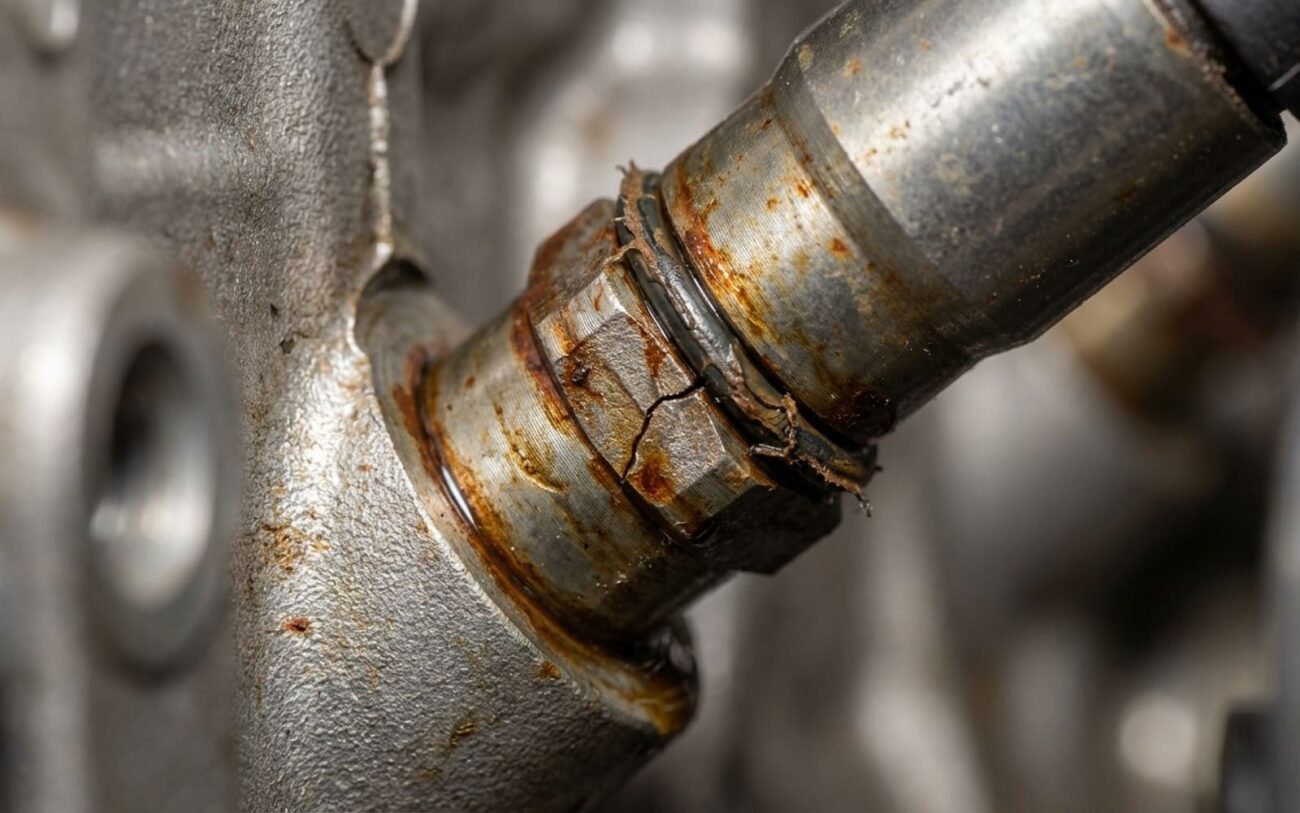
Fatigue cracks are another big one. The rail is bolted to the engine, which is always vibrating. Stress concentrates at mounting tabs or weld points. Over time, microscopic cracks form and grow. I’ve seen rails crack right at the mounting boss after 150,000 miles of normal driving. And of course, physical damage happens: a dropped tool, improper disassembly, or a collision can crack or bend the rail.
If the fuel pressure regulator is built right into the rail (which is common on many direct injection systems), its diaphragm can rupture. When that happens, fuel bypasses back to the return line or tank, and you can’t build pressure. That’s a classic cause of a P0087 with no visible leak. Less common, but I’ve seen it: internal passages getting restricted from debris or sludge if contaminated fuel gets past a failing filter.
Patterns I’ve Seen in the Shop:
Certain Ford 3.5L EcoBoost engines from the early 2010s were notorious for fuel rail cracking. High-pressure pulsation and thermal stress just did them in. Ford even put out a service bulletin recommending updated rails. Some GM and Saab models had casting porosity issues in their aluminum rails that led to slow, frustrating leaks. These weren’t isolated incidents; we saw these patterns come through the bay repeatedly.
But again, be careful not to misdiagnose. A leaking fuel injector O-ring isn’t a rail failure—it’s a seal issue. The rail comes off to replace them, but the rail itself is fine. A faulty fuel rail pressure sensor screws into the rail, but it’s the sensor that’s bad, not the rail. And a leaking quick-connect? That’s a line or fitting issue. Blaming the rail for those is like blaming the engine block for a bad spark plug wire.
The Fix: Real Resolution Pathways
How you fix it depends entirely on what you’ve actually diagnosed. Let’s walk through the real options, from simple to “call a pro.”
Schrader Valve Core Replacement DIY Feasible
Temporary Epoxy Repair Risky
Professional Replacement Only
For any significant issue—a crack in the rail itself, an internal regulator failure, or a major leak—the only reliable fix is replacement. This is professional-level work for most people. You’ll need a complete fuel rail assembly, a torque wrench, fuel line disconnect tools, and a scan tool to safely depressurize the system and sometimes reprogram adaptations after the repair. Torque specs matter immensely here. On many modern engines, rail bolts are torqued in inch-pounds, not foot-pounds. Overtighten, and you can crack a brand-new aluminum rail in your hands. I’ve seen it happen.
Internal Failure Management Non-Repairable
Post-Repair Validation: Making Sure It’s Actually Fixed
Never assume it’s fixed just because you bolted it back together. That’s a rookie mistake. Always start with the basics: pressurize the system and check for leaks. For a simple Schrader valve or O-ring replacement, a five-minute static pressure test with no drips or fuel odor is a good start. But for a full rail replacement, you need to go further.
Use a scan tool to monitor the fuel rail pressure (FRP) PID. At key-on, engine-off, it should hit spec—typically 50–60 psi for port injection, but for direct injection, you’re looking at 500–2,000+ psi, depending on the engine. At idle and especially under load, it needs to hold steady. If it fluctuates wildly or drops off under throttle, something’s still wrong. Don’t release the car until it’s right.
Also, check your long-term fuel trims. After a fuel pressure problem, they’ll often be maxed out positive (meaning the computer was adding a ton of fuel to compensate for a lean condition). Post-repair, those trims should come back to within ±10%. If they’re still way high, you’ve got a lingering problem you haven’t found yet.
For leak detection, UV dye mixed into the fuel and inspected with a black light is the gold standard. A mirror and flashlight work for a visual check, but dye finds what you can’t see. And I’ll say it again—always have a fire extinguisher nearby when you’re pressurizing any fuel system. Safety first, always.
Cost, Risk & The Bottom-Line Decision
Here’s the reality check, and it’s a conversation I have with customers all the time: repair cost versus vehicle value. Below is a realistic breakdown of what you’re looking at for common repair scenarios.
| Repair Type | DIY Cost (Parts Only) | Shop Cost (Parts & Labor) | Success Rate | Secondary Risk if Failed |
|---|---|---|---|---|
| Schrader valve core replacement | < $10 | $50 – $100 | 99% | Fuel leak, fire hazard if undetected. |
| Fuel rail replacement (4-cylinder) | $150 – $400 | $500 – $1,200 | 95% | Fuel leak, persistent misfire. On returnless systems, a leak into the intake can dilute engine oil, risking engine seizure. I’ve seen that one turn a simple repair into a junked engine. |
The decision isn’t just mechanical—it’s financial. My rule of thumb: if the repair exceeds 40% of the car’s private-party value (check KBB or NADA), and the rest of the car is showing its age—suspension clunking, transmission acting up, rust starting—you really need to think twice. You might be pouring money into a car that’s not worth it. But if it’s a solid vehicle with years of life left, fixing the fuel rail protects your investment and prevents much costlier damage down the road. It’s a calculated risk.
Prevention & Monitoring: Stay Ahead of the Game
You can’t prevent a manufacturing flaw, but you can definitely reduce your risk. Always use Top Tier detergent gasoline—it actually helps keep injectors, regulators, and those tiny internal passages clean. And replace your fuel filter on schedule. On vehicles with in-line filters, this is absolutely critical. A clogged filter makes your fuel pump work harder, leading to premature failure and pressure drop.
My Maintenance Checklist
-
When you’re checking your oil, take an extra minute to glance at the fuel rail. Look for any fuel stains, corrosion (especially on aluminum rails), or cracked mounting points.
-
Trust your nose—a persistent fuel smell after driving is a red flag. Don’t ignore it.
-
If you’ve got an OBD2 scanner, monitor the fuel rail pressure PID and long-term fuel trims. A gradual drop in pressure or rising trims can signal a developing issue long before a misfire even starts. That’s how you catch it early.
