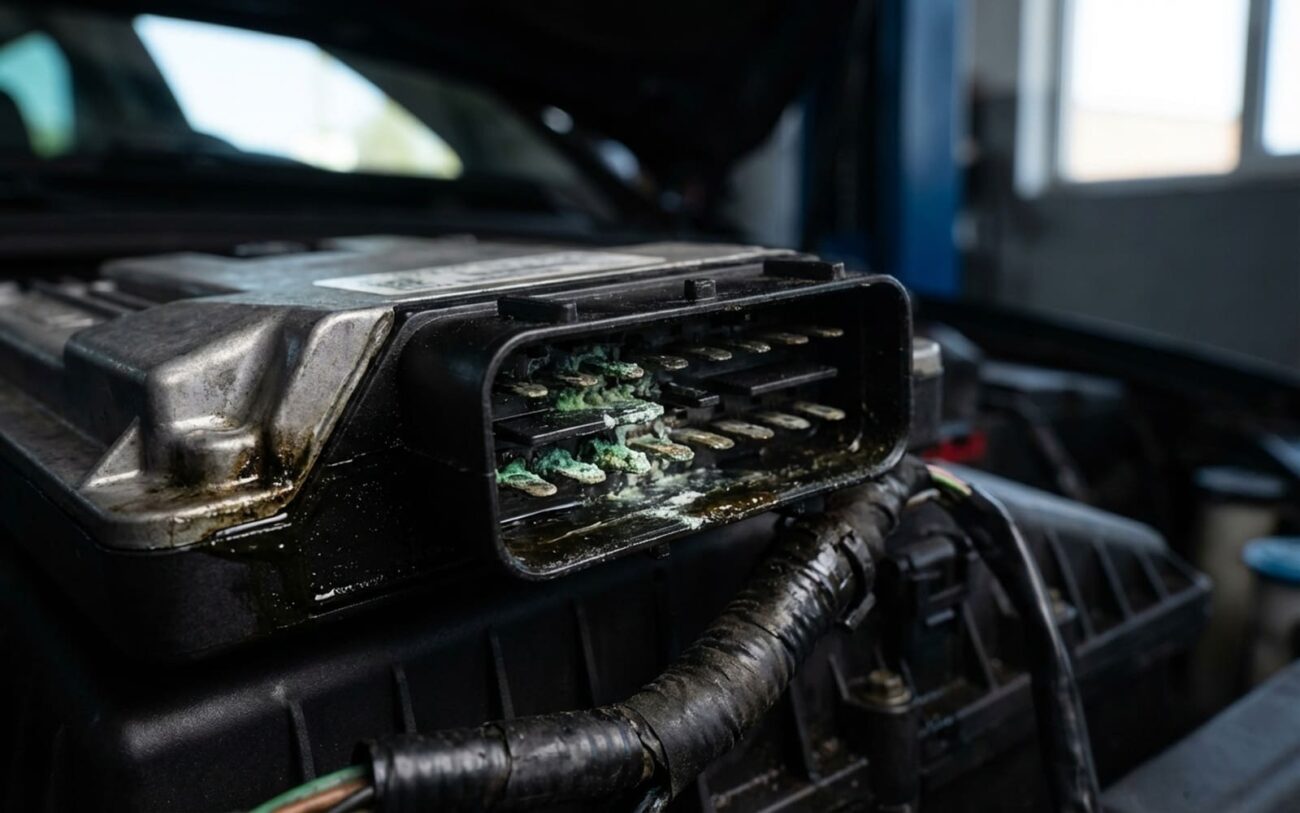
I’ve pulled more fried ECUs off the line than I care to count — and yeah, sometimes it was the damn scanner that started the fire. But not because the tool’s cursed. It’s because someone skipped the basics. Let me tell you how this really goes down, from the bench to the bay.
When the Scanner Pulls the Trigger
Can a code reader kill an ECU? Absolutely. But it’s not like the thing wakes up evil one morning. It’s usually a chain reaction — bad tool, bad wiring, bad battery, bad luck. I had a guy bring in a 2018 Silverado last month. Plugged in a $30 Amazon scanner, heard a pop under the dash, and boom — no crank, no comms, nothing. Thought the PCM was toast. Turned out? Blown ECU fuse from a back-fed OBD2 adapter. Saved him $1,800 in unnecessary ECU replacement.
Real ECU death is silent. No codes. No response. The scan tool just stares at you like, “I can’t even.” But here’s the kicker: 60% of the time, it’s not the computer. It’s the stuff feeding it.
Dead ECU or Just a Blown Fuse? Here’s How I Tell
I don’t touch the ECU until I’ve ruled out the easy stuff. And I mean all the easy stuff. Power, ground, fuses, relays — the whole chain. On GM trucks from 2014–2020, the ECU fuse lives in the underhood box (fuse 43, usually). One loose connection there, and the whole system goes dark. Same with the ground at the firewall — if it’s corroded, your scanner won’t talk to anything, and you’ll think the brain’s dead.
| What You’re Seeing | Points to ECU | Points to Wiring/Fuse | How I Test It |
|---|---|---|---|
| No comms with ECU — other modules fine | Burnt CAN transceiver or MCU | Blown fuse, bad relay, open ground |
Test: Key ON, check 12V at ECU power pin (pin 30 or 16 on OBD2). Ground? Less than 0.1 ohms to chassis. No power? Don’t blame the ECU — trace the circuit. |
| Scanner shows over-voltage error | Fried protection diodes or regulator | Shorted CAN line, miswired adapter |
Test: Unplug ECU. Check CAN_H (pin 6) and CAN_L (pin 14) for continuity to battery or ground. If shorted, fix the harness — not the module. |
| No relay click, no power-up | Internal power supply failure | Bad ignition relay, broken feed, corroded strap |
Test: Voltage drop test on power and ground under load. More than 0.5V? You’ve got resistance — clean the connections. |
How the Damage Actually Happens
It’s not the scan that kills it — it’s the voltage spike. CAN bus lines run at 2.5–3.5V. Hit them with 12V, even for a millisecond, and the transceiver chip lets out the magic smoke. I’ve seen it from:
- Cheap OBD2 adapters — some don’t isolate power properly. I pulled one apart last year — no diodes, no fuses, just raw wires. Junk.
- Reverse polarity — someone wired a custom interface backward. Poof. Protection circuits are meant to handle one-time events, not sustained reverse voltage.
- Wiggling the connector — loose fit? Arcing happens. Inductive kick from the harness can spike over 30V. That’s enough to jump past TVS diodes.
- Ground loops — scanner plugged into a laptop on a battery charger, car on a lift with poor ground. Now you’ve got current flowing through the CAN lines. Bad news.
And yeah, Chrysler put out a TSB for certain 2008–2014 models warning that aftermarket J2534 tools could fry the TIPM if connected wrong. They weren’t joking. I’ve got three of those modules in my core bin from shops that didn’t read the manual.
Fixing It: What Actually Works
This Isn’t a DIY Game
I’ve said it before: ECU repair is bench work with zero margin for error. ESD, thermal control, schematic access — if you don’t have it, don’t touch it.
Pin Repair Professional Only
Board-Level Fix Professional Only
Full Replacement / Reflash
Did It Really Work? Here’s How I Know
Starting the engine isn’t the finish line. I want proof the ECU’s solid.
To Confirm Repair
-
Connector fixes: Check continuity pin-to-pin. Wiggle the harness — if resistance jumps, you’ve got a cold joint.
-
Board repairs: Power it up on the bench. Should draw 80–150mA. Then scan — look for bidirectional control. If you can’t toggle a fan or injector, the MCU’s not talking.
-
Full replacement: Run a module scan. All systems should recognize the ECU. No U-codes, no immobilizer faults. And do a drive cycle — sometimes issues only show under load.
Is It Worth Fixing?
Here’s my rule: if the repair’s over 40% of the car’s value, ask why. I had a 2012 Accord come in — $4,500 value, $1,900 ECU job. Customer loved it, but let’s be real: one bad wheel bearing, and you’re upside down.
| Repair Type | DIY Cost | Shop Cost | Success Rate | Hidden Risks |
|---|---|---|---|---|
| Connector Repair | $40–$70 | $150–$300 | >95% | Corrosion returns if seal fails |
| Board Repair | $100–$500 | $300–$800 | 60–80% | Latent failure weeks later |
| Full Replacement | $800–$2,500 | $1,000–$3,000 | >98% | Wrong flash = bricked unit |
| Specialist Repair | N/A | $500–$1,500 | Variable | Core charge even if it fails |
How I Keep It From Happening Again
Prevention’s cheap. Fixing it’s not.
To Prevent Recurrence
-
Use scanners with real protection — Autel, Snap-On, or Bosch. Not the no-name eBay crap.
-
Check battery voltage before connecting. Below 12.4V? Charge it. A weak battery causes voltage swings that stress CAN lines.
-
Inspect the OBD2 port. Bent pins? Corrosion? That’s a red flag. Clean it with contact cleaner — not WD-40.
-
Test the port: Key OFF, check pin 16 for 12V, pins 6 and 14 for no shorts. If you see 12V on CAN_H, stop — something’s wrong.
-
Plug in once, firmly. No wiggling. If it doesn’t seat, don’t force it — find out why.
And if the car’s got other gremlins — flickering lights, random resets — don’t assume it’s just the ECU. I’ve traced half a dozen “dead PCM” cases back to a failing BCM or bad ground on the CAN bus. Check the network, not just the node. For more on that, see: How to Diagnose a CAN Bus Failure Causing Multiple Lighting System Malfunctions.
