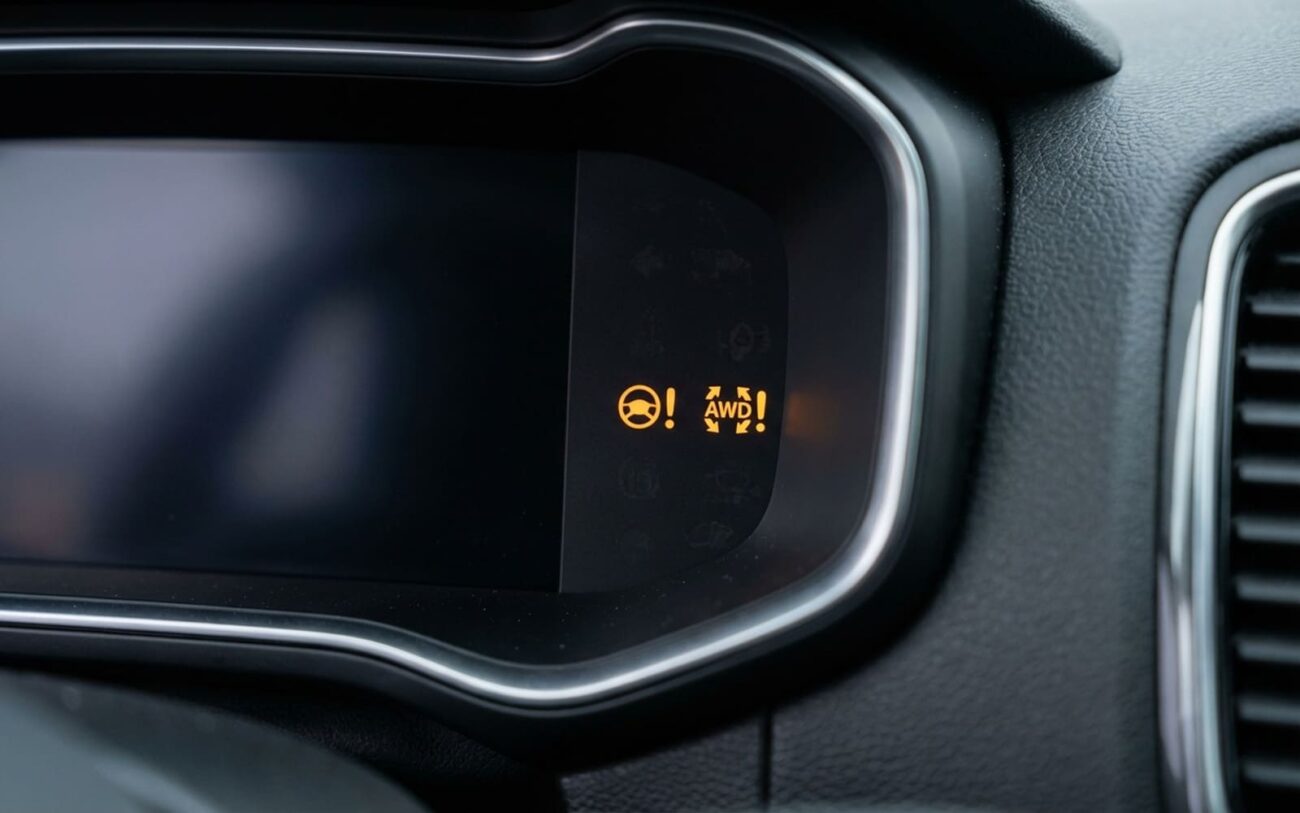
Alright, let’s talk about those weird electrical gremlins that pop up after you’ve had the battery disconnected. I’ve seen this scenario play out countless times in my 25+ years in the shop. You swap out a dead battery, or maybe you just unhooked it for some service, and suddenly your car’s acting like it’s possessed.
You might notice your adaptive headlights are stuck pointing straight down, or they’re doing a crazy dance at startup. Maybe you’ve got those annoying AWD or stability control warning lights glaring at you from the dash. It’s easy to panic and think you’ve got multiple systems failing at once. But in my experience, that’s rarely the case.
Most of the time, these symptoms all point back to one common culprit: your Steering Angle Sensor (SAS) has lost its calibration. This sensor is critical; it tells the car’s computer exactly where your steering wheel is pointed. When you cut power to the battery, that “zero point” reference—the straight-ahead position—gets wiped from the volatile memory in the control module. It’s like your radio losing its presets, but with much bigger consequences.
Offset: 12.5°
The Concept
Think of it like a runner trying to sprint while blindfolded. They’ve got the power, but no idea which way they’re actually facing. The car’s systems are the same—they’re ready to work, but they’re getting bad directions from the steering.
First Steps: Diagnosing the Real Problem
While SAS calibration loss is the most common issue after a battery reset, you can’t just assume. You’ve got to confirm it’s not a hardware failure. A sensor that’s on its way out, a damaged clock spring, or even a wiring issue could just happen to show its face right when you’re messing with the battery. Misdiagnosing a hardware problem as a simple recalibration will only waste your time and money.
| Symptom | Most Likely Cause (Post-Battery) | Common Mimics (Hardware) | My Definitive Test |
|---|---|---|---|
| AFL or AWD warning light immediately after battery reconnect | Lost zero-point calibration in the SAS or Steering Control Module. This is what I see 90% of the time. | A truly failed SAS sensor, a damaged clock spring, corroded connector, or a faulty AFL/AWD module that just happened to fail at the same time. |
Grab your bidirectional scan tool and check the ‘Steering Angle’ live data parameter. If the wheels are straight and it reads anything outside of ±5.0 degrees, you’ve lost calibration. |
| SAS fault codes return immediately after attempted calibration | This isn’t a calibration issue anymore. If it won’t calibrate, you’re looking at a hardware or electrical failure. | An internal SAS failure, an open or short in the wiring, a CAN bus communication fault, or even module software corruption. |
Monitor the sensor output via live data while you slowly turn the steering wheel lock-to-lock. A broken signal, erratic jumps, or no change at all confirms sensor or wiring failure. |
A good, capable scan tool isn’t optional here; it’s essential. Those basic OBD2 code readers won’t cut it. You need something that can get into manufacturer-specific modules, read live steering angle data, and—most importantly—initiate that zero-point calibration. Tools like Autel, Snap-on, or brand-specific platforms (think Toyota’s Techstream, BMW’s ISTA, or VW/Audi’s VCDS) are what you’ll need.
Why This Happens: The Root Cause
The core issue with most SAS faults after a battery disconnect isn’t physical damage; it’s simply data loss. The steering control module stores that critical “zero-point” calibration in volatile memory. Think of it like your home computer’s RAM—when you pull the plug, that data’s gone. Disconnect the car battery for more than a few minutes, and that reference point for straight-ahead steering just vanishes.
I see this misdiagnosed often:
Too many technicians jump straight to replacing the SAS or the clock spring when a proper recalibration or a module reflash would solve the problem. Now, if you’ve got an airbag light along with the SAS warning, then you should definitely suspect a damaged clock spring—that component carries both SAS and airbag wiring. But if the only issue started right after you reconnected the battery, trust me, calibration loss is far more likely. Start there.
Getting It Fixed: Your Resolution Options
Lost Calibration Only DIY Feasible
Professional Territory Only
Module Software Corruption or Reflash Required: If you try to calibrate and it just won’t take, or if the fault codes immediately return, you might have corrupted software in the steering module. This is where it gets serious. You’ll need an OEM diagnostic platform to reflash the module. And here’s a pro tip: always, always use a battery maintainer during a reflash. If the voltage drops, you risk “bricking” the module, and then you’re looking at a much bigger bill. This is absolutely not a DIY procedure.
Driving the Vehicle Last Resort
Post-Repair Validation: Double-Checking Your Work
My Verification Checklist
-
First, confirm your live steering angle reads 0.0° (it should be within ±1.0°) with the wheels perfectly straight using your scan tool. This is non-negotiable.
-
Next, observe your adaptive headlights at startup. They should perform their self-check sweep and then settle level. If they’re still pointing down or erratic, something’s still off.
-
Then, pull the car up to a wall about 25 feet away and check the beam pattern. Make sure there’s no excessive glare or weird dark spots.
-
Finally, take it for a test drive. Make some gentle turns, cycle the ignition a few times, and ensure no new Diagnostic Trouble Codes (DTCs) return.
Costs & Your Options
| Repair Type | DIY Cost | Shop Cost | My Success Rate |
|---|---|---|---|
| SAS Calibration Only | $50–$150 (for a capable scan tool) | $75–$150 | 98% (when it’s truly just calibration) |
| SAS Sensor Replacement | $150–$500 (parts only) | $400–$1,000+ | 95% (if the sensor is actually bad) |
| Module Reflash/Replacement | N/A (don’t even try this at home) | $500–$1,500+ | 90% (can be tricky, sometimes modules are just dead) |
My Prevention Tip
Whenever you’re disconnecting the battery, use a memory saver plugged into the OBD-II port. It’s a cheap tool that provides a trickle charge to keep those volatile memories alive. After any battery service, start the engine and slowly turn the steering wheel full left to full right and back to center. This simple ritual can often catch issues early, just like you’d check for handling changes after suspension work—like that car that wanders at highway speeds due to worn bushings. It’s all about proactive checks.
