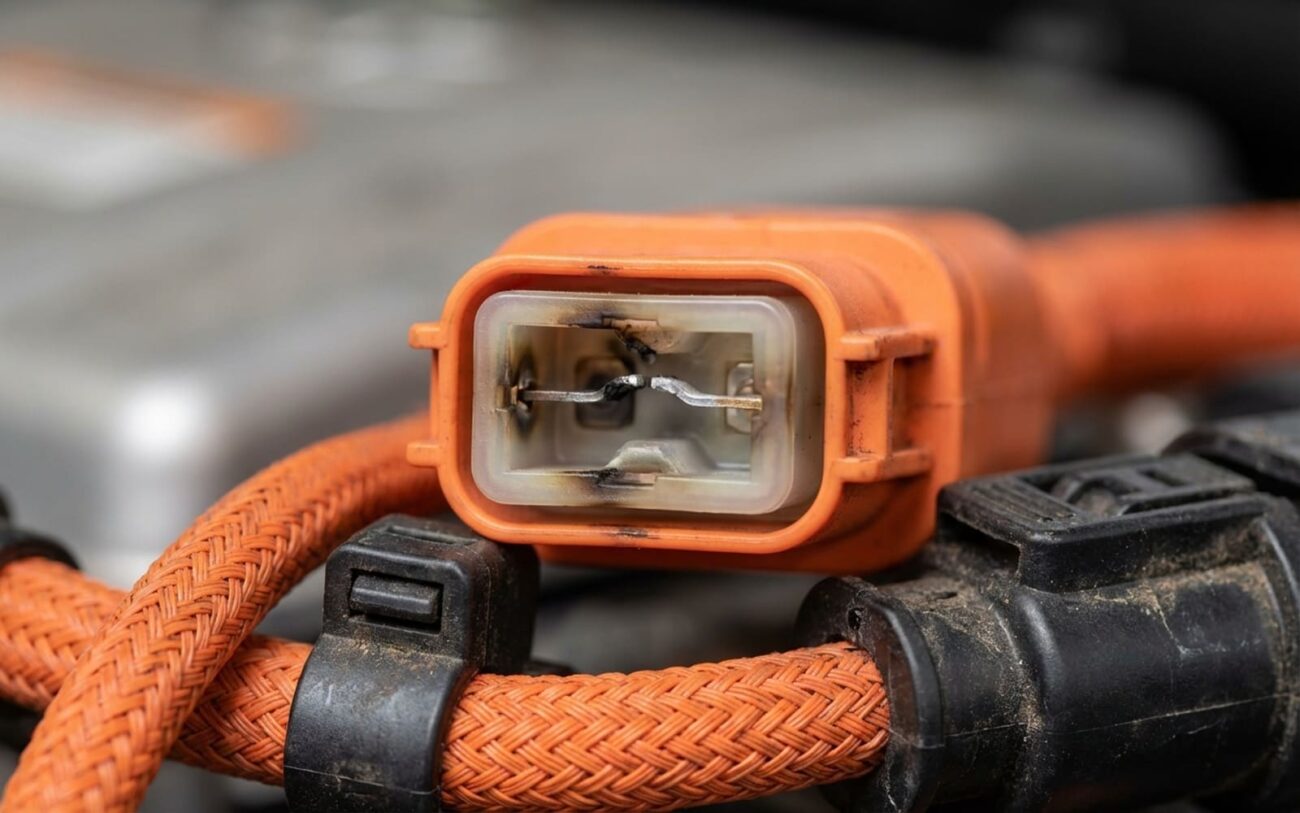
Alright, let’s talk about that moment. You’ve had a bump, maybe just a fender bender, nothing major. Airbags didn’t even pop. But now your hybrid, especially if it’s a Toyota or Lexus, is completely dead. I mean, dead. No dash lights, no power windows, dome light’s out. You hit the start button, and… nothing. No “READY” light. It feels like the battery’s been pulled right out of the car.
I’ve seen this a hundred times. And here’s the kicker: the car isn’t broken. It’s doing exactly what it was designed to do. This isn’t a fluke; it’s a safety shutdown. Your vehicle has triggered its high-voltage safety system. Why? To prevent a fire or a nasty electrical hazard after an impact. It’s cut power to the main high-voltage battery and, crucially, it’s disabled the DC-DC converter. That converter is what normally keeps your little 12V auxiliary battery charged up. So, even if your 12-volt battery was perfectly healthy a minute ago, it’s not getting any juice now, and it’ll drain down fast. The car is in what we call a “safety lockout mode.” That’s why even things like hazard lights, power doors, or the emergency calling system might not work.
What you’re experiencing is the “hybrid collision low voltage system disabled” scenario. Understanding this is the first step, because trying to fix it without knowing this will just lead you down a rabbit hole of replacing parts you don’t need.
Why Your Hybrid Goes Silent: The Engineered Safety Cascade
This isn’t a failure, folks. It’s a carefully engineered safety response, a sequence that kicks off the moment the vehicle detects a collision. It all starts with the Airbag Control Sensor Assembly (ACSA). This module is always watching for rapid deceleration or an impact. When it detects an event that crosses a certain threshold, it immediately sends a hardwired signal and a CAN bus message to the Hybrid Vehicle Control ECU (HV ECU).
At that point, the HV ECU has one priority: safety. It instantly opens the System Main Relays (SMRs), which completely cuts off the high-voltage battery from the rest of the system. Think of it as hitting a giant kill switch. Simultaneously, it commands the DC-DC converter to stop working. And since that DC-DC converter is the only way your 12V battery gets charged when the car’s in READY mode or running, its shutdown means a complete loss of low-voltage power over time. That’s why your 12V battery goes flat. This is precisely what Toyota means by a “hybrid collision low voltage system cut off.” The car is designed to enter a fail-safe state to protect you, your passengers, and first responders from high-voltage hazards.
I’ve seen this misdiagnosed more times than I can count. Technicians (and even some DIYers) will replace 12V batteries or DC-DC units, only to find the system locks out again because the root cause—a pending collision flag in the computer—was never cleared. It’s not a glitch; it’s the system doing its job.
Diagnosing the Problem: Safety Lockout or a Simple Fuse?
When everything shuts down after a collision, your first thought is probably, “Is the 12V battery dead?” And sometimes it is, but with Toyota and Lexus hybrids, the real issue is often deeper. A blown fuse can definitely mimic the symptoms of a triggered safety protocol, so you’ve got to diagnose methodically. Jumping to conclusions—like just replacing the 12V battery—won’t fix the underlying issue if the high-voltage safety loop is still open.
Here’s how I typically approach it:
Total 12V System Loss After Collision
If you have absolutely no 12V power—no lights, no dash, nothing—it’s usually because the high-voltage interlock loop (HVIL) has been triggered, and the DC-DC converter has been disabled by the control signal. But it can also look like a blown 12V AM2 or ALT fuse, or even a severed fusible link near the battery.
My Test: Grab your multimeter. Check the voltage (should be around 12.6V) at the input side of the AM2 fuse in the engine bay fuse box. If you’ve got voltage there, but no systems are responding, the vehicle is almost certainly in safety lockout. If there’s no voltage, then you need to trace back to the fusible links or battery connections. That’s a different problem altogether.
No READY Light, High-Voltage Isolation Fault Codes
If the car won’t go into “READY” mode and you’re seeing Diagnostic Trouble Codes (DTCs) related to high-voltage isolation faults, that’s a strong indicator. It means the HV ECU received a collision signal and opened those System Main Relays (SMRs) to isolate the HV battery. Of course, physical damage to HV wiring, a damaged service plug, or a loose HVIL connector can cause similar symptoms.
My Test: You absolutely need a factory-level scan tool for this, like Toyota’s Techstream. I’ll check for active collision-related DTCs—you’ll often see B-codes in the B1800 series. More importantly, I’ll monitor the HV ECU data list for the “Collision Signal” status. If it reads “ON,” the system is locked. While I’m in there, I’ll also perform an HV insulation resistance test to rule out any actual physical damage to the high-voltage system. That’s critical.
12V Battery Drains Completely After Incident
This is a common one. The 12V battery was fine, but a day or two after the bump, it’s dead as a doornail. This happens because the DC-DC converter is disabled by the HV ECU, so your 12V system isn’t being recharged. But don’t forget, a parasitic draw from damaged wiring, a shorted module, or even a cracked 12V battery case can cause the same thing.
My Test: First, fully recharge that 12V battery. Then, with the ignition off but power restored, use your scan tool to monitor the DC-DC converter output current PID. If it reads zero, the converter is being commanded off by the HV ECU—it’s not faulty. It’s just following orders from the safety system.
The Fix: Getting Your Hybrid Back on the Road (Professional Territory Only)
This is Not a DIY Job. Seriously.
Working on a high-voltage system after a collision demands specialized tools, HV safety training, and proper Personal Protective Equipment (PPE)—including Class 0 insulated gloves rated for 1,000V DC. Never, ever skip the HV safety inspection. If there’s any sign of damage to orange cables, the battery pack, or the inverter, do not attempt a reset. You risk HV exposure, severe injury, or fire. There is no safe shortcut here.
There’s no single fix for this. The repair path depends entirely on how severe the impact was and whether any physical damage actually occurred. Choosing the wrong approach can leave the car unsafe or lead to recurring faults. Here are the scenarios I deal with:
Logic Reset (No Airbag Deployment, No Physical Damage) Professional Only
Collision Flag Cleared Without Deployment Professional Only
Full HV and SRS System Restoration
Making Sure the Fix Actually Worked
After any reset or repair, don’t just assume success because the “READY” light came on. You need to validate multiple systems. I always do a thorough check:
For a simple logic reset: The vehicle absolutely must enter READY mode. Then, I use my multimeter to check the 12V system voltage—it should rise to somewhere between 13.8V and 14.4V when in READY, which confirms the DC-DC converter is active and charging. After that, I’ll use the scan tool again to verify that no collision DTCs have returned and that the HV ECU status shows “Normal” or “System Ready.” And, of course, the MIL (check engine light) should be off.
After physical repairs, the validation is much more involved. Every SRS component must report “OK” in the diagnostic tool. The HV system must pass a full insulation test. If the car has a pre-collision system (PCS), that should self-test and operate normally. And finally, the vehicle needs to complete a full drive cycle without triggering any new codes. This level of work really requires a technician trained in hybrid vehicle repair safety and with access to OEM-level diagnostics. There’s no room for guesswork.
The Bottom Line: What This Is Going to Cost You
Here’s the reality: getting these systems reset or repaired isn’t cheap, but it’s often less than most people fear. It really depends on the severity.
| Repair Type | DIY Cost | Shop Cost | Success Rate | Secondary Risk if Failed |
|---|---|---|---|---|
| Logic Reset (No damage) | Not Applicable | $150–$300 (includes 1 hour diagnostic time and Techstream use) | 95%+ when no underlying HV damage exists | If physical HV damage is overlooked, risk of intermittent faults, MIL illumination, or safety system failure. |
| Clearance after minor collision (codes in HV/SRS) | Not Applicable | $200–$500 (requires deeper module access and possible SRS reset) | High, but dependent on tool capability and technician training | Incorrectly cleared SRS codes can compromise airbag readiness and create liability in future incidents. |
| Physical HV/SRS component replacement | Not Applicable | $2,000–$20,000+ (includes HV battery inspection, cable replacement, SRS parts, and labor) | Near 100% when performed by certified technicians using OEM procedures | Improper HV system reintegration can lead to electric shock, fire, or failed safety systems. Only trained professionals should attempt this. |
Here’s the grim reality for insurance companies: they use a threshold—usually around 70% of the car’s pre-accident value—to decide whether to total a vehicle. If the cost of replacing HV components and SRS parts exceeds that, the car is very likely totaled. That’s why a minor-looking crash can still lead to a write-off if the HV system was compromised.
Always check your EV battery warranty status before authorizing major repairs. Sometimes, parts of the HV system are still covered.
A Final Word on Safety: Don’t Mess With This System
Let me be absolutely clear: this safety shutdown isn’t something you can or should try to prevent. The Lexus hybrid high voltage safety loop, and Toyota’s equivalent systems, are there for a reason—to protect lives. Any attempt to bypass, disable, or modify the HVIL circuit or collision detection logic is extremely dangerous, violates federal safety standards, and will absolutely void the vehicle’s certification. There’s no aftermarket monitor or alert system that can “warn” you before this activates—because it’s not a fault, it’s a feature.
The best thing you can do after a collision is simple: turn the car off completely. Don’t keep pressing the start button. Just let it sit. This gives the system a clean state for diagnosis. The car did its job by shutting down. Now, it’s up to a qualified technician with the right tools—like Techstream and HV safety training—to safely restore it. Remember, this isn’t a defect. It’s engineering doing exactly what it was meant to do: keep you safe when it matters most.
