That Random Recirc Button? It’s Not Magic — It’s the Air Quality Sensor
I get this call all the time: “My VW turns on recirc mode by itself — is it possessed?” No. On most VW Group cars from 2010 onward (VW, Audi, Skoda, Seat), the climate system has a built-in reflex. When it smells diesel smoke or heavy exhaust, it slams the fresh air door shut and goes into recirc. It’s not broken. It’s doing its job.
The trigger is the air quality sensor (G238), buried behind the grille or near the wiper cowl. It’s a simple solid-state sensor that detects particulates — not exact chemicals, just “dirty air.” When levels spike, it tells the HVAC control unit (J301) to close the fresh air flap (V113) and switch to recirc. You’ll see it most often idling behind a bus, in a tunnel, or stuck in city traffic.
When It’s Not Normal: Diagnosing Real Problems
So how do you know when it’s working right versus actually broken? Simple: context.
If the recirc light comes on every time you stop behind a truck and turns off once you’re moving — that’s normal. If it kicks in on the open highway with zero traffic, or cycles every 30 seconds while you’re cruising at 70 mph, that’s a fault.
And here’s what I tell every tech who walks into my shop: do not replace the HVAC unit first. I’ve pulled good J301 modules out of cars where the real issue was a $120 sensor or a stuck flap motor. You’ll look like an amateur — and cost the customer hundreds for nothing.
Step 1: Scan Before You Touch
You need a tool that talks to the HVAC module — VCDS, OBDeleven, or ODIS. No exceptions. Plug in, go to J301, and pull up live data.
Look for:
-
Air Quality Sensor (G238) reading — should fluctuate with environment
-
Fresh Air Flap Position — matches commanded state?
-
Vehicle Speed — system uses this to validate traffic stops
If G238 reads “high pollution” while you’re driving through the countryside, the sensor is faulty or contaminated. If the flap moves without command and G238 is normal — now you’ve got a J301 or motor issue.
Step 2: Test the Flap Mechanically
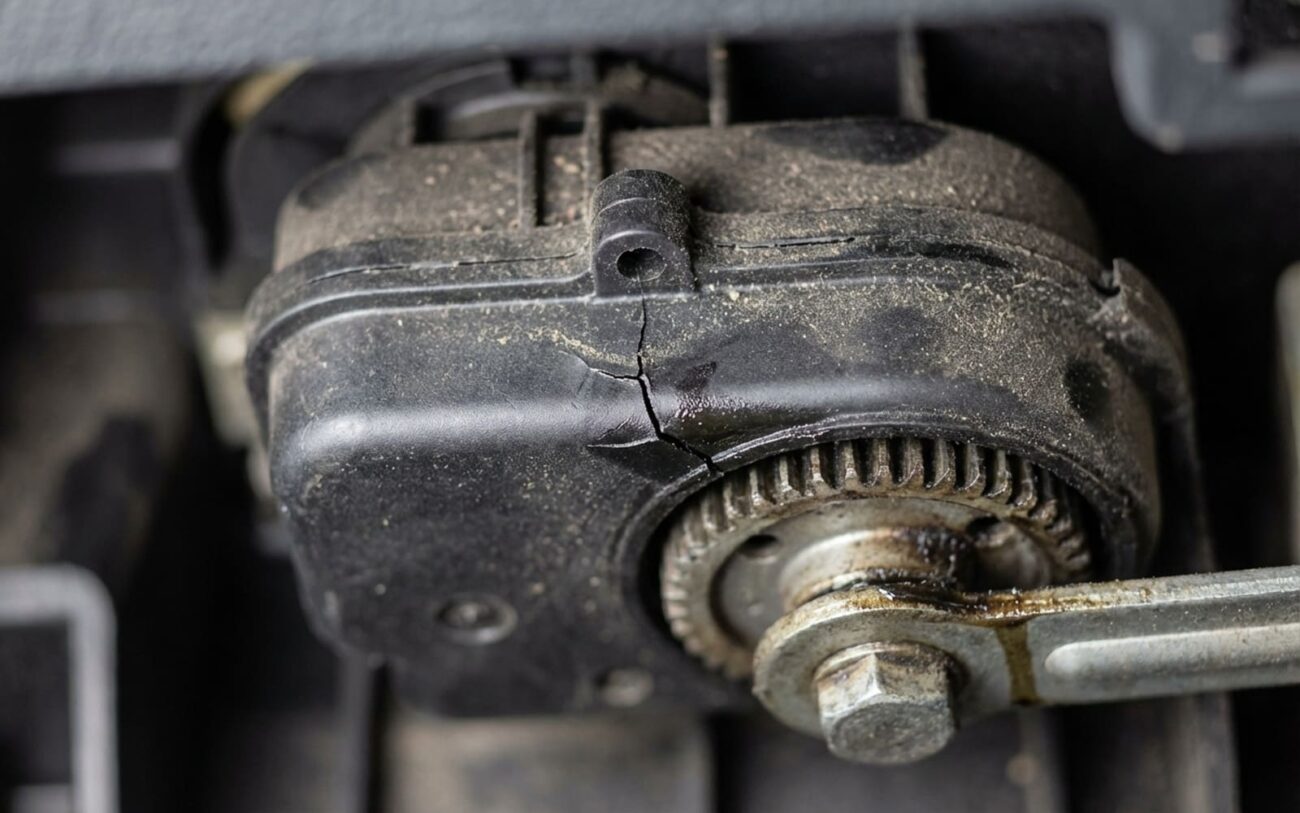
Use the output test function to command the V113 motor to open and close. Watch the live feedback — does it reach full travel? Does it hesitate?
If the motor doesn’t move, or only twitches, check:
-
Fuse #18 (if applicable — varies by model year)
-
Wiring between J301 and V113 — look for chafing near the evaporator housing
-
Manual operation — remove the motor and try turning the shaft by hand. If it’s stiff or binds, the flap is gummed up with leaves or debris.
I’ve cleared dozens of “bad HVAC unit” diagnoses just by pulling out a wad of pine needles from the fresh air intake. (Yes, really.)
When the J301 Itself Is Bad
Internal failures in the HVAC control unit are rare — maybe 1 in 20 of the “random recirc” cases I see. But when it happens, it’s usually from heat fatigue.
These units sit on the dash, baking in summer sun. Over 5–8 years, the circuit board expands and contracts. Solder joints crack — especially around the relay drivers that control the V113 motor. You get intermittent signals, which the system interprets as commands.
Classic signs:
-
Recirc activates when engine heats up — not tied to sensor readings
-
Buttons flicker or don’t light up consistently
-
Complete HVAC shutdown after driving 45+ minutes
If you’ve ruled out G238 and V113, and the unit behaves erratically under thermal load, it’s likely J301. But don’t just swap it — test it first.
Fix It Right: Repair vs. Replace vs. Disable
Disable the Feature (If You Don’t Want It) DIY-FEASIBLE with proper tool
If the system works but you hate it, just turn it off. Use VCDS or OBDeleven to access J301 coding. Look for “Automatic Recirculation” or “AQS Function” — set to “Inactive.”
That’s it. Manual recirc still works. No more surprise mode changes. I’ve done this on my own A4 — not because it was broken, but because I prefer control.
Repair the J301 (For the Skilled)
If you’ve confirmed a hardware fault and want to save money, repair is possible. Open the unit, inspect the board. Look for cracked solder near the relay cluster or voltage regulator.
Reflow those joints with a hot air station. Test under heat. It’s not guaranteed, but I’ve had units last 3+ years after a proper rework.
Replace the Module (Most Reliable)
For most people, replacement is the way. Buy new or reman. But — and this is critical — you’ll need online coding capability to unlock Component Protection. The car won’t accept the module otherwise.
Installation torque: 2 Nm on the mounting screws. No more. The housing is brittle.
Verify the Fix — Or It Didn’t Happen
Don’t just clear codes and call it done.
After disabling the feature: drive in traffic. Recirc should not activate. Scan tool should show no command from J301.
After repair or replacement: run a full output test on V113. Confirm full travel. Take the car out — include stop-and-go. No random switching. No hesitation.
And check the basics: defrost performance. A sticky flap kills defogging. If the windshield takes forever to clear, go back and inspect the linkage.
Is It Worth Fixing?
Software Deactivation
DIY tool cost $200–$600 (one-time). Shop labor 0.5–1.0 hour. 100% success if diagnosis is correct. Fully reversible.
Control Unit Replacement
Part $300–$800 + tool cost (DIY). Shop cost $800–$1500 (parts & labor). 95% success with correct diagnosis. High risk if failed (HVAC disabled, module locked).
If the repair costs more than 40% of the car’s value, just disable the feature. I’ve recommended this dozens of times. The car still heats and cools fine. You lose a convenience, not a function.
Final Advice From the Bench
Don’t ignore early signs. If the recirc button starts flashing, or the flap moves sluggishly, check it now. A $120 motor today can prevent a $1,200 module job tomorrow.
And always — always — scan first. Your gut is wrong more often than you think. The data doesn’t lie.
